Editor’s Note (2026): This article was originally published on AngelaCathey.com in 2016. It is reproduced here with only minor grammatical edits for readability. Some resources and terminology have evolved since its original publication, but the conceptual discussion is presented largely as it appeared at that time.
Here’s an outline for today’s post:
1. Functional Analysis (FA) our most powerful and under-utilized tool.
2. What RFT can offer to FA.
3. General guidelines for bringing RFT-FA into the room via integration with the 5 Rules of FAP.
4. A few groups of relations described functionally
5. What RFT-guided FA could do for our ability to assess the effectiveness of functionally oriented treatments (e.g., FAP).
RFT has a lot to offer for the applicability, precision, and utility of Functional Analysis.
Functional Analysis is one of our most powerful therapeutic frameworks in behaviorism (underlying most of our orientations), yet it has fallen out of use in the clinical environment.
Why? Because:
1) We are generally not in the client’s environment to see the variables controlling their behavior.
2) People are exceedingly bad at understanding/describing the variables that control their own behavior (see above on seeing everything through your own relational history and Measurement: Why we get no R.E.S.P.E.C.T., which explains how CBS has tried to deal with issues of measurement in relation to behavior).
3.) And, in the therapy hour, what you can do with FA is often to teach the client how to recognize (and hopefully influence) their own behavior or contexts, outside the therapy environment. Then you hope for the best.
So, let’s consider FA and what RFT-informed Functional Analysis has to offer clinicians:
First, by gaining experiential knowledge of RFT/REC, we get a much better picture of what variables may be controlling the client’s behavior, in the room and in their lives.
Second, we get a much better picture of how to intervene effectively by being able to test our hypotheses (often per session) by altering the variables in the room (in the present moment) and paying attention to the client’s response, our experience, and other contextual variables.
Thus, with RFT/REC we can go a long way to restoring our ability to use functional analysis during the therapeutic hour. (Not to mention getting more of the warm fuzzy feeling you get when you realize you’re doing something that’s ‘working’ for the client.)
So, let’s talk about how we can begin to use RFT in Functional Analysis. I’ll present some general guidelines and then discuss the how and why of these.
You’ll also notice that this is going to map right onto the “5 Rules” of Functional Analytic Psychotherapy. (Addition, 2026 note – I am speaking about the models of Functional Analytic Psychotherapy that were deeply behavioral and not the “Awareness, Courage, and Love” ACL model here.)
This is purposeful, as in my experience: 1) FAP is already one of the models that purposely trains you to bring FA into the present moment and look at behavior functionally, rather than topographically, and all we’re really doing here is adding knowledge of how the properties of symbolic relating also get tied into all the other ‘behaviors’ you see.
Note: This isn’t meant to substitute for or be better than learning RFT in other forms. If you want a full, more advanced understanding of RFT, I would recommend starting with Villatte, Villatte, and Hayes’ Mastering the Clinical Conversation or Matt Villatte’s online course on RFT through Practice Ground. Much of what I say here is an entry point to what these resources and others (such as Hayes’ Rule-governed Behavior) may teach you.
1. First, and above all else, listen to the client’s experience. (Rule 1: Watch for CRB1s AND watch for the general pattern of behavior (verbally and ‘non-verbally ‘) around important relations.)
2. Look for rule-governed behavior and rules. (If you’re in a stuck spot and feel like you’re bumping your head against the wall, it’s highly likely that either you and/or the client are responding to a ‘rule’.) This is Rule 1 again, but rule-governed behavior is such a big factor in the breakdown of communication I feel it stands repeating.
3. Understand what the HOW of the behavior tells you. (Again, Rule 1 in FAP but extended to understanding, using RFT, the function and properties of the symbolic relations that show up in the room.)
4. Start altering the context in the room, in the moment, with your hypotheses and noting the client’s HOW of response. (This is Rule 2, Evoke, from the FAP model, except evoke is also extended to using RFT to evoke verbal relations and understand the client’s response.)
5. Relate (functionally). (This is Rule 3, Reinforce, from the FAP model, except when you bring RFT into the mix, you begin to see how many more ways you can affect the client’s relating to you, themselves, the world, their pain, etc right there in the moment. This may sound a bit foreign, but I almost promise you that you’re already doing some form of it. If you’re an ACT clinician and the client is fused. then you get them to defuse. Congrats! You just moved a relation! Except RFT has far more to offer than defusion. Some of which I’ll describe below.)
6. Note your impact on relations as well as other behavior (Rule 4, Notice your impact except extended to noticing your impact on relations and their properties as well as other behavior).
7. Provide functional interpretations (Rule 5, in FAP) except that I would say that ‘functional’ may also need to be seen from an RFT perspective. Sometimes it’s helpful to provide direct feedback about the relations you perceive, but we also know that humans like simplicity a bit too much. Careful with providing interpretations that may easily be turned into rules (and rule-based insensitivity), so tread lightly and experientially here.
Included in this, but discussed less, is an assumption of general knowledge regarding Functional Analysis and Functional Assessment. For readers who want a review of this, start here: Iwata & Dozier, 2008; Gareth Holman’s Intro to FA on Practice Ground; and for mapping out your effect for research (or warm fuzzies), begin with Koerner and Holman’s 2014 Single-case designs in clinical practice.
It’s good to have a general awareness of how the character of the behavior (e.g., approach/repeat may indicate presence of reinforcing qualities) may indicate relations. Then in the FA you learn the problematic relation only through noticing what moves the relation in a more adaptive direction (functionally determined).
How do you know what’s adaptive? I like Villatte, Villatte, and Hayes’ Mastering the Clinical Conversation overall framework.
That is, the overall goals of treatment are:
1. Helping the client develop flexible context sensitivity and functional coherence (read awareness when it’s adaptive and an overall system of relating that ‘works’ for the client).
The overall means of treatment are:
1. Transforming symbolic functions by altering context (read influencing relations and their properties by any of your symbolic behavior in the room with the client, etc.)
So, in doing a Functional Relational Analysis, we’re doing an in-the-moment analysis to increase adaptive relating as defined by Villatte, Villatte, and Hayes in the manner in which we influence relating with the 5 Rules in FAP (you following me?)
So, now about the business of recognizing relations that can be influenced in your RFT-FA. First, let’s begin by making things a bit simpler: some relations that frequently come up and affect treatment in the moment.
1. Rule-governed behavior – consider this a kind of fusion that, in whatever form, usually results in an inability to contact important contingencies at hand.
Example(s): “Jimmy is always anxious.” vs “Jimmy is anxious.” vs. “Jimmy sometimes gets anxious.” Inherent in these statements is a rule. Though you’d need ideographic context, they may likely indicate different levels of fusion with the rule. The intensity/rigidity and lack of noticing other contingencies may give you a good idea about how fused the speaker is to the rule and how unaware they may be when Jimmy acts in ways that are non-anxious (see later post on discrimination/stigma/violence towards others). Keep in mind that almost any kind of relation can be rule-ified into inflexibility over time, repetition, etc.
2. How to influence it: Defusion, context changes of many sorts (emotion, experientially walking through the contingencies that allow the person to note what was previously missed, etc.
3. How to assess your impact: Is the person now loosening in their behavior guided by the rule? Is their language around the rule more flexible?
2. Influencing awareness towards whole or parts – here I’m talking about several relations in combination functionally. We often use distinction framing (this but not that), combination (this and this), opposition (this is the opposite of that) to bring more awareness to the parts and pieces.
Examples(s): Hierarchicals and moving towards seeing the self or experience as a part of the continuing experience. “I am this feeling, this moment” versus “I am more than my experience.”
How to influence it: Mindfulness, either noticing continuity, wholeness, or otherwise noticing detail.
How to assess your impact: Do they seem (verbally or otherwise) more aware of the direction needed to note important contingencies? Other relations can also be added in, but let’s focus on these for now.
What can elements of an RFT allow us to fine-grain and repeated attempts to change relating of several types each session?
We can aim for more or less flexibility, more or less awareness of certain contingencies, and more adaptive stories about the “self” and its experience. This can allow several dimensions for FA beyond what is normally present.
Add the REC Model, and you can evaluate behavior based on its complexity and derivation (allowing you to see whether you need to increase the variety and complexity of learning experiences to make it stable and adaptive).
Further elaborating on this kind of workup could help us more effectively assess some of the benefits of functionally oriented treatments.
Essentially, mapping out change in other relations would add further assess change.
For example, we know that one of the mechanisms responsible for the effectiveness of FAP is likely to be contingent reinforcement (see Kanter, Landes, Busch, Rusch, Brown, Baruch, and Holman 2006 Effect of contingent reinforcement) and that systems can be derived for measuring change based on this functional target (see Callaghan 2001 FIAT Functional Ideographic Assessment Template).
With RFT, everything can be parsed relationally in some respect (every treatment, nearly every behavior, diagnosis, etc.). This, in combination with other FA relations (e.g., reinforcement), can allow us to examine change across therapies, diagnoses, contexts, etc. Further, noticing the change in relation in verbal behavior gives us many more opportunities for altering and assessing our impact each session.
If you’re thinking that assessment and coding of verbal relations would take years, wait for the posts on Natural Language Processing, Machine Learning, and sensor-based experience sampling.
Iwata, B. A., & Dozier, C. L. (2008). Clinical application of functional analysis methodology. Behavior Analysis in Practice, 1(1), 3–9.
Callaghan, G. M. (2001). Functional Ideographic Assessment Template (FIAT) System. Reno, NV: Context Press.
Hayes, S. C. (Ed.). (1989). Rule-Governed Behavior: Cognition, Contingencies, and Instructional Control. New York: Plenum Press.
Kanter, J. W., Landes, S. J., Busch, A. M., Rusch, L. C., Brown, K. R., Baruch, D. E., & Holman, G. I. (2006). The effect of contingent reinforcement on target variables in outpatient psychotherapy for depression: An investigation of Functional Analytic Psychotherapy. Journal of Applied Behavior Analysis, 39(4), 463–467. https://doi.org/10.1901/jaba.2006.21-06
Koerner, K., & Holman, G. I. (2014). Single-case designs in clinical practice. In The Wiley Handbook of Contextual Behavioral Science.
Villatte, M., Villatte, J. L., & Hayes, S. C. (2016). Mastering the Clinical Conversation: Language as Intervention. New York, NY: Guilford Press.

One of the most confusing things for students entering Clinical Behavior Analysis is that psychologists often seem to disagree about almost everything.
They disagree about diagnoses. They disagree about treatment. They disagree about what should be measured. They even disagree about what counts as good evidence.
It is tempting to think these disagreements arise because people simply have different opinions. More often, however, they begin much earlier. They begin with different assumptions about what science is trying to accomplish.
Steven Hayes described these assumptions in Varieties of Scientific Contextualism (1992), drawing on the work of philosopher Stephen Pepper. Before we can understand why behavior analysts think differently about measurement, treatment, or theory, it helps to understand the philosophical ground on which those decisions are made.
Hayes argues that philosophies of science can be understood as different “world hypotheses.” Each begins with a root metaphor—a basic way of understanding how the world works. That metaphor influences what questions become important, what counts as evidence, and ultimately how scientists decide whether they are making progress.
Although there are many philosophical positions, four have been particularly influential in psychology.
The oldest approach is formism. Its root metaphor is similarity or form. The world is understood by identifying things that belong together and giving them names. The scientific task becomes classification. This approach gave us taxonomies, categories, and much of our early scientific thinking. In psychology, it is reflected whenever we ask, “What disorder does this person have?” or “Which category does this behavior belong in?”
Naming is useful. But naming is not the same thing as understanding. Two people may both receive a diagnosis of major depressive disorder while behaving very differently and responding to entirely different interventions. Formism helps us organize observations. It does not necessarily explain why they occur.
Mechanism extends formism. Its metaphor is the machine. If we understand the parts and how they interact, we can explain the system. Truth becomes a matter of correspondence. Our theories are considered better to the extent that they accurately represent how reality actually works. Much of modern medicine follows this approach. Find the broken mechanism. Repair it. Psychology has inherited many mechanistic assumptions as well. We often search for underlying mechanisms, latent variables, or internal systems presumed to generate behavior. Mechanistic methods have produced tremendous advances. Hayes is careful to point out that functional contextualists borrow many of these methods. The danger is not the methods themselves.
The danger is quietly adopting the assumptions that accompany them.
Organicism begins with a different metaphor. The world is viewed as an unfolding story. Events that appear contradictory today may eventually make sense when viewed within a larger developmental narrative. Truth is evaluated by coherence. Does this explanation fit within the broader story? Developmental psychology often leans in this direction. Individual events become meaningful because of the role they play within an evolving system. Again, this perspective offers valuable insights. But it answers a different kind of question.
Contextualism asks a different question altogether. Its root metaphor is the act-in-context. Rather than asking what something is, contextualism asks what it does, under what conditions it occurs, and what difference that understanding allows us to make. The truth criterion becomes successful working, or what Hayes calls workability. Importantly, something can only “work” relative to a stated goal. If our goal is to reduce panic attacks, improve relationships, increase adherence to medical treatment, or help someone live more consistently with their values, then our scientific models are judged by whether they help us move toward those outcomes.
William James is generally considered the father of contextualism; however, Skinner’s work reflected an implicit contextualist philosophy long before these distinctions were discussed explicitly.
Hayes makes an important distinction between two forms of contextualism.
Descriptive contextualism attempts to appreciate the richness of the whole. The goal is understanding. James, Dewey, and Kantor each worked largely within this tradition. Here, coherence remains important because the scientist is attempting to capture the complexity of an event as completely as possible.
Functional contextualism asks a different question. Can this analysis improve our ability to predict and influence behavior? The goal is practical rather than descriptive. Hayes compares this to engineering. Knowing that a bridge will collapse is useful. Knowing how to build one that won’t collapse is far more useful. That shift has enormous implications for psychology.
A functional contextualist is less interested in whether a theory is elegant than whether it increases our ability to predict and influence behavior toward meaningful goals.
This philosophical foundation explains why Clinical Behavior Analysis often approaches familiar problems differently than other traditions. When behavior analysts question diagnoses, latent constructs, or statistical summaries, they are not necessarily rejecting them outright.
They are asking a different question.
What additional predictive or practical value does this way of describing behavior provide?
Sometimes the answer is “quite a lot.” Sometimes the answer is “not much.” That becomes an empirical question rather than a philosophical argument. This perspective also explains why measurement has become such an important issue for our field.
If our goal is to predict and influence behavior, then the quality of our measurement becomes central. As our technologies improve, we are no longer limited to occasional questionnaires or broad diagnostic categories. We can increasingly observe behavior unfolding across time, context, physiology, language, and daily life.
That doesn’t mean our older methods were mistakes. They represented the best measurements we had available. But science progresses by improving observation. Clinical Behavior Analysis, at its best, has always been about improving our ability to understand behavior in context.
Referecnces
Hayes, S. C. (1993). Varieties of Scientific Contextualism. Reno, NV: Context Press.
Pepper, S. C. (1942). World Hypotheses: A Study in Evidence. University of California Press.

Clinical Behavior Analyst, Methodologist & Trainer
Angela J. Coreil, PhD, is a professor at the University of Louisiana at Lafayette, clinical behavior analyst, and methodologist. Formerly director of an OCD and anxiety IOP/PHP, she integrates behavior analysis, ACT, Interpersonal Behavior Therapy, CBT, and exposure-based treatment. Her work develops practical improvements in behavioral science, and she provides consultation, professional training, workshops, and continuing education across disciplines.
Views expressed are those of Dr. Coreil or the explicitly named author, not the University of Louisiana at Lafayette.

This may be a time of transition for psychology. Our path as a field has led to some great advances, but as it has grown, it appears to have come undone at the seams.
The need for a standard metric.
As clinicians, we struggle to gain reimbursement and prove our effectiveness in meaningful terms to our clients. As researchers and academics, we are now at a point of crisis such that the NIH has begun a funding initiative demanding coherent metrics from our field.
If we are to remain a credible and effective science, we must do it not by arguing for small islands of theoretical turf but by deep integration and coherence in our methods. From there, we can build a solid base on which to help humanity tackle its largest issues.
Measuring dynamic relationships between behavior and context is the place to begin.
Starting with a more basic level of observations in measurement allows us to realign on solid ground. Our field departed from this with traditional CBT, which led to a great deal of gains. And we must be clear about that – it would be easy to ‘poo poo’ this progress now; however, we need to be careful not to invalidate our own foundation and history.
Let RFT stand larger than ACT.
We moved to measuring constructs like “psychological flexibility,” “self-confidence, ” “anxiety sensitivity” because we did not have a way to measure and understand the complexity of behaviors humans constantly. Look around now: where is your iPhone? Where is your Fitbit? Where is your Alexa? Is your browser open? Guess what. Consumer goods are currently measuring intensive flows of your behavioral data right now. Sadly, psychology and behavior analysis haven’t caught up to the fact that we no longer need to rely on the most rudimentary of measurements.
Consultant and Educator
Angela J. Coreil, PhD works with individuals and organizations to promote better connected, purposeful, and effective living through behavior analytic principles. She has over a decade of clinical experience treating human suffering and promoting human excellence using Acceptance and Commitment Therapy (ACT) and other behavioral therapies. She now focuses on the promotion and translation of Clinical Behavior Analysis as a way to improve our science.
Editor’s Note (2026): This article was originally published on AngelaCathey.com in 2016. It is reproduced here with only minor grammatical edits for readability. Some resources and terminology have evolved since its original publication, but the conceptual discussion is presented largely as it appeared at that time.
UNDERSTANDING PROPERTIES OF RFT: The signal in noise of human behavior
Now that we’ve talked about space-time distortion, let’s blow your mind a bit more by learning to understand the properties of RFT.
You’ve all seen the diagrams explaining how the letters in the word “cat” = a picture of a cat = the sound of “cat” spoken. You may have also seen the complex ‘algebra’ that formulaically explains properties of RFT like transformation of stimulus function.
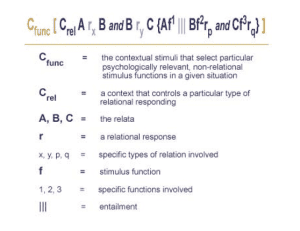
See: https://contextualscience.org/transformation_of_stimulus_functions
Yikes! So, that formula is sheer genius but not particularly functional for people who don’t already understand RFT. Explaining RFT in these terms to those who are learning is a bit like explaining gravity as a formula. In some way it is ‘true,’ but if you want someone to understand the meaning of gravity, you’re better off dropping the DSM on their foot.
Let’s understand the meaning of RFT at a deeper, more experiential level.
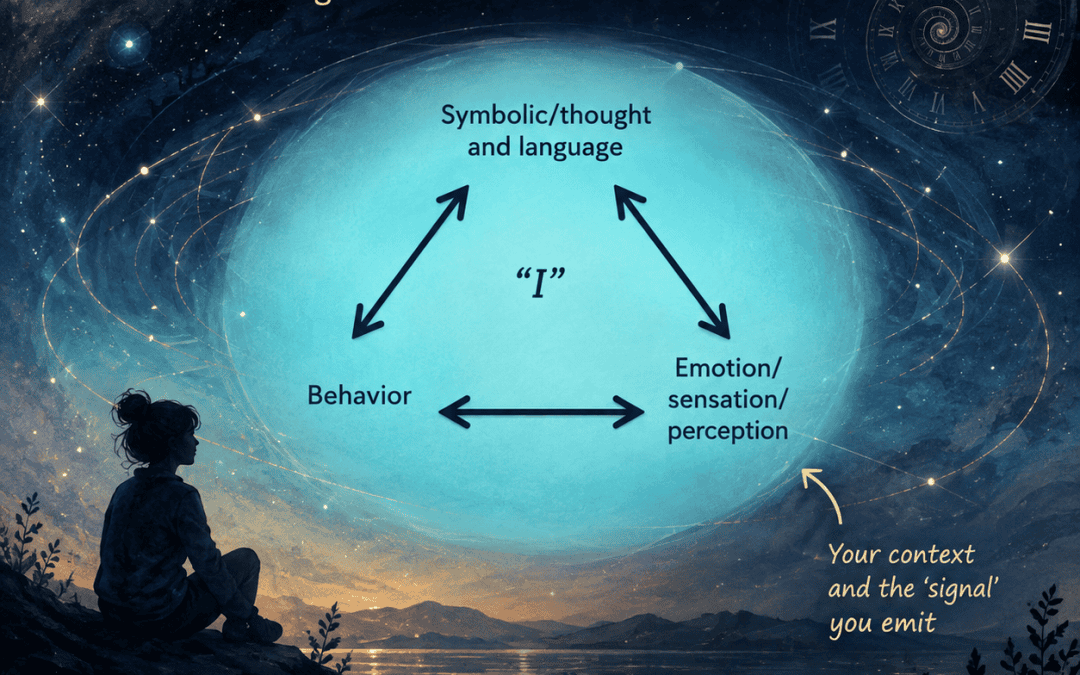
RFT explains the inter-relations of different elements of our behavior and context.
 Diagram: Cathey (2016)
This is a diagram showing how the properties of RFT and operant/classical conditioning tell us that our behaviors are interrelated.
It’s not perfect. Anyone can tell you these aren’t entirely separate.
Our experience is actually much more like this.
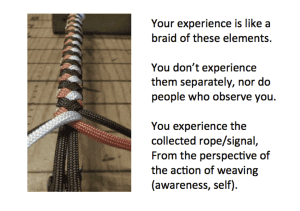
Picture: indulgy.com
Let’s dig a little deeper…

So, in some way we are this relational signal that we experience as a whole, which isn’t entirely separate from our experience of our external context (blurry line). What we perceive in the world is viewed through our internal context (if you’re inside that bubble looking out, everything will be tinted blue). This is why we can all react in different ways to the ‘same’ ‘external’ stimuli and why we may act differently in different contexts. All is through the filter of our experience and through relation, after we become old enough to have a symbolic world. This symbolic world is, in some respect verbal but more importantly highly symbolic. Words/language are one important network that forms the scaffolding of our internal experience, and which we can somewhat efficiently use to show others our world.
That ‘sticky’ scaffolding gives words power.
So, RFT is not just a theory of language. It is a theory of symbolism.
‘Anything can become anything’ because it is nearly all symbolic at some level.
Sensation, perception, visual stimuli, auditory stimuli, words, actions, are all a symbolic soup of experience, and your own relational history makes some of those cues more salient than others.
For example, listen to just a second of this music. Close your eyes. Notice the feelings and thoughts.
Now, what you all experienced was the same stimulus, but how it affected you is through relation, in a very deep way.
My experience is not yours, in great part, because of my distinct relational history with this stimulus.
For me, that song is chills, tears in my eyes, the taste of a tequila shot (hey… I was nervous that day), and a visual of walking down the aisle. It will never again be separate from those moments. BECAUSE of the RELATIONS it obtained when I chose it for that defining moment.
For you, maybe it was just squeaky violin music or something pretty. This is RFT. The song had no words and yet it is still symbolic and influenced by what I say. Now, if you meet me, you will have the words above as a scaffolding between our worlds.
As you read them you were likely able, in some part, to experience part of my experience but even still through your relational history. For those of you who know me, the experience of learning this information might have been more intense if I’m close to you or if you experience me as like you. This is predictable based on RFT: a frame of coordination (she is like me) or (I like her) will increase your experience of my description. A frame of distinction (I am not like her) or (this is crap, etc.) will decrease the intensity of the experience (transformation of stimulus functions) evoked by reading my experience.

Cathey (2016)
Thus our experiences are tinted, amplified, and de-amplified by the frames in which we hold ourselves, those we are exposed to, and many other contextual variables that influence our experience.
Isn’t it lovely? We are all connected, through relation. (Imagine: You can totally win 6 degrees to Kevin Bacon now. 😉

Media: www.mangowed.com
Further, your actual perceptual, emotional, behavioral, and verbal experience is predicable based on RFT and the significance or depth of the learning you have related to the the stimuli (REC Model; Hughes, Barnes-Holmes, Vahey, 2012; Barnes-Holmes, Barnes-Holmes, Stewart, & Boles (2010)).
So, let’s switch frames a bit to get ready for clinical/social applications:
Let’s look at the REC Model of some things that could cause us to feel fear or disgust. This is a functional example. It’s not perfect but let’s hope it gets the job done. Look at the items in the REC Model below and note your emotional response.
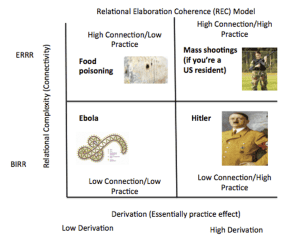
Cathey (2016)
What I’m willing to bet is that even though you likely have some very rich sensory experiences (high connectivity) of food poisoning, unless you’ve had one recently you probably didn’t have much of a response to that stimuli. As a US resident, few of us will have a strong visceral response to Ebola as its not connected to most things in our daily worlds. Few of us will have had direct experience with it.
Now here’s the curious part, what was your response to the gun woman? What was your response to Hitler?
If you had a more intense emotional response to Hitler that is understandable based on REC, but few other theories would predict this or allow for testing of it. We could say that we have “habituated” to gun violence. Or, perhaps we’ve now heard so many derivations of this occurring that we can now control the response to it, as it is sunken into the rich networks of other relations.
Hitler, on the other hand. I’m guessing no one reading this met him. Yet you may have felt a lurch of disgust even stronger than the food poisoning picture.
Without RFT and personal experience with this it is difficult to make sense of your response to Hitler, vs food poisoning, vs. mass shootings, vs. Ebola.
Stay with me here. A low complexity network with high derivation is a bit like all the relations flowing through this single point of symbolic ‘evil’. If he is a single point of relation through which all we know about the Holocaust and those horrors is filtered there is a lot of derivation through repeated understanding but little complexity. For most of us we only have knowledge of these things through history classes, documentaries, etc. This results in a highly derived but not complex network of emotional learning. It lends itself to strong/rigid/somewhat two dimensional responses.
Otherwise it’s a little difficult to explain why we’d have such a strong response to someone none of us have ever met AND yet have a have a much more moderated response to gun violence.
Clinical Behavior Analyst, Methodologist & Trainer
Angela J. Coreil, PhD, is a professor at the University of Louisiana at Lafayette, clinical behavior analyst, and methodologist. Formerly director of an OCD and anxiety IOP/PHP, she integrates behavior analysis, ACT, Interpersonal Behavior Therapy, CBT, and exposure-based treatment. Her work develops practical improvements in behavioral science, and she provides consultation, professional training, workshops, and continuing education across disciplines.
Views expressed are those of Dr. Coreil or the explicitly named author, not the University of Louisiana at Lafayette.

For a while, I stopped writing so much. Life had a lot of turns in store for me.I kept thinking about measurement, language, and understanding complex human behavior in context. Those questions simply moved with me across contexts.
Around 2015, I had already fallen in love with Relational Frame Theory and Clinical Behavior Analysis. RFT gave me a flexible way to bring language, thought, meaning, and symbolic behavior into behavioral analysis without abandoning behavioral principles. It opened a door I had been trying to find for years. And yes, I know – I’d been an ACT clinician forever, but RFT evolved. Once I saw what might be possible, I wanted to know how far it could go.
The research was important, but contingencies had me finding reinforcement outside the lab. The beauty of behavior analysis and human language is that its everywhere. Language changing across settings, relational patterns unfolding over time, and then I learned that clinicians were interested in the technology but bringing it to them wasn’t feasilble at the time. The NSF i-corps taught me Lean Start-up though and I rolled with it. I landed organizational gigs and I bootstrapped ways to run what I wanted to build myself.
What I-Corps changed was my understanding of how scientific advances might become products, services, and tools that people could actually use. It taught me to think about customers, implementation, workflows, and whether an idea could survive outside the conditions in which it was developed.
That mattered. I learned to bootstrap prototypes. For those of you that are unfamilair, here’s an example of a bootstrapped prototype.
A scientific advance can be brilliant and still go nowhere. Someone has to make it usable. (And, as above – eventually someone has to make it not look like a circuit board in a suitcase.) Someone has to understand the environment into which it will be introduced. Someone has to build the bridge between an important finding and getting people to make use of the finding.
I began doing organizational work with medium-sized companies. I worked on problems involving communication, leadership, culture, employee behavior, and the ways verbal networks shape what organizations do. and what people buy. I enjoyed it. Organizations offered a remarkably rich setting for thinking about relational responding, rule-governed behavior, and behavior across complex systems.
The work also showed me how much behavioral science could contribute outside traditional clinical and academic settings. But organizational contracts move slowwwwwly.
A company may spend months discussing a project, revising the scope, securing approval, and moving through procurement before anyone gets paid. That timeline may be manageable for an established consulting firm. It is much harder for a doctoral student raising a toddler.
At the same time, I was receiving invitations into exciting academic conversations, including opportunities to spend time around research programs I admired. I was deeply interested in that work.
Interest, however, does not pay the bills.
I had a child to raise, a doctorate to complete, and a life that required income on a schedule more reliable than organizational consulting or emerging research collaborations could offer.
So, I followed the contingencies.
Clinical work paid more reliably, and I knew I how to a run specialized Intensive Outpatient (IOP) and Partial Hospitalization (PHP) units from previous work. In 2018, I opened the Better Living Center for Behavioral Health.
I built an intensive behavioral health center from the ground up. Seeing my first clients involved renting their therapy room for an hour while paying for 1.5 hours of drop-off care. But, I am scrappy. I hired and trained clinicians, supervised treatment, developed programs, managed crises, built documentation systems, negotiated with insurers, handled compliance, fixed operational problems, and learned every part of running a clinical organization. The result was an 18 room higher-level treatment facility specialized for treatment of severe OCD and anxiety disorders.
The clinic was a master class in so much. I had treated complex clients. I had trained clinicians but as the CEO of a treatment facility everything was mine to solve. Someday, over a drink, you can ask me about poop-ma-gedon. (Hint: It wasn’t an exposure exercise.)
But in the mix of this work, again – the same themes ate at me. Clients did not arrive as clean constructs. They did not separate themselves into neatly bounded diagnoses, treatment protocols, or theoretical models. They arrived with overlapping histories, medical conditions, family systems, complex verbal repertoires, changing environments, practical constraints, and problems that behaved differently across contexts.
The harder the case, the more obvious it became that no single treatment model could anticipate all of the complexity in front of us. Evidence-based treatments remained essential. The work was learning how to apply them intelligently to the individual.
That required following behavioral principles, observing closely, adapting carefully, and asking better questions.
What is happening? Under what conditions? What changed?
What could a clinician realistically collect while still providing care?
Running a clinic changed how I understand science. It showed me how reimbursement shapes treatment. It showed me how organizational contingencies shape clinician behavior. It showed me how documentation requirements alter what gets observed and what gets ignored.
It also showed me how often useful information gets lost. Rich clinical observations become checkboxes. Repeated reports become total scores. Language becomes a diagnosis. Complex behavior gets flattened into categories that fit billing systems, electronic records, or research conventions.
The clinic made it impossible for me to treat measurement as a neutral activity. Measurement always occurs inside a system. The system determines what gets collected, what gets rewarded, what gets retained, and what gets discarded.
It also made clear the kinds of issues that occur when solutions meet clinical reality. A sophisticated tool that clinicians cannot use is not useful. A measure that takes too long will not be completed. A dashboard no one understands will be ignored. A theoretically elegant system that does not fit the workflow will disappear. Those lessons now sit at the center of how I think about research.
There is a recognizable academic path: graduate school, post-doc, faculty position, publications, lab, promotion.
I’ve never been one to follow the beaten path. My path moved through research, technology, organizational consulting, entrepreneurship, intensive clinical care, business ownership, supervision, insurance systems, and the daily work of keeping an organization alive.
The years of finding my potential forever home – they were worth it all. They were where I learned what happens when theory meets reimbursement, staffing, liability, time pressure, and the lives of actual clients. They were where I learned that implementation is not an afterthought. It is part of the science.
I came back to academia understanding how to build my work in ways that can survive and thrive within systems. And, now, I’m home and happy to be writing again.
Clinical Behavior Analyst, Methodologist & Trainer
Angela J. Coreil, PhD, is a professor at the University of Louisiana at Lafayette, clinical behavior analyst, and methodologist. Formerly director of an OCD and anxiety IOP/PHP, she integrates behavior analysis, ACT, Interpersonal Behavior Therapy, CBT, and exposure-based treatment. Her work develops practical improvements in behavioral science, and she provides consultation, professional training, workshops, and continuing education across disciplines.
Views expressed are those of Dr. Coreil or the explicitly named author, not the University of Louisiana at Lafayette.
By Angela Coreil, PhD, LP, BCBA
One of the things that first drew me to Relational Frame Theory (RFT) was that it finally provided a behavior-analytic framework capable of addressing the complexity of human language. Rather than treating thoughts and language as something outside the domain of behavior analysis, RFT offered a principled way to integrate verbal behavior into behavioral analysis while remaining grounded in basic behavioral principles. It felt like finding a missing piece.
As exciting as that realization was, it immediately led to another question:
How do we actually measure complex verbal behavior outside of the laboratory?
Around 2015, that question sent me down a rabbit hole that consumed much of my free time. I began teaching myself the emerging world of natural language processing. I dug through Python libraries, Anaconda environments, early machine learning tools, and resources that would eventually evolve into platforms like Hugging Face. I wasn’t approaching these technologies as a computer scientist. I was trying to answer a behavioral question:
Could these emerging computational methods help us measure verbal behavior in ways that were more consistent with contextual behavioral science?
In 2016, I presented some of these early ideas at the Association for Contextual Behavioral Science (ACBS) Research-Based Practice Special Interest Group in Seattle. The excitement surrounding the possibilities eventually grew into this manuscript, co-authored with the wonderful Olga Berkout and Karen Kate Kellum.
The paper argues that Contextual Behavioral Science has an opportunity to advance measurement by treating language itself as behavior rather than simply as evidence for latent psychological constructs. Building on Relational Frame Theory, we proposed that emerging Natural Language Processing (NLP) technologies could begin measuring increasingly complex verbal behavior across applied and clinical settings while maintaining greater theoretical consistency with functional contextualism.
Rather than viewing written and spoken language merely as indicators of underlying mental states, we suggested analyzing language directly as observable behavior. We outlined how computational linguistics, ecological momentary assessment, mobile technologies, and behavioral signal processing might eventually be integrated to examine verbal behavior as it unfolds across time, contexts, and social interactions. At the time, many of these ideas were speculative. Today, many have become technically feasible.
The manuscript also sought to address one of the longstanding challenges facing Relational Frame Theory: translating decades of elegant basic research into tools that clinicians and applied researchers could actually use. We discussed integrating contemporary RFT models, including the Multi-Dimensional Multi-Level (MDML) framework, with modern computational methods to visualize and quantify increasingly complex relational networks as they emerge in everyday language.
Looking back, many of the ideas I continue to pursue – including treating self-report as verbal behavior rather than latent variables, integrating ecological momentary assessment with physiological and language data, preserving behavioral observations rather than collapsing them into composite constructs, and developing scalable behavioral measurement systems – can be traced back to the questions first explored in this paper. In many ways, this manuscript marked the beginning of my effort to build a more integrated science of human behavior.
Berkout, O. V., Cathey (Coreil), A. J., & Kellum, K. K. (2019). Scaling-up assessment from a contextual behavioral science perspective: Potential uses of technology for analysis of unstructured text data. Journal of Contextual Behavioral Science, 12, 216–224. https://doi.org/10.1016/j.jcbs.2018.06.007
Related Works:
Berkout, O. V., Cathey (Coreil), A. J., & Berkout, D. V. (2020). Inflexitext: A program assessing psychological inflexibility in unstructured verbal data. Journal of Contextual Behavioral Science, 18, 92–98. https://doi.org/10.1016/j.jcbs.2020.09.002
Cathey (Coreil), A. J., Holman, G., Villatte, M., Zettle, R., Canare, D., & Swails, J. (2016, June). Adapting research to the clinical environment: Computer-aided verbal behavior analysis (CAVBA). Association for Contextual Behavioral Science Annual Conference, Seattle, WA.
Cathey (Coreil), A. J., Vilardaga, R., & Zettle, R. D. (2016, June). Using ecological momentary assessment to examine the impact of self-regulation choice on affect. Association for Contextual Behavioral Science Annual Conference, Seattle, WA.
Cathey (Coreil), A. J., Zettle, R. D., & Swails, J. (2016, April). Computer-aided verbal behavior analysis (CAVBA): Evidence for the feasibility of detecting framing behavior with natural language processing. Wichita State University Research Roundup, Wichita, KS.
Clinical Behavior Analyst, Methodologist & Trainer
Angela J. Coreil, PhD, is a professor at the University of Louisiana at Lafayette, clinical behavior analyst, and methodologist. Formerly director of an OCD and anxiety IOP/PHP, she integrates behavior analysis, ACT, Interpersonal Behavior Therapy, CBT, and exposure-based treatment. Her work develops practical improvements in behavioral science, and she provides consultation, professional training, workshops, and continuing education across disciplines.
Views expressed are those of Dr. Coreil or the explicitly named author, not the University of Louisiana at Lafayette.