

Kafka Finds His Rage (Against the Machine): Using Hierarchicals to Pull Yourself Up
Parts of my life have been a little too much like a Chuck Palahniuk novel: chaotic, painful, and governed by the reliable presence of unreliability. Chaos breeds a different kind of attention—if you survive it. What I have found is that surviving a painful context...

Every Therapy Trains a Different Pair of Eyes: Why the languaging of training matters
Imagine handing three clinicians the same therapy session.
One was trained in ACT.
One in CBT.
One in psychodynamic therapy.
Now stop the video every thirty seconds and ask a simple question.
“What did you notice?”

Where to go to study Clinical Behavior Analysis: Programs and advisors with CBA leanings
As I've met with people interested in CBA over the years, I've realized that those interested are often in need of direct advice. Vague guidelines suggesting types of programs or places to work leave people confused. So, here are some direct suggestions about where...

Computational Functional Analysis: Extending functional analysis into the digital age
A brief update to a talk originally presented at the Association for Contextual Behavioral Science (ACBS) World Conference in Seattle, Washington, June 2016. Nearly ten years ago, I had the opportunity to present an idea that felt, at the time, almost impossibly...
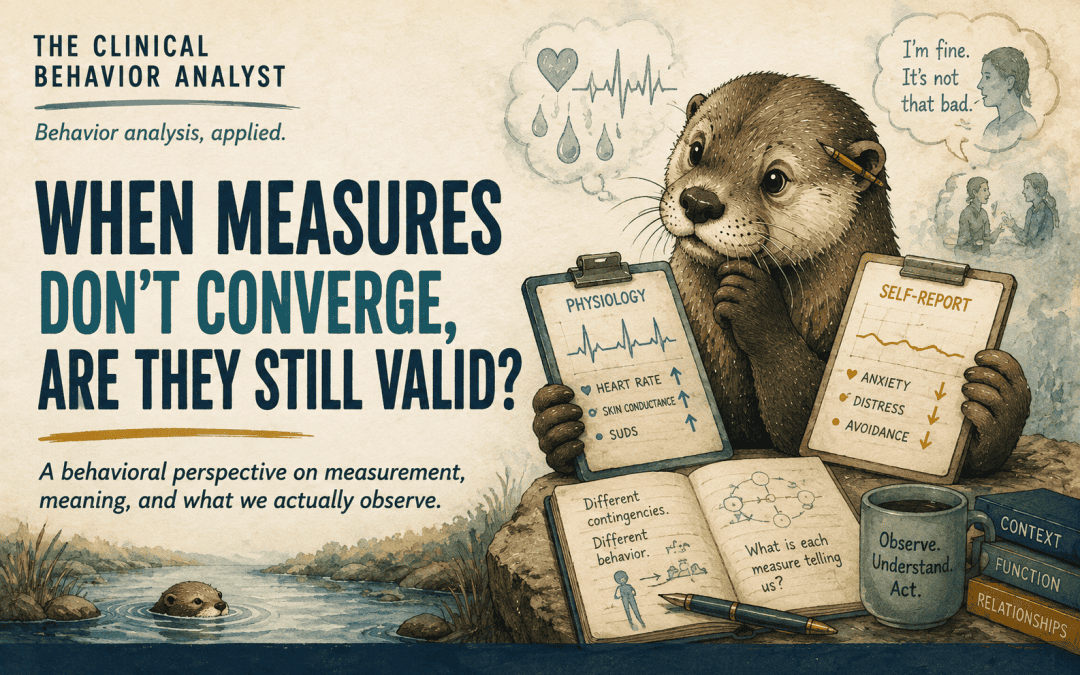
When measures don’t converge, are they still valid?
One of the most influential concepts in psychological measurement is convergent validity. The idea seems straightforward. If several different measures are supposed to assess the same phenomenon, we would expect them to agree. If they do, we often become more...

Functional Relational Analysis: RFT infused functional analysis
Let’s consider FA and what RFT-informed Functional Analysis has to offer clinicians.

Building Science on Solid Ground
Why Clinical Behavior Analysis Starts with a Different Philosophy of Science One of the most confusing things for students entering Clinical Behavior Analysis is that psychologists often seem to disagree about almost everything. They disagree about diagnoses. They...

RFT & BA: Measuring dynamic behavior over time
This may be a time of transition for psychology. Our path as a field has led to some great advances, but as it has grown, it appears to have come undone at the seams. The need for a standard metric. As clinicians, we struggle to gain reimbursement and prove our...

RFT (Part 2): The signal in the noise of human behavior
Editor’s Note (2026): This article was originally published on AngelaCathey.com in 2016. It is reproduced here with only minor grammatical edits for readability. Some resources and terminology have evolved since its original publication, but the conceptual discussion...

Journey Home: The Clinical Behavior Analyst
A scientific advance can be brilliant and still go nowhere. Someone has to make it usable. (And, as above – eventually someone has to make it not look like a circuit board in a suitcase.) Someone has to understand the environment into which it will be introduced. Someone has to build the bridge between an important finding and getting people to make use of the finding.
Subscribe Today!
Stay up to date on advances in the field, special offers on our courses, and new blogs!