



Select Page
Every Therapy Trains a Different Pair of Eyes: Why the languaging of training matters

Every Therapy Trains a Different Pair of Eyes: Why the languaging of training matters

​Imagine handing three clinicians the same therapy session. One was trained in ACT, one in Beckian CBT, and one in psychodynamic object relations.

Now stop the video every thirty seconds and ask a simple question.

“What did you notice?”

I doubt you’d get the same answers. The ACT therapist might notice experiential avoidance. The CBT therapist might notice a core belief. The psychodynamic clinician may notice a pattern in how the client talks about important others.

We often talk about therapy as the thing helping clients, but it’s not. ‘Therapy’ isn’t a thing in the room. It’s a therapist trained by someone, hopefully, to skillfully notice and shape behavior.

Therapy first changes the therapist’s behavior. We shape a new clinician’s behavior with feedback through supervision and consultation. We read books in our therapeutic orientations. We attend workshops. We read literature.

Training isn’t simply the transfer of knowledge. It’s the shaping of a repertoire. It teaches clinicians what to attend to and what to ignore. It suggests what the clinician should do to change behavior and when the clinician should do it.

Every therapy model is, in part, a language for organizing experience. Contextual behavioral scientists understand this better than most. We spend our careers studying how language changes what clients notice, feel, avoid, and pursue.

Why would therapists be any different? A therapist trained in ACT doesn’t simply know different terminology. They may literally perceive different functional relations because their training has altered what stimuli acquire discriminative control.

My experience tells me that one way of seeing will never be ‘correct’ all the time. That different languaging repertoires make us skilled and weak in different areas. My experience tells me that most skilled clinicians know something of value, and if I just learn to see what they see, I might grow.

The point is that every language highlights some relations while making others easier to overlook. That raises a question I rarely see asked in psychotherapy research.

What clinician repertoire did the training actually produce?

I want to see studies that examine this – in a real way – not assuming that there won’t be drawbacks to every language. I want to see an honest look at how each therapy language shapes different skills and what those work best for. I am flat tired of seeing Randomized Controlled Trials (RCTs) where someone is deemed to be ‘doing’ ACT or CBT because these are not ‘things’; these are repertoires of interacting with clients.

If you’re not sure what I mean, most RCTs rely on inter-rater reliability to fairly shallow topography associated with the particular treatment model. Now, whether ACT moves rule-governed behavior or ‘psychological flexibility’ – any clinician worth their salt can tell you that ACT is not saying “psychological flexibility” in sessions. Below you can see a more typical ACT vs CBT inter-rater reliability assessment in the McGrath (2012) manuscript. In Plumb and Vilardaga (2010), we have a deeper attempt at trying to assess competence and adherence. 

For citations of interest, see: 

McGrath, K. B. (2012). Validation of the Drexel University ACT/tCBT adherence and competence rating scale: Revised for use in a clinical population [Doctoral dissertation, Drexel University]. https://doi.org/10.17918/etd-3803

Plumb, J. C., & Vilardaga, R. (2010). Assessing treatment integrity in acceptance and commitment therapy: Strategies and suggestions. International Journal of Behavioral Consultation and Therapy, 6(3), 263–295. https://doi.org/10.1037/h0100912

Angela Coreil, PhD, BCBA

Angela Coreil, PhD, BCBA

Clinical Behavior Analyst, Methodologist & Trainer

Angela J. Coreil, PhD, is a professor at the University of Louisiana at Lafayette, clinical behavior analyst, and methodologist. Formerly director of an OCD and anxiety IOP/PHP, she integrates behavior analysis, ACT, Interpersonal Behavior Therapy, CBT, and exposure-based treatment. Her work develops practical improvements in behavioral science, and she provides consultation, professional training, workshops, and continuing education across disciplines.

Views expressed are those of Dr. Coreil or the explicitly named author, not the University of Louisiana at Lafayette.

Where to go to study Clinical Behavior Analysis: Programs and advisors with CBA leanings

Where to go to study Clinical Behavior Analysis: Programs and advisors with CBA leanings

As I’ve met with people interested in CBA over the years, I’ve realized that those interested are often in need of direct advice. Vague guidelines suggesting types of programs or places to work leave people confused. So, here are some direct suggestions about where you might go to study Clinical Behavior Analysis. This is by nature an incomplete listing. Likewise, if I list a program or person here would like their information removed, feel free to contact me or comment on the post.


University of Louisiana at Lafayette

M.S. in Psychology

The University of Louisiana at Lafayette offers a research-intensive master’s degree that I would describe as a doctoral launch program rather than a terminal clinical degree. We do have some students who have successfully applied for Licensed Psychological Associate (LPA) status in Louisiana after completion of the program. Of note, the Licensed Psychological Associate (LPA) designation in Louisiana is new, and criteria for licensure are still evolving. Students at UL’s master’s program complete rigorous training in psychological science, research methods, and statistics while preparing for competitive doctoral programs. This program is best suited for students actively planning to take what they learn about Clinical Behavior Analysis on into a Clinical Psychology, Counseling Psychology, Behavior Analysis, Human Factors, or related behavioral sciences degree.

Students interested in Clinical Behavior Analysis currently have opportunities to work with two laboratories emphasizing contextual behavioral science from complementary perspectives.

THRIVE Lab
University of Louisiana at Lafayette
Director: Angela Coreil

Dr. Coreil focuses on developing new methods for measuring clinically meaningful behavior while integrating behavior analysis, contextual behavioral science, and emerging computational technologies. I welcome research collaborators worldwide; if our interests align, contact me.

The Contextual Behavioral Science Lab
University of Louisiana at Lafayette
Director: Emily Sandoz

Dr. Emily Sandoz’s laboratory focuses on Acceptance and Commitment Therapy, contextual behavioral science, clinical intervention, and translational research. Students receive mentorship in both basic and applied contextual behavioral science while working within one of the longest-established ACT research programs. Dr. Sandoz is widely known for the ability to move back and forth from clinical application to deep technical explanation. Please note that Dr. Sandoz’s lab and my own are entirely independent labs. Please contact Dr. Sandoz directly if you’re primarily interested in her work.

University of Nevada, Reno

For many behavior analysts, the University of Nevada, Reno has long been considered one of the historical centers of Clinical Behavior Analysis, Relational Frame Theory, and Contextual Behavioral Science.

Its behavior analysis program helped launch much of the work surrounding ACT and RFT and continues to provide graduate training grounded in behavior analysis while encouraging translational work bridging laboratory science and clinical practice.

Linda Hayes deserves particular recognition for helping establish one of the strongest graduate behavior analysis training environments in the United States while making foundational contributions to philosophy of science, graduate education, and behavior analysis.

Luisa Cañon, PsyD, BCBA-D, is a lecturer and graduate faculty member in UNR’s online and satellite behavior-analysis programs. She is both a licensed clinical psychologist and a clinical behavior analyst. Her broader work includes clinical behavior analysis, interbehaviorism, cultural responsiveness, trauma, and psychological flexibility.

Contextual Behavioural Science Laboratory
University College Dublin (Ireland)

Director: Louise McHugh

The Contextual Behavioural Science Laboratory at University College Dublin is one of the world’s leading centers for Relational Frame Theory and Clinical Behavior Analysis research. The laboratory explicitly bridges basic behavioral science and applied clinical work, with research examining the development of the self, perspective taking, psychological flexibility, stigma, chronic health conditions, smoking cessation, and other clinical applications of CBS.

University of Edinburgh (Scotland)
Clinical & Health Psychology
David Gillanders

David Gillanders has played a major role in integrating Contextual Behavioral Science into mainstream clinical psychology. His research program focuses on Acceptance and Commitment Therapy, behavioral process measurement, supervision, chronic health conditions, and translating contextual behavioral science into routine clinical practice. Students interested in combining clinical psychology with rigorous process-based behavioral research should strongly consider his laboratory and training program. On a more personal note, David Gillanders is rather famous for his ability to so fluidly talk and sing about Relational Frame Theory (RFT) that, if memory serves me right… he may have won the ACBS follies one year.

Eastern Michigan University
Behavior Analysis Research Laboratory
Director: Adam Briggs

Dr. Adam Briggs directs the Behavior Analysis Research Laboratory at Eastern Michigan University. His laboratory emphasizes translational behavior analysis, functional assessment, treatment durability, relapse, caregiver training, and generalization. For students seeking rigorous training grounded in applied behavior analysis while maintaining strong connections to clinically relevant behavioral research, this laboratory represents an excellent option.

Clinical Psychology Program 
Western Michigan University
Scott T. Gaynor, PhD

Dr. Gaynor is a Professor of Psychology and Co-Director of Clinical Training in Western Michigan University’s APA-accredited Clinical Psychology doctoral program. His laboratory is grounded in the scientist-practitioner model, emphasizing both rigorous empirical research and clinically meaningful intervention.

The laboratory’s research focuses on psychotherapy process and outcome, with particular emphasis on contemporary behavioral therapies. Current projects examine behavioral interventions with children, adolescents, and adults while attempting to understand not only whether treatments work, but also why they work and the behavioral processes responsible for change.

For students seeking doctoral training that explicitly integrates behavior analysis with clinical psychology, Western Michigan remains one of the few programs where Clinical Behavior Analysis is a main focus of study and the program leads to doctoral-level licensure.


Angela Coreil, PhD, BCBA

Angela Coreil, PhD, BCBA

Clinical Behavior Analyst, Methodologist & Trainer

Angela J. Coreil, PhD, is a professor at the University of Louisiana at Lafayette, clinical behavior analyst, and methodologist. Formerly director of an OCD and anxiety IOP/PHP, she integrates behavior analysis, ACT, Interpersonal Behavior Therapy, CBT, and exposure-based treatment. Her work develops practical improvements in behavioral science, and she provides consultation, professional training, workshops, and continuing education across disciplines.

Views expressed are those of Dr. Coreil or the explicitly named author, not the University of Louisiana at Lafayette.

Computational Functional Analysis: Extending functional analysis into the digital age

Computational Functional Analysis: Extending functional analysis into the digital age

A brief update to a talk originally presented at the Association for Contextual Behavioral Science (ACBS) World Conference in Seattle, Washington, June 2016. 

Nearly ten years ago, I had the opportunity to present an idea that felt, at the time, almost impossibly ambitious. The project was called Computer-aided Verbal Behavior Analysis (CAVBA). The presentation asked a deceptively simple question:

“Could technology help clinicians conduct richer, more contextual functional analyses?”

Looking back, many of the technologies discussed in that presentation have become ordinary. Smartphones continuously collect behavioral data. Wearable devices monitor physiology. Ecological Momentary Assessment (EMA) has become increasingly common. Natural language processing has advanced at a pace few of us anticipated.

What still feels unfinished is not the technology. It’s situating the data in a conceptual and technical framework that ‘works’ for others to use it. This was an issue from the beginning. I used data visualizations like the ACT Matrix to help people make sense of a lot of data easily. I could have used heat maps, graphs, or any number of visual representations – but what’s important is that people have to be able to easily make sense of the data.

The problem was never a lack of data

At the time, clinicians were already struggling with assessment. Clients rarely completed questionnaires consistently. Measures were often collected too infrequently to guide treatment. Clinical practice rarely resembled the carefully controlled conditions of randomized clinical trials. Comorbidity was the rule rather than the exception.

From a contextual behavioral perspective, this created a mismatch. Functional analysis asks us to understand behavior in context. Our assessment methods were increasingly removing behavior from the very contexts in which it occurred.

Functional analysis deserved better tools

The original project was named Computer-aided Verbal Behavior Analysis (CAVBA), but the software itself was never the primary contribution. The larger idea was what I would now call Computational Functional Analysis.

What is Computational Functional Analysis?

Computational Functional Analysis is a behavior-analytic framework for organizing multiple streams of behavioral data, including verbal behavior, direct observation, ecological momentary assessment, physiological measures, and environmental context, into a form that aids the clinician’s functional analysis. Computational methods assist by integrating and prioritizing observations within an interbehavioral field, while functional interpretation remains the responsibility of the clinician.

Those observations might include:

  • verbal behavior during therapy;
  • verbal behavior outside therapy;
  • Ecological Momentary Assessment (EMA);
  • physiological measures;
  • movement and environmental context;
  • clinician observations;
  • behavioral outcomes across time.

The purpose is not to reduce these observations to a single score. Nor is it to infer hidden psychological constructs from increasingly sophisticated statistical models.

Instead, the goal is to help clinicians organize observations behaviorally – to identify meaningful relationships, generate functional hypotheses, and prioritize intervention. Technology assists. The clinician still conducts the functional analysis.

Why multiple behavioral streams, over time, matter

One aspect of the original presentation that has become even more important to my thinking is the recognition that behavior occurs simultaneously across many interacting systems.

A client’s physiology may change. Their languaging will shift. Their overt behavior may change in different ways across the contexts in their daily lives. And, that’s really the point, isn’t it? We don’t do therapy to improve the client’s behavior IN THERAPY. We do therapy so the client’s life improves. We can’t know if our work is having an impact in the way we want without measuring more of the client’s interaction with their actual life. Generalization is a fairly basic behavioral principle, but we seem to have traded it in on the idea that if we change the hypothetical “depression” or “anxiety” driving the person’s behavior, it will change their behavior in other contexts.

Organizing behavior as an interbehavioral field

Over time, my thinking has become increasingly influenced by Kantor’s interbehavioral field construction. Because the objective isn’t just to collect masses of data, anyone can tell you that will just be a mess. We want to collect data that is most likely to drive behavior and prioritize our streams based on behavioral principles.

To be theoretically consistent, you’re going to look at your data only with the base level assumptions. A questionnaire item endorsed is a moment in time, decontextualized verbal report. Verbal behavior over time is a signal, not a sign. Physiological measures are likely to be organized as setting factors, not some ground-level truth prioritized above other things.

Reading the slides from my 2016 talks nearly a decade later, I’m struck by how much of the technology and the world have caught up. In 2016, I would get two different kinds of responses. “We looked into this in the 1980’s and it’s just word counts,” or on the other end, “Is the Terminator going to be reading my email?” (Those are, in fact, both actual responses I received to CAVBA. Now, people are quite acquainted with natural language processing. LLM’s now masquerade nearly successfully as humans. The difficult problems today are no longer technical or perceptual. The logistics that hog-tied me in 2016 no longer apply.

Now, it’s just the conceptual and technical refinement. In many ways, CAVBA was never simply a software project. It was an early attempt to imagine what functional analysis might become when clinicians could finally observe behavior across the complexity of everyday life.

I think that conversation is only just beginning.


Angela Coreil, PhD, BCBA

Angela Coreil, PhD, BCBA

Clinical Behavior Analyst, Methodologist & Trainer

Angela J. Coreil, PhD, is a professor at the University of Louisiana at Lafayette, clinical behavior analyst, and methodologist. Formerly director of an OCD and anxiety IOP/PHP, she integrates behavior analysis, ACT, Interpersonal Behavior Therapy, CBT, and exposure-based treatment. Her work develops practical improvements in behavioral science, and she provides consultation, professional training, workshops, and continuing education across disciplines.

Views expressed are those of Dr. Coreil or the explicitly named author, not the University of Louisiana at Lafayette.

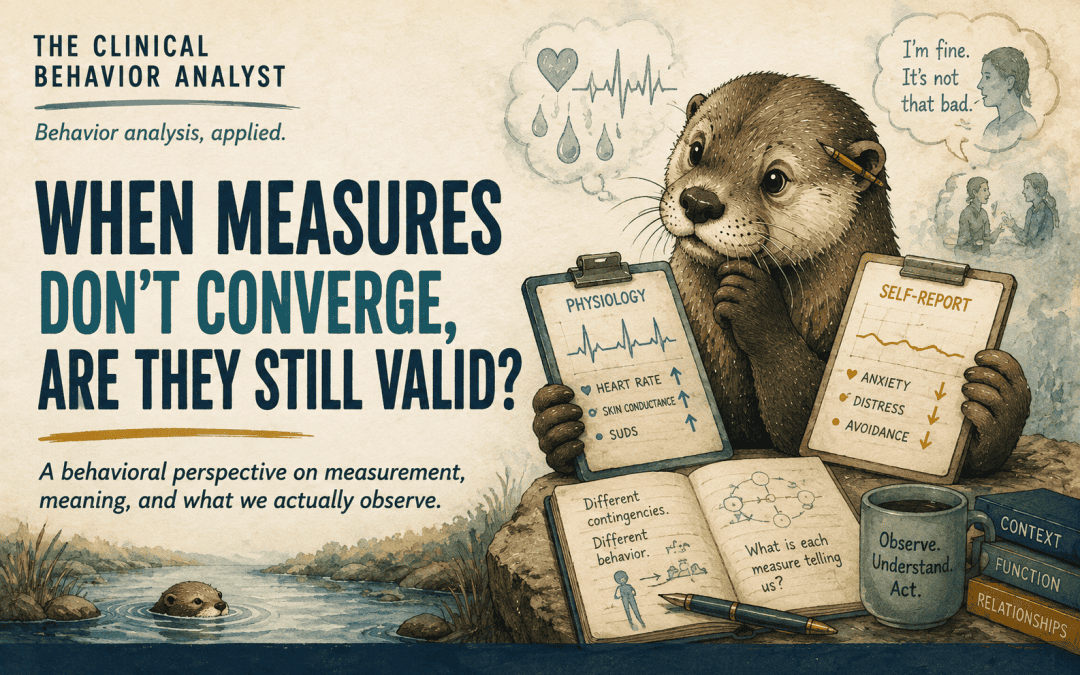
When measures don’t converge, are they still valid?

When measures don’t converge, are they still valid?

One of the most influential concepts in psychological measurement is convergent validity.

The idea seems straightforward. If several different measures are supposed to assess the same phenomenon, we would expect them to agree. If they do, we often become more confident that we’ve measured something “real.”

That sounds sensible.

Until you stop and ask a simple question:

What exactly have we observed?

Imagine someone with a snake phobia.

As they approach the snake, their heart rate increases. Their hands begin to sweat. At the same time, they continue walking toward the snake because their therapist is encouraging them and they are committed to treatment. If you ask them what they’re thinking, they tell you they are imagining themselves somewhere else entirely.

Three different response systems.

Three different patterns of behavior.

Which one tells us how afraid they “really” are?

From a behavioral perspective, that question is actually the wrong place to begin.

Each of those responses is behavior occurring under somewhat different environmental influences. The physiological response may reflect years of learning in which snakes became associated with danger. Walking toward the snake may be controlled by social reinforcement. The person’s verbal report may indicate rule-governed behavior, or not.

Why would we expect these behaviors to match perfectly?

What happens if, instead of asking “which one tells us how ‘afraid’ they really are?”, we ask “which one is going to be most tied to the change we’d like to drive?” We need to stop assuming “afraid” is some ‘thing’ we can accurately detect. 

Staying close to what we actually observed

This is one of the places where I think psychology sometimes moves too quickly away from its observations. Suppose someone completes a questionnaire designed to measure anxiety.

What did we actually observe?

We observed that a person endorsed a series of verbal statements in response to a particular set of prompts, under a particular set of circumstances.

That’s the observation.

Everything beyond that requires another inference.

If that questionnaire correlates highly with another questionnaire asking similar questions, what have we learned?

We have learned that people tend to respond similarly to similar verbal prompts.

That is an interesting and important finding.

But it is not, by itself, proof that an underlying psychological entity called “anxiety” or “fear” has been discovered.

The data demonstrate consistency in responding. Whether that consistency reflects an internal construct, a learned repertoire, recurring environmental contingencies, stable patterns of relational responding, characteristics of the measurement situation, or some combination of these remains a separate scientific question.

Those are different claims.

And they require different evidence.

Behavior analysis takes a more conservative position.

Behavior is treated as behavior.

Not as a sign pointing toward some hidden thing that must exist behind it.

That doesn’t mean internal events are ignored. It means we begin with what we can actually observe and then ask what variables are influencing those observations. When different measurements disagree, the first question isn’t, “Which one is right?”

Instead, it’s, “What environmental variables might be influencing each of these different behaviors?”

Sometimes disagreement between measures isn’t ‘measurement error’. Sometimes it is exactly what we should expect.

A person’s physiology, overt behavior, and verbal behavior are all influenced by overlapping—but not identical—histories and current contingencies.

Understanding why they diverge may teach us far more than forcing them into agreement.

Angela Coreil, PhD, BCBA

Angela Coreil, PhD, BCBA

Clinical Behavior Analyst, Methodologist & Trainer

Angela J. Coreil, PhD, is a professor at the University of Louisiana at Lafayette, clinical behavior analyst, and methodologist. Formerly director of an OCD and anxiety IOP/PHP, she integrates behavior analysis, ACT, Interpersonal Behavior Therapy, CBT, and exposure-based treatment. Her work develops practical improvements in behavioral science, and she provides consultation, professional training, workshops, and continuing education across disciplines.

Views expressed are those of Dr. Coreil or the explicitly named author, not the University of Louisiana at Lafayette.

Functional Relational Analysis: RFT infused functional analysis

Functional Relational Analysis: RFT infused functional analysis

Editor’s Note (2026): This article was originally published on AngelaCathey.com in 2016. It is reproduced here with only minor grammatical edits for readability. Some resources and terminology have evolved since its original publication, but the conceptual discussion is presented largely as it appeared at that time.

Here’s an outline for today’s post:

1. Functional Analysis (FA) our most powerful and under-utilized tool.
2. What RFT can offer to FA.
3. General guidelines for bringing RFT-FA into the room via integration with the 5 Rules of FAP.
4. A few groups of relations described functionally
5. What RFT-guided FA could do for our ability to assess the effectiveness of functionally oriented treatments (e.g., FAP).
RFT has a lot to offer for the applicability, precision, and utility of Functional Analysis.

Functional Analysis is one of our most powerful therapeutic frameworks in behaviorism (underlying most of our orientations), yet it has fallen out of use in the clinical environment.

Why? Because:

1) We are generally not in the client’s environment to see the variables controlling their behavior.
2) People are exceedingly bad at understanding/describing the variables that control their own behavior (see above on seeing everything through your own relational history and Measurement: Why we get no R.E.S.P.E.C.T., which explains how CBS has tried to deal with issues of measurement in relation to behavior).
3.) And, in the therapy hour, what you can do with FA is often to teach the client how to recognize (and hopefully influence) their own behavior or contexts, outside the therapy environment. Then you hope for the best.

So, let’s consider FA and what RFT-informed Functional Analysis has to offer clinicians:

First, by gaining experiential knowledge of RFT/REC, we get a much better picture of what variables may be controlling the client’s behavior, in the room and in their lives.

Second, we get a much better picture of how to intervene effectively by being able to test our hypotheses (often per session) by altering the variables in the room (in the present moment) and paying attention to the client’s response, our experience, and other contextual variables.

Thus, with RFT/REC we can go a long way to restoring our ability to use functional analysis during the therapeutic hour. (Not to mention getting more of the warm fuzzy feeling you get when you realize you’re doing something that’s ‘working’ for the client.)

So, let’s talk about how we can begin to use RFT in Functional Analysis. I’ll present some general guidelines and then discuss the how and why of these.

You’ll also notice that this is going to map right onto the “5 Rules” of Functional Analytic Psychotherapy. (Addition, 2026 note – I am speaking about the models of Functional Analytic Psychotherapy that were deeply behavioral and not the “Awareness, Courage, and Love” ACL model here.)

This is purposeful, as in my experience: 1) FAP is already one of the models that purposely trains you to bring FA into the present moment and look at behavior functionally, rather than topographically, and all we’re really doing here is adding knowledge of how the properties of symbolic relating also get tied into all the other ‘behaviors’ you see.

Note: This isn’t meant to substitute for or be better than learning RFT in other forms. If you want a full, more advanced understanding of RFT, I would recommend starting with Villatte, Villatte, and Hayes’ Mastering the Clinical Conversation or Matt Villatte’s online course on RFT through Practice Ground. Much of what I say here is an entry point to what these resources and others (such as Hayes’ Rule-governed Behavior) may teach you.

1. First, and above all else, listen to the client’s experience. (Rule 1: Watch for CRB1s AND watch for the general pattern of behavior (verbally and ‘non-verbally ‘) around important relations.)

2. Look for rule-governed behavior and rules. (If you’re in a stuck spot and feel like you’re bumping your head against the wall, it’s highly likely that either you and/or the client are responding to a ‘rule’.) This is Rule 1 again, but rule-governed behavior is such a big factor in the breakdown of communication I feel it stands repeating.

3. Understand what the HOW of the behavior tells you. (Again, Rule 1 in FAP but extended to understanding, using RFT, the function and properties of the symbolic relations that show up in the room.)

4. Start altering the context in the room, in the moment, with your hypotheses and noting the client’s HOW of response. (This is Rule 2, Evoke, from the FAP model, except evoke is also extended to using RFT to evoke verbal relations and understand the client’s response.)

5. Relate (functionally). (This is Rule 3, Reinforce, from the FAP model, except when you bring RFT into the mix, you begin to see how many more ways you can affect the client’s relating to you, themselves, the world, their pain, etc right there in the moment. This may sound a bit foreign, but I almost promise you that you’re already doing some form of it. If you’re an ACT clinician and the client is fused. then you get them to defuse. Congrats! You just moved a relation! Except RFT has far more to offer than defusion. Some of which I’ll describe below.)

6. Note your impact on relations as well as other behavior (Rule 4, Notice your impact except extended to noticing your impact on relations and their properties as well as other behavior).

7. Provide functional interpretations (Rule 5, in FAP) except that I would say that ‘functional’ may also need to be seen from an RFT perspective. Sometimes it’s helpful to provide direct feedback about the relations you perceive, but we also know that humans like simplicity a bit too much. Careful with providing interpretations that may easily be turned into rules (and rule-based insensitivity), so tread lightly and experientially here.

Included in this, but discussed less, is an assumption of general knowledge regarding Functional Analysis and Functional Assessment. For readers who want a review of this, start here: Iwata & Dozier, 2008; Gareth Holman’s Intro to FA on Practice Ground; and for mapping out your effect for research (or warm fuzzies), begin with Koerner and Holman’s 2014 Single-case designs in clinical practice.

It’s good to have a general awareness of how the character of the behavior (e.g., approach/repeat may indicate presence of reinforcing qualities) may indicate relations. Then in the FA you learn the problematic relation only through noticing what moves the relation in a more adaptive direction (functionally determined).

How do you know what’s adaptive? I like Villatte, Villatte, and Hayes’ Mastering the Clinical Conversation overall framework.

That is, the overall goals of treatment are:

1. Helping the client develop flexible context sensitivity and functional coherence (read awareness when it’s adaptive and an overall system of relating that ‘works’ for the client).

The overall means of treatment are:

1. Transforming symbolic functions by altering context (read influencing relations and their properties by any of your symbolic behavior in the room with the client, etc.)

So, in doing a Functional Relational Analysis, we’re doing an in-the-moment analysis to increase adaptive relating as defined by Villatte, Villatte, and Hayes in the manner in which we influence relating with the 5 Rules in FAP (you following me?)

So, now about the business of recognizing relations that can be influenced in your RFT-FA. First, let’s begin by making things a bit simpler: some relations that frequently come up and affect treatment in the moment.

1. Rule-governed behavior – consider this a kind of fusion that, in whatever form, usually results in an inability to contact important contingencies at hand.

Example(s): “Jimmy is always anxious.” vs “Jimmy is anxious.” vs. “Jimmy sometimes gets anxious.” Inherent in these statements is a rule. Though you’d need ideographic context, they may likely indicate different levels of fusion with the rule. The intensity/rigidity and lack of noticing other contingencies may give you a good idea about how fused the speaker is to the rule and how unaware they may be when Jimmy acts in ways that are non-anxious (see later post on discrimination/stigma/violence towards others). Keep in mind that almost any kind of relation can be rule-ified into inflexibility over time, repetition, etc.

2. How to influence it: Defusion, context changes of many sorts (emotion, experientially walking through the contingencies that allow the person to note what was previously missed, etc.

3. How to assess your impact: Is the person now loosening in their behavior guided by the rule? Is their language around the rule more flexible?

2. Influencing awareness towards whole or parts – here I’m talking about several relations in combination functionally. We often use distinction framing (this but not that), combination (this and this), opposition (this is the opposite of that) to bring more awareness to the parts and pieces. 

Examples(s): Hierarchicals and moving towards seeing the self or experience as a part of the continuing experience. “I am this feeling, this moment” versus “I am more than my experience.”

How to influence it: Mindfulness, either noticing continuity, wholeness, or otherwise noticing detail.

How to assess your impact: Do they seem (verbally or otherwise) more aware of the direction needed to note important contingencies? Other relations can also be added in, but let’s focus on these for now.

What can elements of an RFT allow us to fine-grain and repeated attempts to change relating of several types each session?

We can aim for more or less flexibility, more or less awareness of certain contingencies, and more adaptive stories about the “self” and its experience. This can allow several dimensions for FA beyond what is normally present.

Add the REC Model, and you can evaluate behavior based on its complexity and derivation (allowing you to see whether you need to increase the variety and complexity of learning experiences to make it stable and adaptive).

Further elaborating on this kind of workup could help us more effectively assess some of the benefits of functionally oriented treatments.

Essentially, mapping out change in other relations would add further assess change.

For example, we know that one of the mechanisms responsible for the effectiveness of FAP is likely to be contingent reinforcement (see Kanter, Landes, Busch, Rusch, Brown, Baruch, and Holman 2006 Effect of contingent reinforcement) and that systems can be derived for measuring change based on this functional target (see Callaghan 2001 FIAT Functional Ideographic Assessment Template).

With RFT, everything can be parsed relationally in some respect (every treatment, nearly every behavior, diagnosis, etc.). This, in combination with other FA relations (e.g., reinforcement), can allow us to examine change across therapies, diagnoses, contexts, etc. Further, noticing the change in relation in verbal behavior gives us many more opportunities for altering and assessing our impact each session.

If you’re thinking that assessment and coding of verbal relations would take years, wait for the posts on Natural Language Processing, Machine Learning, and sensor-based experience sampling.

References

Iwata, B. A., & Dozier, C. L. (2008). Clinical application of functional analysis methodology. Behavior Analysis in Practice, 1(1), 3–9.

Callaghan, G. M. (2001). Functional Ideographic Assessment Template (FIAT) System. Reno, NV: Context Press.

Hayes, S. C. (Ed.). (1989). Rule-Governed Behavior: Cognition, Contingencies, and Instructional Control. New York: Plenum Press.

Kanter, J. W., Landes, S. J., Busch, A. M., Rusch, L. C., Brown, K. R., Baruch, D. E., & Holman, G. I. (2006). The effect of contingent reinforcement on target variables in outpatient psychotherapy for depression: An investigation of Functional Analytic Psychotherapy. Journal of Applied Behavior Analysis, 39(4), 463–467. https://doi.org/10.1901/jaba.2006.21-06

Koerner, K., & Holman, G. I. (2014). Single-case designs in clinical practice. In The Wiley Handbook of Contextual Behavioral Science

Villatte, M., Villatte, J. L., & Hayes, S. C. (2016). Mastering the Clinical Conversation: Language as Intervention. New York, NY: Guilford Press.

RFT (Part 2): The signal in the noise of human behavior

RFT (Part 2): The signal in the noise of human behavior

Editor’s Note (2026): This article was originally published on AngelaCathey.com in 2016. It is reproduced here with only minor grammatical edits for readability. Some resources and terminology have evolved since its original publication, but the conceptual discussion is presented largely as it appeared at that time.

UNDERSTANDING PROPERTIES OF RFT: The signal in noise of human behavior

Now that we’ve talked about space-time distortion, let’s blow your mind a bit more by learning to understand the properties of RFT.

You’ve all seen the diagrams explaining how the letters in the word “cat” = a picture of a cat = the sound of “cat” spoken. You may have also seen the complex ‘algebra’ that formulaically explains properties of RFT like transformation of stimulus function.

See: https://contextualscience.org/transformation_of_stimulus_functions

Yikes! So, that formula is sheer genius but not particularly functional for people who don’t already understand RFT. Explaining RFT in these terms to those who are learning is a bit like explaining gravity as a formula. In some way it is ‘true,’ but if you want someone to understand the meaning of gravity, you’re better off dropping the DSM on their foot.

Let’s understand the meaning of RFT at a deeper, more experiential level.

RFT explains the inter-relations of different elements of our behavior and context.


Diagram: Cathey (2016)

This is a diagram showing how the properties of RFT and operant/classical conditioning tell us that our behaviors are interrelated.

It’s not perfect. Anyone can tell you these aren’t entirely separate.

Our experience is actually much more like this.

Picture: indulgy.com

Let’s dig a little deeper…

So, in some way we are this relational signal that we experience as a whole, which isn’t entirely separate from our experience of our external context (blurry line). What we perceive in the world is viewed through our internal context (if you’re inside that bubble looking out, everything will be tinted blue). This is why we can all react in different ways to the ‘same’ ‘external’ stimuli and why we may act differently in different contexts. All is through the filter of our experience and through relation, after we become old enough to have a symbolic world. This symbolic world is, in some respect verbal but more importantly highly symbolic. Words/language are one important network that forms the scaffolding of our internal experience, and which we can somewhat efficiently use to show others our world.

That ‘sticky’ scaffolding gives words power.

So, RFT is not just a theory of language. It is a theory of symbolism.

‘Anything can become anything’ because it is nearly all symbolic at some level.

Sensation, perception, visual stimuli, auditory stimuli, words, actions, are all a symbolic soup of experience, and your own relational history makes some of those cues more salient than others.

For example, listen to just a second of this music. Close your eyes. Notice the feelings and thoughts.

Mystery Music

Now, what you all experienced was the same stimulus, but how it affected you is through relation, in a very deep way.

My experience is not yours, in great part, because of my distinct relational history with this stimulus.

For me, that song is chills, tears in my eyes, the taste of a tequila shot (hey… I was nervous that day), and a visual of walking down the aisle. It will never again be separate from those moments. BECAUSE of the RELATIONS it obtained when I chose it for that defining moment.

For you, maybe it was just squeaky violin music or something pretty. This is RFT. The song had no words and yet it is still symbolic and influenced by what I say. Now, if you meet me, you will have the words above as a scaffolding between our worlds.

As you read them you were likely able, in some part, to experience part of my experience but even still through your relational history. For those of you who know me, the experience of learning this information might have been more intense if I’m close to you or if you experience me as like you. This is predictable based on RFT: a frame of coordination (she is like me) or (I like her) will increase your experience of my description. A frame of distinction (I am not like her) or (this is crap, etc.) will decrease the intensity of the experience (transformation of stimulus functions) evoked by reading my experience.

Cathey (2016)

Thus our experiences are tinted, amplified, and de-amplified by the frames in which we hold ourselves, those we are exposed to, and many other contextual variables that influence our experience.

Isn’t it lovely? We are all connected, through relation. (Imagine: You can totally win 6 degrees to Kevin Bacon now. 😉

Media: www.mangowed.com

Further, your actual perceptual, emotional, behavioral, and verbal experience is predicable based on RFT and the significance or depth of the learning you have related to the the stimuli (REC Model; Hughes, Barnes-Holmes, Vahey, 2012Barnes-Holmes, Barnes-Holmes, Stewart, & Boles (2010)).

So, let’s switch frames a bit to get ready for clinical/social applications:

Let’s look at the REC Model of some things that could cause us to feel fear or disgust. This is a functional example. It’s not perfect but let’s hope it gets the job done. Look at the items in the REC Model below and note your emotional response.

Cathey (2016)

What I’m willing to bet is that even though you likely have some very rich sensory experiences (high connectivity) of food poisoning, unless you’ve had one recently you probably didn’t have much of a response to that stimuli. As a US resident, few of us will have a strong visceral response to Ebola as its not connected to most things in our daily worlds. Few of us will have had direct experience with it.

Now here’s the curious part, what was your response to the gun woman? What was your response to Hitler?

If you had a more intense emotional response to Hitler that is understandable based on REC, but few other theories would predict this or allow for testing of it. We could say that we have “habituated” to gun violence. Or, perhaps we’ve now heard so many derivations of this occurring that we can now control the response to it, as it is sunken into the rich networks of other relations.

Hitler, on the other hand. I’m guessing no one reading this met him. Yet you may have felt a lurch of disgust even stronger than the food poisoning picture.

Without RFT and personal experience with this it is difficult to make sense of your response to Hitler, vs food poisoning, vs. mass shootings, vs. Ebola.

Stay with me here. A low complexity network with high derivation is a bit like all the relations flowing through this single point of symbolic ‘evil’.  If he is a single point of relation through which all we know about the Holocaust and those horrors is filtered there is a lot of derivation through repeated understanding but little complexity. For most of us we only have knowledge of these things through history classes, documentaries, etc. This results in a highly derived but not complex network of emotional learning. It lends itself to strong/rigid/somewhat two dimensional responses.

Otherwise it’s a little difficult to explain why we’d have such a strong response to someone none of us have ever met AND yet have a have a much more moderated response to gun violence.


Angela Coreil, PhD, BCBA

Angela Coreil, PhD, BCBA

Clinical Behavior Analyst, Methodologist & Trainer

Angela J. Coreil, PhD, is a professor at the University of Louisiana at Lafayette, clinical behavior analyst, and methodologist. Formerly director of an OCD and anxiety IOP/PHP, she integrates behavior analysis, ACT, Interpersonal Behavior Therapy, CBT, and exposure-based treatment. Her work develops practical improvements in behavioral science, and she provides consultation, professional training, workshops, and continuing education across disciplines.

Views expressed are those of Dr. Coreil or the explicitly named author, not the University of Louisiana at Lafayette.

Pin It on Pinterest