Advancing Contextual Behavioral Science Measurement with Natural Language Processing
By Angela Coreil, PhD, LP, BCBA
One of the things that first drew me to Relational Frame Theory (RFT) was that it finally provided a behavior-analytic framework capable of addressing the complexity of human language. Rather than treating thoughts and language as something outside the domain of behavior analysis, RFT offered a principled way to integrate verbal behavior into behavioral analysis while remaining grounded in basic behavioral principles. It felt like finding a missing piece.
As exciting as that realization was, it immediately led to another question:
How do we actually measure complex verbal behavior outside of the laboratory?
Around 2015, that question sent me down a rabbit hole that consumed much of my free time. I began teaching myself the emerging world of natural language processing. I dug through Python libraries, Anaconda environments, early machine learning tools, and resources that would eventually evolve into platforms like Hugging Face. I wasn’t approaching these technologies as a computer scientist. I was trying to answer a behavioral question:
Could these emerging computational methods help us measure verbal behavior in ways that were more consistent with contextual behavioral science?
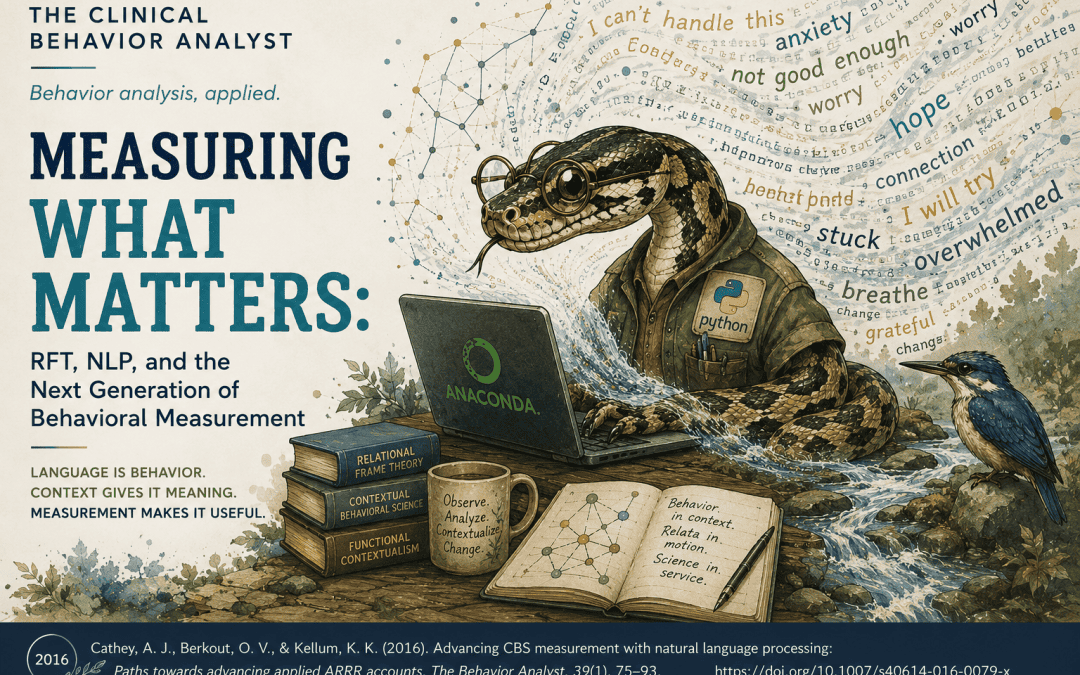
In 2016, I presented some of these early ideas at the Association for Contextual Behavioral Science (ACBS) Research-Based Practice Special Interest Group in Seattle. The excitement surrounding the possibilities eventually grew into this manuscript, co-authored with the wonderful Olga Berkout and Karen Kate Kellum.
The paper argues that Contextual Behavioral Science has an opportunity to advance measurement by treating language itself as behavior rather than simply as evidence for latent psychological constructs. Building on Relational Frame Theory, we proposed that emerging Natural Language Processing (NLP) technologies could begin measuring increasingly complex verbal behavior across applied and clinical settings while maintaining greater theoretical consistency with functional contextualism.
Rather than viewing written and spoken language merely as indicators of underlying mental states, we suggested analyzing language directly as observable behavior. We outlined how computational linguistics, ecological momentary assessment, mobile technologies, and behavioral signal processing might eventually be integrated to examine verbal behavior as it unfolds across time, contexts, and social interactions. At the time, many of these ideas were speculative. Today, many have become technically feasible.
The manuscript also sought to address one of the longstanding challenges facing Relational Frame Theory: translating decades of elegant basic research into tools that clinicians and applied researchers could actually use. We discussed integrating contemporary RFT models, including the Multi-Dimensional Multi-Level (MDML) framework, with modern computational methods to visualize and quantify increasingly complex relational networks as they emerge in everyday language.
Looking back, many of the ideas I continue to pursue – including treating self-report as verbal behavior rather than latent variables, integrating ecological momentary assessment with physiological and language data, preserving behavioral observations rather than collapsing them into composite constructs, and developing scalable behavioral measurement systems – can be traced back to the questions first explored in this paper. In many ways, this manuscript marked the beginning of my effort to build a more integrated science of human behavior.
Berkout, O. V., Cathey (Coreil), A. J., & Kellum, K. K. (2019). Scaling-up assessment from a contextual behavioral science perspective: Potential uses of technology for analysis of unstructured text data. Journal of Contextual Behavioral Science, 12, 216–224. https://doi.org/10.1016/j.jcbs.2018.06.007
Related Works:
Berkout, O. V., Cathey (Coreil), A. J., & Berkout, D. V. (2020). Inflexitext: A program assessing psychological inflexibility in unstructured verbal data. Journal of Contextual Behavioral Science, 18, 92–98. https://doi.org/10.1016/j.jcbs.2020.09.002
Cathey (Coreil), A. J., Holman, G., Villatte, M., Zettle, R., Canare, D., & Swails, J. (2016, June). Adapting research to the clinical environment: Computer-aided verbal behavior analysis (CAVBA). Association for Contextual Behavioral Science Annual Conference, Seattle, WA.
Cathey (Coreil), A. J., Vilardaga, R., & Zettle, R. D. (2016, June). Using ecological momentary assessment to examine the impact of self-regulation choice on affect. Association for Contextual Behavioral Science Annual Conference, Seattle, WA.
Cathey (Coreil), A. J., Zettle, R. D., & Swails, J. (2016, April). Computer-aided verbal behavior analysis (CAVBA): Evidence for the feasibility of detecting framing behavior with natural language processing. Wichita State University Research Roundup, Wichita, KS.

Angela Coreil, PhD, BCBA
Clinical Behavior Analyst, Methodologist & Trainer
Angela J. Coreil, PhD, is a professor at the University of Louisiana at Lafayette, clinical behavior analyst, and methodologist. Formerly director of an OCD and anxiety IOP/PHP, she integrates behavior analysis, ACT, Interpersonal Behavior Therapy, CBT, and exposure-based treatment. Her work develops practical improvements in behavioral science, and she provides consultation, professional training, workshops, and continuing education across disciplines.
Views expressed are those of Dr. Coreil or the explicitly named author, not the University of Louisiana at Lafayette.