
Journey Home: The Clinical Behavior Analyst
By Angela Coreil, PhD, LP, BCBA
For a while, I stopped writing so much. Life had a lot of turns in store for me.I kept thinking about measurement, language, and understanding complex human behavior in context. Those questions simply moved with me across contexts.
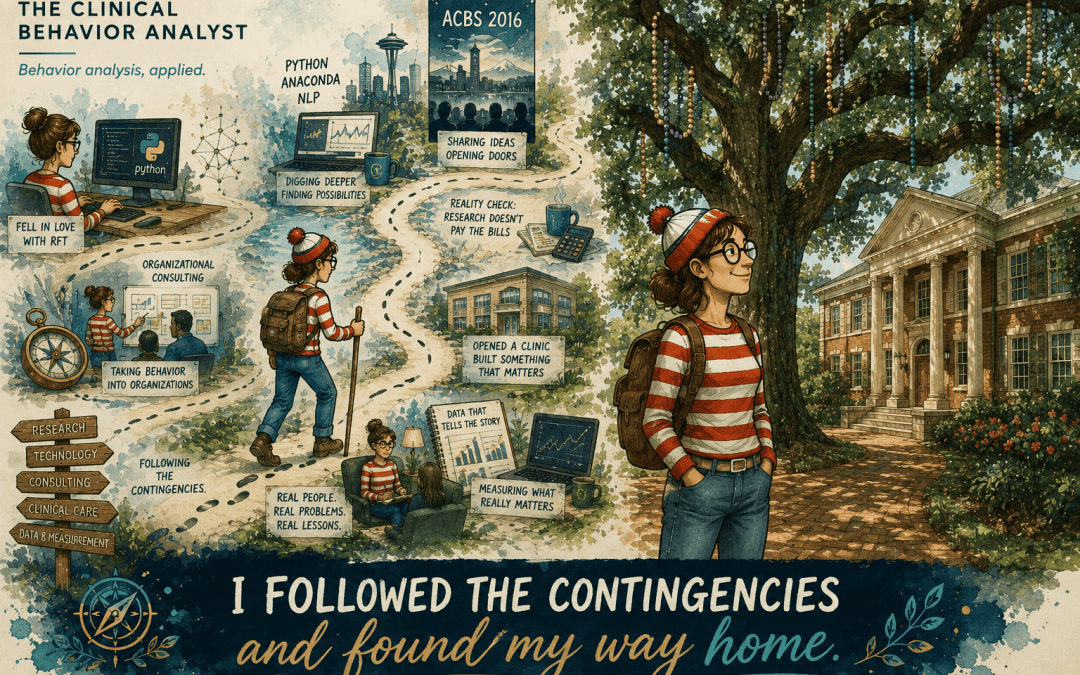
Around 2015, I had already fallen in love with Relational Frame Theory and Clinical Behavior Analysis. RFT gave me a flexible way to bring language, thought, meaning, and symbolic behavior into behavioral analysis without abandoning behavioral principles. It opened a door I had been trying to find for years. And yes, I know – I’d been an ACT clinician forever, but RFT evolved. Once I saw what might be possible, I wanted to know how far it could go.
The research was important, but contingencies had me finding reinforcement outside the lab. The beauty of behavior analysis and human language is that its everywhere. Language changing across settings, relational patterns unfolding over time, and then I learned that clinicians were interested in the technology but bringing it to them wasn’t feasilble at the time. The NSF i-corps taught me Lean Start-up though and I rolled with it. I landed organizational gigs and I bootstrapped ways to run what I wanted to build myself.
What I-Corps changed was my understanding of how scientific advances might become products, services, and tools that people could actually use. It taught me to think about customers, implementation, workflows, and whether an idea could survive outside the conditions in which it was developed.
That mattered. I learned to bootstrap prototypes. For those of you that are unfamilair, here’s an example of a bootstrapped prototype.
A scientific advance can be brilliant and still go nowhere. Someone has to make it usable. (And, as above – eventually someone has to make it not look like a circuit board in a suitcase.) Someone has to understand the environment into which it will be introduced. Someone has to build the bridge between an important finding and getting people to make use of the finding.
Taking the Work Into Organizations
I began doing organizational work with medium-sized companies. I worked on problems involving communication, leadership, culture, employee behavior, and the ways verbal networks shape what organizations do. and what people buy. I enjoyed it. Organizations offered a remarkably rich setting for thinking about relational responding, rule-governed behavior, and behavior across complex systems.
The work also showed me how much behavioral science could contribute outside traditional clinical and academic settings. But organizational contracts move slowwwwwly.
A company may spend months discussing a project, revising the scope, securing approval, and moving through procurement before anyone gets paid. That timeline may be manageable for an established consulting firm. It is much harder for a doctoral student raising a toddler.
At the same time, I was receiving invitations into exciting academic conversations, including opportunities to spend time around research programs I admired. I was deeply interested in that work.
Interest, however, does not pay the bills.
I had a child to raise, a doctorate to complete, and a life that required income on a schedule more reliable than organizational consulting or emerging research collaborations could offer.
So, I followed the contingencies.
Better Living Center for Behavioral Health
Clinical work paid more reliably, and I knew I how to a run specialized Intensive Outpatient (IOP) and Partial Hospitalization (PHP) units from previous work. In 2018, I opened the Better Living Center for Behavioral Health.
I built an intensive behavioral health center from the ground up. Seeing my first clients involved renting their therapy room for an hour while paying for 1.5 hours of drop-off care. But, I am scrappy. I hired and trained clinicians, supervised treatment, developed programs, managed crises, built documentation systems, negotiated with insurers, handled compliance, fixed operational problems, and learned every part of running a clinical organization. The result was an 18 room higher-level treatment facility specialized for treatment of severe OCD and anxiety disorders.
The clinic was a master class in so much. I had treated complex clients. I had trained clinicians but as the CEO of a treatment facility everything was mine to solve. Someday, over a drink, you can ask me about poop-ma-gedon. (Hint: It wasn’t an exposure exercise.)
But in the mix of this work, again – the same themes ate at me. Clients did not arrive as clean constructs. They did not separate themselves into neatly bounded diagnoses, treatment protocols, or theoretical models. They arrived with overlapping histories, medical conditions, family systems, complex verbal repertoires, changing environments, practical constraints, and problems that behaved differently across contexts.
The harder the case, the more obvious it became that no single treatment model could anticipate all of the complexity in front of us. Evidence-based treatments remained essential. The work was learning how to apply them intelligently to the individual.
That required following behavioral principles, observing closely, adapting carefully, and asking better questions.
What is happening? Under what conditions? What changed?
What could a clinician realistically collect while still providing care?
What Running a Clinic Taught Me
Running a clinic changed how I understand science. It showed me how reimbursement shapes treatment. It showed me how organizational contingencies shape clinician behavior. It showed me how documentation requirements alter what gets observed and what gets ignored.
It also showed me how often useful information gets lost. Rich clinical observations become checkboxes. Repeated reports become total scores. Language becomes a diagnosis. Complex behavior gets flattened into categories that fit billing systems, electronic records, or research conventions.
The clinic made it impossible for me to treat measurement as a neutral activity. Measurement always occurs inside a system. The system determines what gets collected, what gets rewarded, what gets retained, and what gets discarded.
It also made clear the kinds of issues that occur when solutions meet clinical reality. A sophisticated tool that clinicians cannot use is not useful. A measure that takes too long will not be completed. A dashboard no one understands will be ignored. A theoretically elegant system that does not fit the workflow will disappear. Those lessons now sit at the center of how I think about research.
The Long Way Around
There is a recognizable academic path: graduate school, post-doc, faculty position, publications, lab, promotion.
I’ve never been one to follow the beaten path. My path moved through research, technology, organizational consulting, entrepreneurship, intensive clinical care, business ownership, supervision, insurance systems, and the daily work of keeping an organization alive.
The years of finding my potential forever home – they were worth it all. They were where I learned what happens when theory meets reimbursement, staffing, liability, time pressure, and the lives of actual clients. They were where I learned that implementation is not an afterthought. It is part of the science.
Finding My Way Home
I came back to academia understanding how to build my work in ways that can survive and thrive within systems. And, now, I’m home and happy to be writing again.
Angela Coreil, PhD, BCBA
Clinical Behavior Analyst, Methodologist & Trainer
Angela J. Coreil, PhD, is a professor at the University of Louisiana at Lafayette, clinical behavior analyst, and methodologist. Formerly director of an OCD and anxiety IOP/PHP, she integrates behavior analysis, ACT, Interpersonal Behavior Therapy, CBT, and exposure-based treatment. Her work develops practical improvements in behavioral science, and she provides consultation, professional training, workshops, and continuing education across disciplines.
Views expressed are those of Dr. Coreil or the explicitly named author, not the University of Louisiana at Lafayette.