Select Page
Kafka Finds His Rage (Against the Machine): Using Hierarchicals to Pull Yourself Up

Kafka Finds His Rage (Against the Machine): Using Hierarchicals to Pull Yourself Up

Parts of my life have been a little too much like a Chuck Palahniuk novel: chaotic, painful, and governed by the reliable presence of unreliability. Chaos breeds a different kind of attention—if you survive it.

What I have found is that surviving a painful context over time requires more than gritting your teeth. At some point, you have to find a reason for the pain. You have to connect the miserable, repetitive thing you are doing today to something larger than today.

You have to contact the hierarchical.

In relational frame theory, a hierarchical relation organizes one event as belonging to or being part of something larger: *this action is part of that goal; this goal is part of that value; this moment is part of the life I am trying to build*. Hierarchical framing does not merely describe what matters. It can transform the psychological function of an action. Something difficult may become more tolerable—or even reinforcing—when it is experienced as contributing to something deeply important.

Villatte, Villatte, and Hayes describe this as building meaning through networks of relations. We can ask:

If you continued doing it, what larger direction would it serve?
What could you do today that would be part of that direction?

These are not questions about discovering a magical object called a “value” hidden inside you. They are ways of arranging relations among actions, consequences, goals, and larger patterns of living. The clinical—and personal—question is whether arranging those relations changes what you do.

That is why I am not talking about “using RFT” as though RFT were a therapeutic technique. RFT is a behavioral account of human language and cognition. What I am describing is a functional relational analysis: examining how a person’s learned relational responding changes the functions of experiences and influences behavior, then deliberately using those relations to help move behavior in a useful direction.

In plain language: Is there a piece of what you’re doing that connects to higher meaning for you?

Maslow Was Not Entirely Wrong

Maslow’s hierarchy contains an important truth. Food, sleep, and safety matter. Connection matters. It is considerably harder to contemplate your grand contribution to humanity when you are hungry, terrified, or trying to keep the electricity on. Harder, but not impossible, and sometimes – it’s just the thing that helps you rise.

Material stability expands the range of behavior available to us. Suffering isn’t an inspirational slogan. And finding “meaning” doesn’t excuse conditions that are dangerous, exploitative, or unjust. Sometimes the most functional response to pain is to leave, resist, seek help, or change the environment that produces it.

But the popular pyramid leaves something out: people do not always wait for stability before reaching toward meaning. In fact, Viktor Frankl spoke about this widely – sometimes meaning is what gets you through the pain.

Gandhi did not wait for comfort before organizing his behavior around a larger purpose. Martin Luther King Jr. did not first achieve a safe and pleasant life before confronting injustice. Kashdan (2022) describes this kind of principled insubordination as dissent directed toward improving an unhealthy status quo—not rebellion for its own sake. Effective dissent requires willingness to experience discomfort, but also the flexibility and skill to make that discomfort serve meaningful change.

The opposition these leaders encountered did not necessarily weaken the relational networks organizing their actions. At times, opposition may have strengthened those networks: “This resistance is evidence that the work matters. This suffering is part of the struggle. This action contributes to freedom.”

Contacting the Hierarchical

There are mornings when the immediate consequences of getting up are not enough. The work is exhausting. The daily details are tedious. The context continues to hurt.

If all I contact is the drudgery, the drudgery wins.

For me, public speaking is part of challenging how people understand behavior. Challenging those ideas is part of making change possible.

The lower-level action participates in a larger relational network, and its function changes when that network becomes psychologically present.

For me, music sometimes brings that network into the room.

Before an important talk, I may listen to Rage Against the Machine or Nine Inch Nails. I am not looking for “calm” in those moments. I am contacting the fire inside. Raising up my lighter and getting ready for the mosh pit.

Someone has to speak about change before change can happen. If I want it to happen, then I’ve got to be out there to do it. Contacting the music helps transform nervous activation from a signal to retreat into energy… the kind of energy that says, “Let’s all get in that pit and dance until we change something that matters.”

That is functional only if it actually improves the behavior that matters.

If the music leaves me so angry that I become rigid, hostile, or incapable of responding, then it’s helping me move right, and I adjust.

Meaning Can Keep You Alive—and Make You Numb

Contact with something larger can carry a person through serious pain. It can lift behavior out of the immediate grind and place it in the service of a longer trajectory.

That capacity is powerful. It is also dangerous.

When suffering is relationally tied to a cherished value, we may tolerate conditions that should be changed. We may become less responsive to pain that is providing important information. We may remain in destructive workplaces, relationships, movements, or personal projects because leaving then feels like weakness, betrayal, or failure.

Todd Kashdan has written about the perils of grit: relentless persistence can produce collateral damage when people continue despite evidence that their strategy is harming them. Persistence is not inherently virtuous. Neither is willingness to experience pain.

Adequately tracking whether our behavior moves us to our goals requires something more discriminating. Kashdan and Rottenberg define it in terms of adapting to situational demands, shifting perspectives or behavior when strategies undermine functioning, balancing competing life domains, and remaining able to act in accordance with important values (Kashdan & Rottenberg, 2010).

Sometimes flexibility means staying. Sometimes it means stopping. Sometimes the courageous act is walking onto the stage. Sometimes it is admitting that the stage is burning and getting everyone out of the building.

An Exercise: Build the Hierarchical, Then Touch It

Choose a piece of music, art, literature, or another experience that helps you contact something larger than your immediate discomfort.

Do not stop at “This inspires me.” Work through your experience to feel the important relations moving.

1. Identify the behavior.

Name one observable action you are having difficulty doing. Not “be courageous.” Try “submit the application,” “make the phone call,” “write for 20 minutes,” or “state my position during the meeting.”

2. Build upward.

Ask yourself:

What is this action moves me toward that matters to me?
Why does that contribution matter?

And let me tell you, sometimes – what you contact doesn’t sound ‘adaptive,’ but if it moves you – it might be. Before Rage Against the Machine got me to harness stage energy, it got me through a clinical training experience where I was what you would call a neuropsych scoring ‘workhorse.’ In those hours of scoring assessments on my own time, Rage Against the Machine was all about not letting ‘The Man’ take me down.)

But I digress; continue until you feel what matters, whether it be creating, protecting, learning, telling the truth, caring for others, or challenging injustice.

3. Build downward.

Ask:

If this larger direction matters, what actions could be part of it?
(Do you need to score an insane amount of assessments to just get past this hurdle – to get what you want?)

4. Use the art deliberately.

Listen, read, or look. Notice what memories, sensations, images, and verbal relations become present. Then perform the target action.

5. Track the effect.

If you did contact a hierarchical, you might feel less sensitive to pain and better able to move. Did it improve persistence, clarity, compassion, or responsiveness? Or did it produce the other effects of rule-governed behavior – the rigidity, numbing, aggression, exhaustion, or continued exposure to unnecessary harm?

Meaning Is a Functional Question

I still love Kafka, Dostoevsky, Dante, Camus, and Palahniuk. Metaphor (and art, by nature) can help us contact experiences that direct explanation cannot reach. But I no longer want only a beautiful description of the rock I am pushing uphill.

I want to know what the metaphor does.

Does it expand my behavior? Does it connect today’s action to something worth building? Does it help me notice when persistence is effective and when I need another response? Or does it become a coherent, elegant blindfold?

A rule that blocks sensitivity to consequences is dangerous. An entire network of such rules can make blindness feel meaningful. So yes, find the reason for the pain. Build the hierarchical, contact those properties that make the action easier and worthwhile…

Then keep your eyes open.

I’d love to hear about the things that help you contact your hierarchicals in the comments, if you feel comfortable.

References and Further Reading

Kashdan, T. B. (2017, April 13). How I learned about the perils of grit. Psychology Today.

Kashdan, T. B. (2022). The art of insubordination: How to dissent and defy effectively. Avery.

Kashdan, T. B. (n.d.). Psychological flexibility: Your new secret weapon for resilience.
Kashdan, T. B., & Rottenberg, J. (2010). Psychological flexibility as a fundamental aspect of health. Clinical Psychology Review, 30(7), 865–878.

Tay, L., & Diener, E. (2011). Needs and subjective well-being around the world. Journal of Personality and Social Psychology, 101(2), 354–365.

Villatte, M., Villatte, J. L., & Hayes, S. C. (2016). Mastering the clinical conversation: Language as intervention. Guilford Press.

RFT (Part 2): The signal in the noise of human behavior

RFT (Part 2): The signal in the noise of human behavior

Editor’s Note (2026): This article was originally published on AngelaCathey.com in 2016. It is reproduced here with only minor grammatical edits for readability. Some resources and terminology have evolved since its original publication, but the conceptual discussion is presented largely as it appeared at that time.

UNDERSTANDING PROPERTIES OF RFT: The signal in noise of human behavior

Now that we’ve talked about space-time distortion, let’s blow your mind a bit more by learning to understand the properties of RFT.

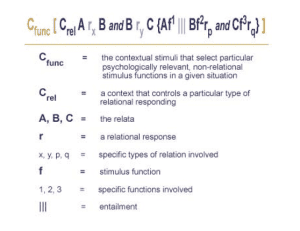
You’ve all seen the diagrams explaining how the letters in the word “cat” = a picture of a cat = the sound of “cat” spoken. You may have also seen the complex ‘algebra’ that formulaically explains properties of RFT like transformation of stimulus function.

See: https://contextualscience.org/transformation_of_stimulus_functions

Yikes! So, that formula is sheer genius but not particularly functional for people who don’t already understand RFT. Explaining RFT in these terms to those who are learning is a bit like explaining gravity as a formula. In some way it is ‘true,’ but if you want someone to understand the meaning of gravity, you’re better off dropping the DSM on their foot.

Let’s understand the meaning of RFT at a deeper, more experiential level.

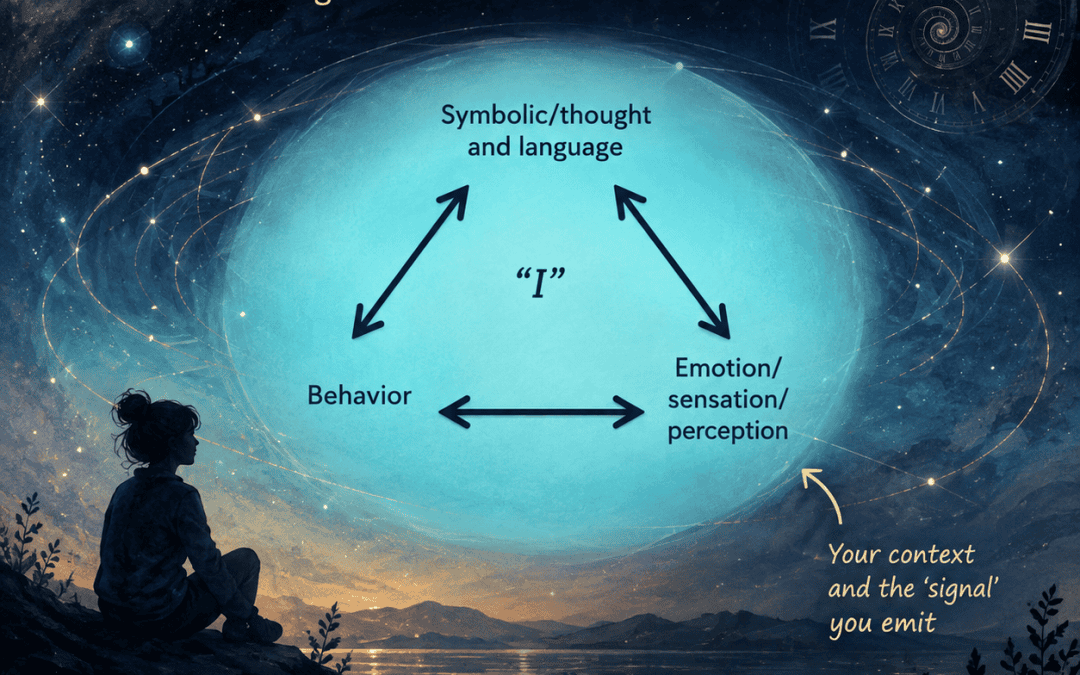
RFT explains the inter-relations of different elements of our behavior and context.


Diagram: Cathey (2016)

This is a diagram showing how the properties of RFT and operant/classical conditioning tell us that our behaviors are interrelated.

It’s not perfect. Anyone can tell you these aren’t entirely separate.

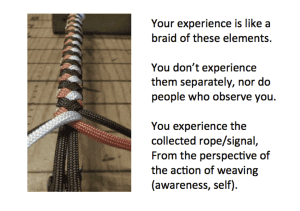
Our experience is actually much more like this.

Picture: indulgy.com

Let’s dig a little deeper…

So, in some way we are this relational signal that we experience as a whole, which isn’t entirely separate from our experience of our external context (blurry line). What we perceive in the world is viewed through our internal context (if you’re inside that bubble looking out, everything will be tinted blue). This is why we can all react in different ways to the ‘same’ ‘external’ stimuli and why we may act differently in different contexts. All is through the filter of our experience and through relation, after we become old enough to have a symbolic world. This symbolic world is, in some respect verbal but more importantly highly symbolic. Words/language are one important network that forms the scaffolding of our internal experience, and which we can somewhat efficiently use to show others our world.

That ‘sticky’ scaffolding gives words power.

So, RFT is not just a theory of language. It is a theory of symbolism.

‘Anything can become anything’ because it is nearly all symbolic at some level.

Sensation, perception, visual stimuli, auditory stimuli, words, actions, are all a symbolic soup of experience, and your own relational history makes some of those cues more salient than others.

For example, listen to just a second of this music. Close your eyes. Notice the feelings and thoughts.

Mystery Music

Now, what you all experienced was the same stimulus, but how it affected you is through relation, in a very deep way.

My experience is not yours, in great part, because of my distinct relational history with this stimulus.

For me, that song is chills, tears in my eyes, the taste of a tequila shot (hey… I was nervous that day), and a visual of walking down the aisle. It will never again be separate from those moments. BECAUSE of the RELATIONS it obtained when I chose it for that defining moment.

For you, maybe it was just squeaky violin music or something pretty. This is RFT. The song had no words and yet it is still symbolic and influenced by what I say. Now, if you meet me, you will have the words above as a scaffolding between our worlds.

As you read them you were likely able, in some part, to experience part of my experience but even still through your relational history. For those of you who know me, the experience of learning this information might have been more intense if I’m close to you or if you experience me as like you. This is predictable based on RFT: a frame of coordination (she is like me) or (I like her) will increase your experience of my description. A frame of distinction (I am not like her) or (this is crap, etc.) will decrease the intensity of the experience (transformation of stimulus functions) evoked by reading my experience.

Cathey (2016)

Thus our experiences are tinted, amplified, and de-amplified by the frames in which we hold ourselves, those we are exposed to, and many other contextual variables that influence our experience.

Isn’t it lovely? We are all connected, through relation. (Imagine: You can totally win 6 degrees to Kevin Bacon now. 😉

Media: www.mangowed.com

Further, your actual perceptual, emotional, behavioral, and verbal experience is predicable based on RFT and the significance or depth of the learning you have related to the the stimuli (REC Model; Hughes, Barnes-Holmes, Vahey, 2012Barnes-Holmes, Barnes-Holmes, Stewart, & Boles (2010)).

So, let’s switch frames a bit to get ready for clinical/social applications:

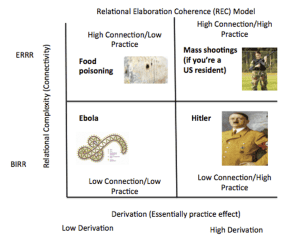
Let’s look at the REC Model of some things that could cause us to feel fear or disgust. This is a functional example. It’s not perfect but let’s hope it gets the job done. Look at the items in the REC Model below and note your emotional response.

Cathey (2016)

What I’m willing to bet is that even though you likely have some very rich sensory experiences (high connectivity) of food poisoning, unless you’ve had one recently you probably didn’t have much of a response to that stimuli. As a US resident, few of us will have a strong visceral response to Ebola as its not connected to most things in our daily worlds. Few of us will have had direct experience with it.

Now here’s the curious part, what was your response to the gun woman? What was your response to Hitler?

If you had a more intense emotional response to Hitler that is understandable based on REC, but few other theories would predict this or allow for testing of it. We could say that we have “habituated” to gun violence. Or, perhaps we’ve now heard so many derivations of this occurring that we can now control the response to it, as it is sunken into the rich networks of other relations.

Hitler, on the other hand. I’m guessing no one reading this met him. Yet you may have felt a lurch of disgust even stronger than the food poisoning picture.

Without RFT and personal experience with this it is difficult to make sense of your response to Hitler, vs food poisoning, vs. mass shootings, vs. Ebola.

Stay with me here. A low complexity network with high derivation is a bit like all the relations flowing through this single point of symbolic ‘evil’.  If he is a single point of relation through which all we know about the Holocaust and those horrors is filtered there is a lot of derivation through repeated understanding but little complexity. For most of us we only have knowledge of these things through history classes, documentaries, etc. This results in a highly derived but not complex network of emotional learning. It lends itself to strong/rigid/somewhat two dimensional responses.

Otherwise it’s a little difficult to explain why we’d have such a strong response to someone none of us have ever met AND yet have a have a much more moderated response to gun violence.


Angela Coreil, PhD, BCBA

Angela Coreil, PhD, BCBA

Clinical Behavior Analyst, Methodologist & Trainer

Angela J. Coreil, PhD, is a professor at the University of Louisiana at Lafayette, clinical behavior analyst, and methodologist. Formerly director of an OCD and anxiety IOP/PHP, she integrates behavior analysis, ACT, Interpersonal Behavior Therapy, CBT, and exposure-based treatment. Her work develops practical improvements in behavioral science, and she provides consultation, professional training, workshops, and continuing education across disciplines.

Views expressed are those of Dr. Coreil or the explicitly named author, not the University of Louisiana at Lafayette.

RFT (Part 1): The Space-time of the Human Universe

RFT (Part 1): The Space-time of the Human Universe

Editor’s Note (2019): This article was originally published on AngelaCathey.com in 2016. It is reproduced here with only minor grammatical edits for readability. Some resources and terminology have evolved since its original publication, but the conceptual discussion is presented largely as it appeared at that time.

I’m going to start this post off by telling you a little secret. I get a little obsessive with ideas. Give me something interesting to think about, and I’m a kid with a Rubik’s cube all over again. When I immersed myself in RFT, I turned that Rubik’s cube so many times I dreamt in RFT. (Yes, I know that’s weird.)

While you’re adjusting to that information, let me show you why I will probably never get tired of playing with this toy. I’m going to show you several metaphorical, philosophical, and sometimes downright fun ways to understand RFT. 

CONSTRUCTS, RELATIONS, AND THE BEAUTY OF THE UNIVERSE

First, let’s loosen your frames a bit and help you ‘connect’ more abstractly. Let’s channel Carl Sagan for a moment and teach RFT through a little astrophysics.

Imagine the Earth and planets swirling about in space. They all have this rhythm and dance to how they move about each other. Imagine now that those planets are constructs (e.g., “psychological flexibility”, “courage”, “love”, “present-moment-focus”, “mindfulness”, “habituation”, “transference”, etc).

Screen Shot 2016-07-06 at 6.40.46 AM

Now looking out on the planets, we are like the astronomers once were. Seeing these celestial bodies in awe but not understanding their rhythms. We can ‘see’ them dancing around each other, but we can’t tell why. Most of our scientific method in psychology is based around this level of mystery. We assume we know very little and that every hypothesis is a bit like glancing in the telescope and hoping we see planets crash together. If we see it, and we haven’t spent all day looking through the telescope, then that’s an important finding! And, because we can’t all watch the whole universe, we each pick a few planets (constructs) to watch intensely.

Now let go of your favorite planets for a moment and zoom back to look at the big picture. See the planets moving on their orbits over the course of time?

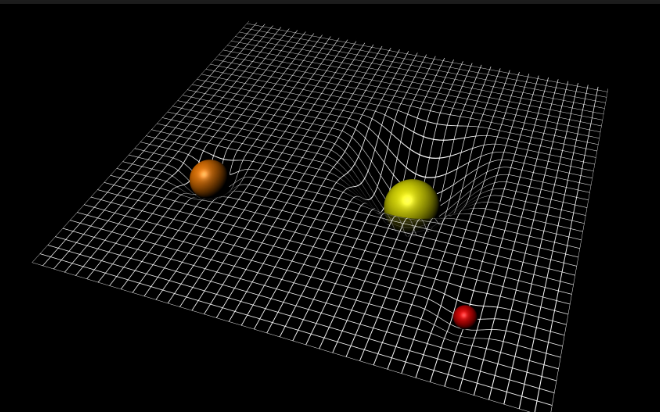
Now drop to a different level of analysis.  In this picture, we see what we scientists later understood about how planets influence each other.

Screen Shot 2016-07-06 at 6.41.44 AM

What we understood that gave us infinite and useful knowledge about space (even beyond the planets we could see) was, as Carl Sagan put it, “gravity is geometry.”

Gravity is a distortion in space-time that forms a kind of net that allows the weight of the planets to pull against each other. This is what gives them their lovely dances in relation to each other.

Screen Shot 2016-07-06 at 6.28.31 AM

RFT, and behavior analysis more broadly, is the gravity beneath our day-to-day behavior. It shows us how the constructs influenced by human verbal/symbolic behavior dance together.

This is ‘true’ in several ways:

Gravity is a very ‘real’ force to be reckoned with, and yet you can’t ‘prove’ it in most contexts. We just trust that it’s there because it is useful to do so. The construct of gravity is a description of relation. It’s a useful explanation in daily life for why it would be stupid to hold the DSM-5 over your foot and drop it. Sure, you could go ask Carl Sagan for the formula and proof, but in the meantime you should probably still move your foot out of the way of the DSM.

In the same way, RFT relations can’t typically be ‘proven’ in the moment. That’s not the point in applied work, though. Like the web you see below the planets, what RFT and behavior analysis more broadly gives us is far more powerful than a view of the actual planets. It gives a way to predict and intervene in nearly anything influenced by human thought. (If that doesn’t inspire awe, go back and read it again.)

Planets collide…

On another level, what it does is let us see the planets in a new light. They are no longer separate planets dancing unpredictably in space. They are a tiny visible piece of the universe dancing an understandable rhythm influenced by the interlocking distortion of space-time that holds them in relation to each other.

And just like this conception of gravity as space-time distortion, understanding RFT and behavior analysis allows us to come up with some amazing ways of understanding our universe.


Angela Coreil, PhD, BCBA

Angela Coreil, PhD, BCBA

Clinical Behavior Analyst, Methodologist & Trainer

Angela J. Coreil, PhD, is a professor at the University of Louisiana at Lafayette, clinical behavior analyst, and methodologist. Formerly director of an OCD and anxiety IOP/PHP, she integrates behavior analysis, ACT, Interpersonal Behavior Therapy, CBT, and exposure-based treatment. Her work develops practical improvements in behavioral science, and she provides consultation, professional training, workshops, and continuing education across disciplines.

Views expressed are those of Dr. Coreil or the explicitly named author, not the University of Louisiana at Lafayette.

Pin It on Pinterest