One of the most confusing things for students entering Clinical Behavior Analysis is that psychologists often seem to disagree about almost everything.
They disagree about diagnoses. They disagree about treatment. They disagree about what should be measured. They even disagree about what counts as good evidence.
It is tempting to think these disagreements arise because people simply have different opinions. More often, however, they begin much earlier. They begin with different assumptions about what science is trying to accomplish.
Steven Hayes described these assumptions in Varieties of Scientific Contextualism (1992), drawing on the work of philosopher Stephen Pepper. Before we can understand why behavior analysts think differently about measurement, treatment, or theory, it helps to understand the philosophical ground on which those decisions are made.
Hayes argues that philosophies of science can be understood as different “world hypotheses.” Each begins with a root metaphor—a basic way of understanding how the world works. That metaphor influences what questions become important, what counts as evidence, and ultimately how scientists decide whether they are making progress.
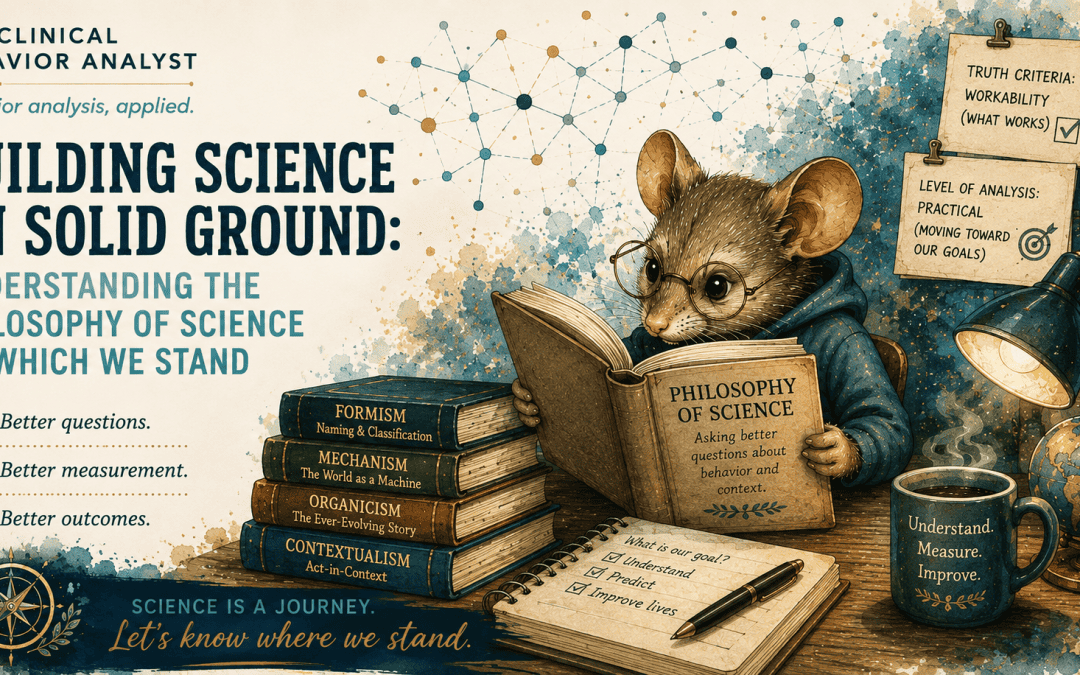
Although there are many philosophical positions, four have been particularly influential in psychology.
The oldest approach is formism. Its root metaphor is similarity or form. The world is understood by identifying things that belong together and giving them names. The scientific task becomes classification. This approach gave us taxonomies, categories, and much of our early scientific thinking. In psychology, it is reflected whenever we ask, “What disorder does this person have?” or “Which category does this behavior belong in?”
Naming is useful. But naming is not the same thing as understanding. Two people may both receive a diagnosis of major depressive disorder while behaving very differently and responding to entirely different interventions. Formism helps us organize observations. It does not necessarily explain why they occur.
Mechanism extends formism. Its metaphor is the machine. If we understand the parts and how they interact, we can explain the system. Truth becomes a matter of correspondence. Our theories are considered better to the extent that they accurately represent how reality actually works. Much of modern medicine follows this approach. Find the broken mechanism. Repair it. Psychology has inherited many mechanistic assumptions as well. We often search for underlying mechanisms, latent variables, or internal systems presumed to generate behavior. Mechanistic methods have produced tremendous advances. Hayes is careful to point out that functional contextualists borrow many of these methods. The danger is not the methods themselves.
The danger is quietly adopting the assumptions that accompany them.
Organicism begins with a different metaphor. The world is viewed as an unfolding story. Events that appear contradictory today may eventually make sense when viewed within a larger developmental narrative. Truth is evaluated by coherence. Does this explanation fit within the broader story? Developmental psychology often leans in this direction. Individual events become meaningful because of the role they play within an evolving system. Again, this perspective offers valuable insights. But it answers a different kind of question.
Contextualism asks a different question altogether. Its root metaphor is the act-in-context. Rather than asking what something is, contextualism asks what it does, under what conditions it occurs, and what difference that understanding allows us to make. The truth criterion becomes successful working, or what Hayes calls workability. Importantly, something can only “work” relative to a stated goal. If our goal is to reduce panic attacks, improve relationships, increase adherence to medical treatment, or help someone live more consistently with their values, then our scientific models are judged by whether they help us move toward those outcomes.
William James is generally considered the father of contextualism; however, Skinner’s work reflected an implicit contextualist philosophy long before these distinctions were discussed explicitly.
Hayes makes an important distinction between two forms of contextualism.
Descriptive contextualism attempts to appreciate the richness of the whole. The goal is understanding. James, Dewey, and Kantor each worked largely within this tradition. Here, coherence remains important because the scientist is attempting to capture the complexity of an event as completely as possible.
Functional contextualism asks a different question. Can this analysis improve our ability to predict and influence behavior? The goal is practical rather than descriptive. Hayes compares this to engineering. Knowing that a bridge will collapse is useful. Knowing how to build one that won’t collapse is far more useful. That shift has enormous implications for psychology.
A functional contextualist is less interested in whether a theory is elegant than whether it increases our ability to predict and influence behavior toward meaningful goals.
This philosophical foundation explains why Clinical Behavior Analysis often approaches familiar problems differently than other traditions. When behavior analysts question diagnoses, latent constructs, or statistical summaries, they are not necessarily rejecting them outright.
They are asking a different question.
What additional predictive or practical value does this way of describing behavior provide?
Sometimes the answer is “quite a lot.” Sometimes the answer is “not much.” That becomes an empirical question rather than a philosophical argument. This perspective also explains why measurement has become such an important issue for our field.
If our goal is to predict and influence behavior, then the quality of our measurement becomes central. As our technologies improve, we are no longer limited to occasional questionnaires or broad diagnostic categories. We can increasingly observe behavior unfolding across time, context, physiology, language, and daily life.
That doesn’t mean our older methods were mistakes. They represented the best measurements we had available. But science progresses by improving observation. Clinical Behavior Analysis, at its best, has always been about improving our ability to understand behavior in context.
Referecnces
Hayes, S. C. (1993). Varieties of Scientific Contextualism. Reno, NV: Context Press.
Pepper, S. C. (1942). World Hypotheses: A Study in Evidence. University of California Press.

Clinical Behavior Analyst, Methodologist & Trainer
Angela J. Coreil, PhD, is a professor at the University of Louisiana at Lafayette, clinical behavior analyst, and methodologist. Formerly director of an OCD and anxiety IOP/PHP, she integrates behavior analysis, ACT, Interpersonal Behavior Therapy, CBT, and exposure-based treatment. Her work develops practical improvements in behavioral science, and she provides consultation, professional training, workshops, and continuing education across disciplines.
Views expressed are those of Dr. Coreil or the explicitly named author, not the University of Louisiana at Lafayette.

Imagine walking into a county fair where the grand prize is about to be awarded for Best Animal. One contestant is an elephant with zebra legs, butterfly wings, peacock feathers, and octopus tentacles. The next is a giraffe with the body of a bear, tiger paws, and the tail of a fish.The judges are having an intense argument.
Which creature is more authentic? Which one has the better anatomy? Which one deserves the blue ribbon for Effective Treatment?
No one stops to ask a more fundamental question.
When did we stop studying animals and start arguing about mythical ones?
Sometimes I wonder whether psychotherapy has wandered into the same county fair.
Every generation of researchers tries to build a better way of understanding human suffering. That’s exactly what science should do. New theories propose new mechanisms. New measures. New therapeutic languages. New ways of organizing behavior.
Over time, though, something subtle happens.
We stop treating those theories as useful maps and begin treating them as though they were different species inhabiting nature.
ACT becomes one animal.
CBT becomes another.
Psychodynamic therapy, DBT, Process-Based Therapy, Unified Protocols—they each develop their own anatomy, their own vocabulary, and their own criteria for what healthy functioning looks like.
Then the debates begin.
One of the most common arguments is that comparing therapies like ACT and CBT is like comparing apples and oranges.
I think we’ve accepted the wrong conclusion.
Apples and oranges are remarkably easy to compare.
We compare them by properties they both possess: acidity, water content, sugar, fiber, weight, shelf life.
What we don’t do is ask whether the orange became a better apple.
Yet that’s surprisingly close to how psychotherapy research often operates.
Each theory develops its own mechanisms.
Its own process measures.
Its own language.
Its own explanations.
Then we ask whether each therapy became a better version of itself.
The more our theories evolve, the stranger the animals become.
New mechanisms are added.
Old concepts are borrowed.
Measures are refined.
Constructs multiply.
Eventually we’re no longer comparing elephants and giraffes.
We’re comparing beautifully assembled mythical creatures built from decades of accumulated assumptions.
Then we race them.
We hand out blue ribbons.
And we argue endlessly about which mythical animal won.
I don’t think this is because psychotherapy research is failing.
I think it’s because our theories have become more sophisticated than the way we measure them.
Karl Popper reminded scientists that observations are never interpreted in isolation. Every scientific test rests on a network of assumptions connecting theory to observation. The challenge is not pretending those assumptions don’t exist; it’s remembering that they’re there.
Perhaps psychotherapy has become so successful at building increasingly sophisticated theories that we’ve started mistaking the theories for the thing they were created to explain.
The thing we were trying to understand was never ACT.
Or CBT.
Or any other named therapy.
It was human behavior.
Maybe the next step in psychotherapy isn’t inventing another mythical animal.
Maybe it’s learning how to measure the behavioral dimensions that all of them have in common.
Because mature sciences don’t advance by becoming more loyal to their taxonomies.
They advance by discovering ways to build knowledge across them.
Clinical Behavior Analyst, Methodologist & Trainer
Angela J. Coreil, PhD, is a professor at the University of Louisiana at Lafayette, clinical behavior analyst, and methodologist. Formerly director of an OCD and anxiety IOP/PHP, she integrates behavior analysis, ACT, Interpersonal Behavior Therapy, CBT, and exposure-based treatment. Her work develops practical improvements in behavioral science, and she provides consultation, professional training, workshops, and continuing education across disciplines.
Views expressed are those of Dr. Coreil or the explicitly named author, not the University of Louisiana at Lafayette.

by Angela Coreil, PhD
Fields Ready for Change: Notes from CalABA 2022
As I sit here today, recalling my experience of CalABA and the responses to talks, including but not limited to my own talk on unifying the sciences, it is clear that change is both needed and wanted. We find ourselves in a world where COVID has altered how we operate in our lives and in our world. We have found ourselves in the ‘Great Resignation’ of people leaving their positions and rethinking their priorities out of necessity.
I too have been on this journey. Long before 2020, I found myself embedded in a system of seemingly unworkable contingencies. This led to several years of inventing and reinventing myself and my career – and finally to freedom from the system that had held me down for a decade. It is from this perspective and with this experience that I find myself advocating for the field to be better, not because I am the right person to do so, but because I built myself a system that allows me to speak up more freely than most.
At CalABA 2022, I was able to speak at my first in-person conference since freeing myself from academia. I found myself re-invigorated by the presence, energy, and curiosity of those who attended my talk: Clinical Behavior Analysis: Unifying the Behavioral Sciences. It was inspiring to see how many people were already thinking about how to find a common language between behavior analysis and psychology and how many people were working in positions where they both needed and wanted more guidance on how to navigate the intersection between our fields.
There were a number of patterns that were evident in the responses of attendees. First, many were unaware that Clinical Behavior Analysis has existed since the 1950s. Second, the pervading thought was that additional degrees would help broach this gap – yet, those with multiple degrees broaching both fields still had the same questions. “Which hat am I operating under?”, “How do I know if I am still in scope?”, “Where does ‘ACT’ begin and end in relation to RFT and to the clinical situation I find myself in on a daily basis?” Many were struggling with how to speak to colleagues and stakeholders about the areas where our fields meet and divide. And, as I presented regarding the bubble forming as more behavior analysts enter the field and nearly all enter the Autism treatment area – there was recognition of how this affects the perception of behavior analysis, drives the narrowing of treatment programs, and ultimately will leave behavior analysts vulnerable to changes that are not under their control (e.g., changes in the DSM, etc).
Sign up for our mailing list or check out our continuing education if you’d like to learn more about clinical behavior analysis or rule-governed behavior!
Clinical Behavior Analyst, Methodologist & Trainer
Angela J. Coreil, PhD, is a professor at the University of Louisiana at Lafayette, clinical behavior analyst, and methodologist. Formerly director of an OCD and anxiety IOP/PHP, she integrates behavior analysis, ACT, Interpersonal Behavior Therapy, CBT, and exposure-based treatment. Her work develops practical improvements in behavioral science, and she provides consultation, professional training, workshops, and continuing education across disciplines.
Views expressed are those of Dr. Coreil or the explicitly named author, not the University of Louisiana at Lafayette.