
Editor’s Note (2026): This article was originally published on AngelaCathey.com in 2016. It is reproduced here with only minor grammatical edits for readability. Some resources and terminology have evolved since its original publication, but the conceptual discussion is presented largely as it appeared at that time.
UNDERSTANDING PROPERTIES OF RFT: The signal in noise of human behavior
Now that we’ve talked about space-time distortion, let’s blow your mind a bit more by learning to understand the properties of RFT.
You’ve all seen the diagrams explaining how the letters in the word “cat” = a picture of a cat = the sound of “cat” spoken. You may have also seen the complex ‘algebra’ that formulaically explains properties of RFT like transformation of stimulus function.
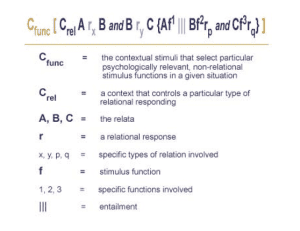
See: https://contextualscience.org/transformation_of_stimulus_functions
Yikes! So, that formula is sheer genius but not particularly functional for people who don’t already understand RFT. Explaining RFT in these terms to those who are learning is a bit like explaining gravity as a formula. In some way it is ‘true,’ but if you want someone to understand the meaning of gravity, you’re better off dropping the DSM on their foot.
Let’s understand the meaning of RFT at a deeper, more experiential level.
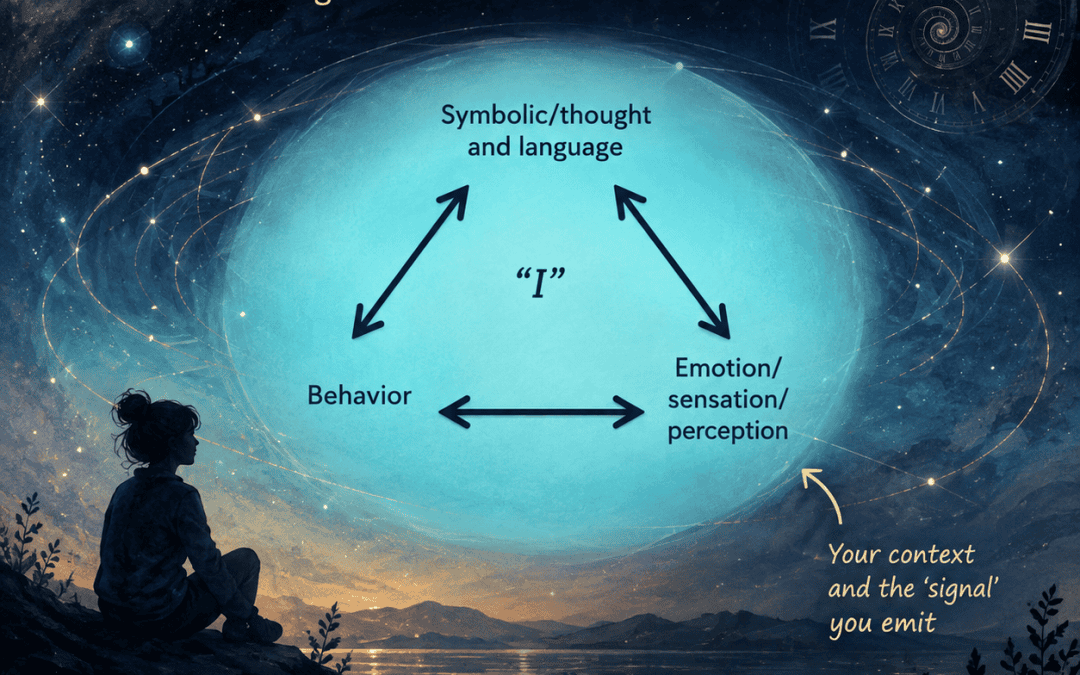
RFT explains the inter-relations of different elements of our behavior and context.
 Diagram: Cathey (2016)
This is a diagram showing how the properties of RFT and operant/classical conditioning tell us that our behaviors are interrelated.
It’s not perfect. Anyone can tell you these aren’t entirely separate.
Our experience is actually much more like this.
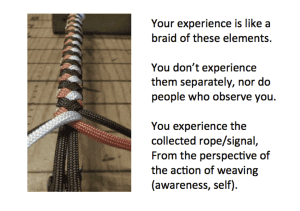
Picture: indulgy.com
Let’s dig a little deeper…

So, in some way we are this relational signal that we experience as a whole, which isn’t entirely separate from our experience of our external context (blurry line). What we perceive in the world is viewed through our internal context (if you’re inside that bubble looking out, everything will be tinted blue). This is why we can all react in different ways to the ‘same’ ‘external’ stimuli and why we may act differently in different contexts. All is through the filter of our experience and through relation, after we become old enough to have a symbolic world. This symbolic world is, in some respect verbal but more importantly highly symbolic. Words/language are one important network that forms the scaffolding of our internal experience, and which we can somewhat efficiently use to show others our world.
That ‘sticky’ scaffolding gives words power.
So, RFT is not just a theory of language. It is a theory of symbolism.
‘Anything can become anything’ because it is nearly all symbolic at some level.
Sensation, perception, visual stimuli, auditory stimuli, words, actions, are all a symbolic soup of experience, and your own relational history makes some of those cues more salient than others.
For example, listen to just a second of this music. Close your eyes. Notice the feelings and thoughts.
Now, what you all experienced was the same stimulus, but how it affected you is through relation, in a very deep way.
My experience is not yours, in great part, because of my distinct relational history with this stimulus.
For me, that song is chills, tears in my eyes, the taste of a tequila shot (hey… I was nervous that day), and a visual of walking down the aisle. It will never again be separate from those moments. BECAUSE of the RELATIONS it obtained when I chose it for that defining moment.
For you, maybe it was just squeaky violin music or something pretty. This is RFT. The song had no words and yet it is still symbolic and influenced by what I say. Now, if you meet me, you will have the words above as a scaffolding between our worlds.
As you read them you were likely able, in some part, to experience part of my experience but even still through your relational history. For those of you who know me, the experience of learning this information might have been more intense if I’m close to you or if you experience me as like you. This is predictable based on RFT: a frame of coordination (she is like me) or (I like her) will increase your experience of my description. A frame of distinction (I am not like her) or (this is crap, etc.) will decrease the intensity of the experience (transformation of stimulus functions) evoked by reading my experience.

Cathey (2016)
Thus our experiences are tinted, amplified, and de-amplified by the frames in which we hold ourselves, those we are exposed to, and many other contextual variables that influence our experience.
Isn’t it lovely? We are all connected, through relation. (Imagine: You can totally win 6 degrees to Kevin Bacon now. 😉

Media: www.mangowed.com
Further, your actual perceptual, emotional, behavioral, and verbal experience is predicable based on RFT and the significance or depth of the learning you have related to the the stimuli (REC Model; Hughes, Barnes-Holmes, Vahey, 2012; Barnes-Holmes, Barnes-Holmes, Stewart, & Boles (2010)).
So, let’s switch frames a bit to get ready for clinical/social applications:
Let’s look at the REC Model of some things that could cause us to feel fear or disgust. This is a functional example. It’s not perfect but let’s hope it gets the job done. Look at the items in the REC Model below and note your emotional response.
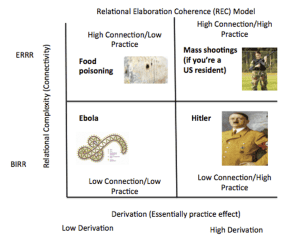
Cathey (2016)
What I’m willing to bet is that even though you likely have some very rich sensory experiences (high connectivity) of food poisoning, unless you’ve had one recently you probably didn’t have much of a response to that stimuli. As a US resident, few of us will have a strong visceral response to Ebola as its not connected to most things in our daily worlds. Few of us will have had direct experience with it.
Now here’s the curious part, what was your response to the gun woman? What was your response to Hitler?
If you had a more intense emotional response to Hitler that is understandable based on REC, but few other theories would predict this or allow for testing of it. We could say that we have “habituated” to gun violence. Or, perhaps we’ve now heard so many derivations of this occurring that we can now control the response to it, as it is sunken into the rich networks of other relations.
Hitler, on the other hand. I’m guessing no one reading this met him. Yet you may have felt a lurch of disgust even stronger than the food poisoning picture.
Without RFT and personal experience with this it is difficult to make sense of your response to Hitler, vs food poisoning, vs. mass shootings, vs. Ebola.
Stay with me here. A low complexity network with high derivation is a bit like all the relations flowing through this single point of symbolic ‘evil’. If he is a single point of relation through which all we know about the Holocaust and those horrors is filtered there is a lot of derivation through repeated understanding but little complexity. For most of us we only have knowledge of these things through history classes, documentaries, etc. This results in a highly derived but not complex network of emotional learning. It lends itself to strong/rigid/somewhat two dimensional responses.
Otherwise it’s a little difficult to explain why we’d have such a strong response to someone none of us have ever met AND yet have a have a much more moderated response to gun violence.

Angela Coreil, PhD, BCBA
Clinical Behavior Analyst, Methodologist & Trainer
Angela J. Coreil, PhD, is a professor at the University of Louisiana at Lafayette, clinical behavior analyst, and methodologist. Formerly director of an OCD and anxiety IOP/PHP, she integrates behavior analysis, ACT, Interpersonal Behavior Therapy, CBT, and exposure-based treatment. Her work develops practical improvements in behavioral science, and she provides consultation, professional training, workshops, and continuing education across disciplines.
Views expressed are those of Dr. Coreil or the explicitly named author, not the University of Louisiana at Lafayette.