Functional Relational Analysis: RFT infused functional analysis
Editor’s Note (2026): This article was originally published on AngelaCathey.com in 2016. It is reproduced here with only minor grammatical edits for readability. Some resources and terminology have evolved since its original publication, but the conceptual discussion is presented largely as it appeared at that time.
Here’s an outline for today’s post:
1. Functional Analysis (FA) our most powerful and under-utilized tool.
2. What RFT can offer to FA.
3. General guidelines for bringing RFT-FA into the room via integration with the 5 Rules of FAP.
4. A few groups of relations described functionally
5. What RFT-guided FA could do for our ability to assess the effectiveness of functionally oriented treatments (e.g., FAP).
RFT has a lot to offer for the applicability, precision, and utility of Functional Analysis.
Functional Analysis is one of our most powerful therapeutic frameworks in behaviorism (underlying most of our orientations), yet it has fallen out of use in the clinical environment.
Why? Because:
1) We are generally not in the client’s environment to see the variables controlling their behavior.
2) People are exceedingly bad at understanding/describing the variables that control their own behavior (see above on seeing everything through your own relational history and Measurement: Why we get no R.E.S.P.E.C.T., which explains how CBS has tried to deal with issues of measurement in relation to behavior).
3.) And, in the therapy hour, what you can do with FA is often to teach the client how to recognize (and hopefully influence) their own behavior or contexts, outside the therapy environment. Then you hope for the best.
So, let’s consider FA and what RFT-informed Functional Analysis has to offer clinicians:
First, by gaining experiential knowledge of RFT/REC, we get a much better picture of what variables may be controlling the client’s behavior, in the room and in their lives.
Second, we get a much better picture of how to intervene effectively by being able to test our hypotheses (often per session) by altering the variables in the room (in the present moment) and paying attention to the client’s response, our experience, and other contextual variables.
Thus, with RFT/REC we can go a long way to restoring our ability to use functional analysis during the therapeutic hour. (Not to mention getting more of the warm fuzzy feeling you get when you realize you’re doing something that’s ‘working’ for the client.)
So, let’s talk about how we can begin to use RFT in Functional Analysis. I’ll present some general guidelines and then discuss the how and why of these.
You’ll also notice that this is going to map right onto the “5 Rules” of Functional Analytic Psychotherapy. (Addition, 2026 note – I am speaking about the models of Functional Analytic Psychotherapy that were deeply behavioral and not the “Awareness, Courage, and Love” ACL model here.)
This is purposeful, as in my experience: 1) FAP is already one of the models that purposely trains you to bring FA into the present moment and look at behavior functionally, rather than topographically, and all we’re really doing here is adding knowledge of how the properties of symbolic relating also get tied into all the other ‘behaviors’ you see.
Note: This isn’t meant to substitute for or be better than learning RFT in other forms. If you want a full, more advanced understanding of RFT, I would recommend starting with Villatte, Villatte, and Hayes’ Mastering the Clinical Conversation or Matt Villatte’s online course on RFT through Practice Ground. Much of what I say here is an entry point to what these resources and others (such as Hayes’ Rule-governed Behavior) may teach you.
1. First, and above all else, listen to the client’s experience. (Rule 1: Watch for CRB1s AND watch for the general pattern of behavior (verbally and ‘non-verbally ‘) around important relations.)
2. Look for rule-governed behavior and rules. (If you’re in a stuck spot and feel like you’re bumping your head against the wall, it’s highly likely that either you and/or the client are responding to a ‘rule’.) This is Rule 1 again, but rule-governed behavior is such a big factor in the breakdown of communication I feel it stands repeating.
3. Understand what the HOW of the behavior tells you. (Again, Rule 1 in FAP but extended to understanding, using RFT, the function and properties of the symbolic relations that show up in the room.)
4. Start altering the context in the room, in the moment, with your hypotheses and noting the client’s HOW of response. (This is Rule 2, Evoke, from the FAP model, except evoke is also extended to using RFT to evoke verbal relations and understand the client’s response.)
5. Relate (functionally). (This is Rule 3, Reinforce, from the FAP model, except when you bring RFT into the mix, you begin to see how many more ways you can affect the client’s relating to you, themselves, the world, their pain, etc right there in the moment. This may sound a bit foreign, but I almost promise you that you’re already doing some form of it. If you’re an ACT clinician and the client is fused. then you get them to defuse. Congrats! You just moved a relation! Except RFT has far more to offer than defusion. Some of which I’ll describe below.)
6. Note your impact on relations as well as other behavior (Rule 4, Notice your impact except extended to noticing your impact on relations and their properties as well as other behavior).
7. Provide functional interpretations (Rule 5, in FAP) except that I would say that ‘functional’ may also need to be seen from an RFT perspective. Sometimes it’s helpful to provide direct feedback about the relations you perceive, but we also know that humans like simplicity a bit too much. Careful with providing interpretations that may easily be turned into rules (and rule-based insensitivity), so tread lightly and experientially here.
Included in this, but discussed less, is an assumption of general knowledge regarding Functional Analysis and Functional Assessment. For readers who want a review of this, start here: Iwata & Dozier, 2008; Gareth Holman’s Intro to FA on Practice Ground; and for mapping out your effect for research (or warm fuzzies), begin with Koerner and Holman’s 2014 Single-case designs in clinical practice.
It’s good to have a general awareness of how the character of the behavior (e.g., approach/repeat may indicate presence of reinforcing qualities) may indicate relations. Then in the FA you learn the problematic relation only through noticing what moves the relation in a more adaptive direction (functionally determined).
How do you know what’s adaptive? I like Villatte, Villatte, and Hayes’ Mastering the Clinical Conversation overall framework.
That is, the overall goals of treatment are:
1. Helping the client develop flexible context sensitivity and functional coherence (read awareness when it’s adaptive and an overall system of relating that ‘works’ for the client).
The overall means of treatment are:
1. Transforming symbolic functions by altering context (read influencing relations and their properties by any of your symbolic behavior in the room with the client, etc.)
So, in doing a Functional Relational Analysis, we’re doing an in-the-moment analysis to increase adaptive relating as defined by Villatte, Villatte, and Hayes in the manner in which we influence relating with the 5 Rules in FAP (you following me?)
So, now about the business of recognizing relations that can be influenced in your RFT-FA. First, let’s begin by making things a bit simpler: some relations that frequently come up and affect treatment in the moment.
1. Rule-governed behavior – consider this a kind of fusion that, in whatever form, usually results in an inability to contact important contingencies at hand.
Example(s): “Jimmy is always anxious.” vs “Jimmy is anxious.” vs. “Jimmy sometimes gets anxious.” Inherent in these statements is a rule. Though you’d need ideographic context, they may likely indicate different levels of fusion with the rule. The intensity/rigidity and lack of noticing other contingencies may give you a good idea about how fused the speaker is to the rule and how unaware they may be when Jimmy acts in ways that are non-anxious (see later post on discrimination/stigma/violence towards others). Keep in mind that almost any kind of relation can be rule-ified into inflexibility over time, repetition, etc.
2. How to influence it: Defusion, context changes of many sorts (emotion, experientially walking through the contingencies that allow the person to note what was previously missed, etc.
3. How to assess your impact: Is the person now loosening in their behavior guided by the rule? Is their language around the rule more flexible?
2. Influencing awareness towards whole or parts – here I’m talking about several relations in combination functionally. We often use distinction framing (this but not that), combination (this and this), opposition (this is the opposite of that) to bring more awareness to the parts and pieces.
Examples(s): Hierarchicals and moving towards seeing the self or experience as a part of the continuing experience. “I am this feeling, this moment” versus “I am more than my experience.”
How to influence it: Mindfulness, either noticing continuity, wholeness, or otherwise noticing detail.
How to assess your impact: Do they seem (verbally or otherwise) more aware of the direction needed to note important contingencies? Other relations can also be added in, but let’s focus on these for now.
What can elements of an RFT allow us to fine-grain and repeated attempts to change relating of several types each session?
We can aim for more or less flexibility, more or less awareness of certain contingencies, and more adaptive stories about the “self” and its experience. This can allow several dimensions for FA beyond what is normally present.
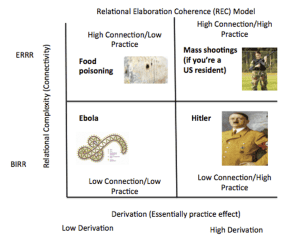
Add the REC Model, and you can evaluate behavior based on its complexity and derivation (allowing you to see whether you need to increase the variety and complexity of learning experiences to make it stable and adaptive).
Further elaborating on this kind of workup could help us more effectively assess some of the benefits of functionally oriented treatments.
Essentially, mapping out change in other relations would add further assess change.
For example, we know that one of the mechanisms responsible for the effectiveness of FAP is likely to be contingent reinforcement (see Kanter, Landes, Busch, Rusch, Brown, Baruch, and Holman 2006 Effect of contingent reinforcement) and that systems can be derived for measuring change based on this functional target (see Callaghan 2001 FIAT Functional Ideographic Assessment Template).
With RFT, everything can be parsed relationally in some respect (every treatment, nearly every behavior, diagnosis, etc.). This, in combination with other FA relations (e.g., reinforcement), can allow us to examine change across therapies, diagnoses, contexts, etc. Further, noticing the change in relation in verbal behavior gives us many more opportunities for altering and assessing our impact each session.
If you’re thinking that assessment and coding of verbal relations would take years, wait for the posts on Natural Language Processing, Machine Learning, and sensor-based experience sampling.
References
Iwata, B. A., & Dozier, C. L. (2008). Clinical application of functional analysis methodology. Behavior Analysis in Practice, 1(1), 3–9.
Callaghan, G. M. (2001). Functional Ideographic Assessment Template (FIAT) System. Reno, NV: Context Press.
Hayes, S. C. (Ed.). (1989). Rule-Governed Behavior: Cognition, Contingencies, and Instructional Control. New York: Plenum Press.
Kanter, J. W., Landes, S. J., Busch, A. M., Rusch, L. C., Brown, K. R., Baruch, D. E., & Holman, G. I. (2006). The effect of contingent reinforcement on target variables in outpatient psychotherapy for depression: An investigation of Functional Analytic Psychotherapy. Journal of Applied Behavior Analysis, 39(4), 463–467. https://doi.org/10.1901/jaba.2006.21-06
Koerner, K., & Holman, G. I. (2014). Single-case designs in clinical practice. In The Wiley Handbook of Contextual Behavioral Science.
Villatte, M., Villatte, J. L., & Hayes, S. C. (2016). Mastering the Clinical Conversation: Language as Intervention. New York, NY: Guilford Press.

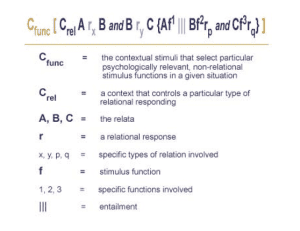
 Diagram: Cathey (2016)