




Select Page
Kafka Finds His Rage (Against the Machine): Using Hierarchicals to Pull Yourself Up

Kafka Finds His Rage (Against the Machine): Using Hierarchicals to Pull Yourself Up

Parts of my life have been a little too much like a Chuck Palahniuk novel: chaotic, painful, and governed by the reliable presence of unreliability. Chaos breeds a different kind of attention—if you survive it.

What I have found is that surviving a painful context over time requires more than gritting your teeth. At some point, you have to find a reason for the pain. You have to connect the miserable, repetitive thing you are doing today to something larger than today.

You have to contact the hierarchical.

In relational frame theory, a hierarchical relation organizes one event as belonging to or being part of something larger: *this action is part of that goal; this goal is part of that value; this moment is part of the life I am trying to build*. Hierarchical framing does not merely describe what matters. It can transform the psychological function of an action. Something difficult may become more tolerable—or even reinforcing—when it is experienced as contributing to something deeply important.

Villatte, Villatte, and Hayes describe this as building meaning through networks of relations. We can ask:

If you continued doing it, what larger direction would it serve?
What could you do today that would be part of that direction?

These are not questions about discovering a magical object called a “value” hidden inside you. They are ways of arranging relations among actions, consequences, goals, and larger patterns of living. The clinical—and personal—question is whether arranging those relations changes what you do.

That is why I am not talking about “using RFT” as though RFT were a therapeutic technique. RFT is a behavioral account of human language and cognition. What I am describing is a functional relational analysis: examining how a person’s learned relational responding changes the functions of experiences and influences behavior, then deliberately using those relations to help move behavior in a useful direction.

In plain language: Is there a piece of what you’re doing that connects to higher meaning for you?

Maslow Was Not Entirely Wrong

Maslow’s hierarchy contains an important truth. Food, sleep, and safety matter. Connection matters. It is considerably harder to contemplate your grand contribution to humanity when you are hungry, terrified, or trying to keep the electricity on. Harder, but not impossible, and sometimes – it’s just the thing that helps you rise.

Material stability expands the range of behavior available to us. Suffering isn’t an inspirational slogan. And finding “meaning” doesn’t excuse conditions that are dangerous, exploitative, or unjust. Sometimes the most functional response to pain is to leave, resist, seek help, or change the environment that produces it.

But the popular pyramid leaves something out: people do not always wait for stability before reaching toward meaning. In fact, Viktor Frankl spoke about this widely – sometimes meaning is what gets you through the pain.

Gandhi did not wait for comfort before organizing his behavior around a larger purpose. Martin Luther King Jr. did not first achieve a safe and pleasant life before confronting injustice. Kashdan (2022) describes this kind of principled insubordination as dissent directed toward improving an unhealthy status quo—not rebellion for its own sake. Effective dissent requires willingness to experience discomfort, but also the flexibility and skill to make that discomfort serve meaningful change.

The opposition these leaders encountered did not necessarily weaken the relational networks organizing their actions. At times, opposition may have strengthened those networks: “This resistance is evidence that the work matters. This suffering is part of the struggle. This action contributes to freedom.”

Contacting the Hierarchical

There are mornings when the immediate consequences of getting up are not enough. The work is exhausting. The daily details are tedious. The context continues to hurt.

If all I contact is the drudgery, the drudgery wins.

For me, public speaking is part of challenging how people understand behavior. Challenging those ideas is part of making change possible.

The lower-level action participates in a larger relational network, and its function changes when that network becomes psychologically present.

For me, music sometimes brings that network into the room.

Before an important talk, I may listen to Rage Against the Machine or Nine Inch Nails. I am not looking for “calm” in those moments. I am contacting the fire inside. Raising up my lighter and getting ready for the mosh pit.

Someone has to speak about change before change can happen. If I want it to happen, then I’ve got to be out there to do it. Contacting the music helps transform nervous activation from a signal to retreat into energy… the kind of energy that says, “Let’s all get in that pit and dance until we change something that matters.”

That is functional only if it actually improves the behavior that matters.

If the music leaves me so angry that I become rigid, hostile, or incapable of responding, then it’s helping me move right, and I adjust.

Meaning Can Keep You Alive—and Make You Numb

Contact with something larger can carry a person through serious pain. It can lift behavior out of the immediate grind and place it in the service of a longer trajectory.

That capacity is powerful. It is also dangerous.

When suffering is relationally tied to a cherished value, we may tolerate conditions that should be changed. We may become less responsive to pain that is providing important information. We may remain in destructive workplaces, relationships, movements, or personal projects because leaving then feels like weakness, betrayal, or failure.

Todd Kashdan has written about the perils of grit: relentless persistence can produce collateral damage when people continue despite evidence that their strategy is harming them. Persistence is not inherently virtuous. Neither is willingness to experience pain.

Adequately tracking whether our behavior moves us to our goals requires something more discriminating. Kashdan and Rottenberg define it in terms of adapting to situational demands, shifting perspectives or behavior when strategies undermine functioning, balancing competing life domains, and remaining able to act in accordance with important values (Kashdan & Rottenberg, 2010).

Sometimes flexibility means staying. Sometimes it means stopping. Sometimes the courageous act is walking onto the stage. Sometimes it is admitting that the stage is burning and getting everyone out of the building.

An Exercise: Build the Hierarchical, Then Touch It

Choose a piece of music, art, literature, or another experience that helps you contact something larger than your immediate discomfort.

Do not stop at “This inspires me.” Work through your experience to feel the important relations moving.

1. Identify the behavior.

Name one observable action you are having difficulty doing. Not “be courageous.” Try “submit the application,” “make the phone call,” “write for 20 minutes,” or “state my position during the meeting.”

2. Build upward.

Ask yourself:

What is this action moves me toward that matters to me?
Why does that contribution matter?

And let me tell you, sometimes – what you contact doesn’t sound ‘adaptive,’ but if it moves you – it might be. Before Rage Against the Machine got me to harness stage energy, it got me through a clinical training experience where I was what you would call a neuropsych scoring ‘workhorse.’ In those hours of scoring assessments on my own time, Rage Against the Machine was all about not letting ‘The Man’ take me down.)

But I digress; continue until you feel what matters, whether it be creating, protecting, learning, telling the truth, caring for others, or challenging injustice.

3. Build downward.

Ask:

If this larger direction matters, what actions could be part of it?
(Do you need to score an insane amount of assessments to just get past this hurdle – to get what you want?)

4. Use the art deliberately.

Listen, read, or look. Notice what memories, sensations, images, and verbal relations become present. Then perform the target action.

5. Track the effect.

If you did contact a hierarchical, you might feel less sensitive to pain and better able to move. Did it improve persistence, clarity, compassion, or responsiveness? Or did it produce the other effects of rule-governed behavior – the rigidity, numbing, aggression, exhaustion, or continued exposure to unnecessary harm?

Meaning Is a Functional Question

I still love Kafka, Dostoevsky, Dante, Camus, and Palahniuk. Metaphor (and art, by nature) can help us contact experiences that direct explanation cannot reach. But I no longer want only a beautiful description of the rock I am pushing uphill.

I want to know what the metaphor does.

Does it expand my behavior? Does it connect today’s action to something worth building? Does it help me notice when persistence is effective and when I need another response? Or does it become a coherent, elegant blindfold?

A rule that blocks sensitivity to consequences is dangerous. An entire network of such rules can make blindness feel meaningful. So yes, find the reason for the pain. Build the hierarchical, contact those properties that make the action easier and worthwhile…

Then keep your eyes open.

I’d love to hear about the things that help you contact your hierarchicals in the comments, if you feel comfortable.

References and Further Reading

Kashdan, T. B. (2017, April 13). How I learned about the perils of grit. Psychology Today.

Kashdan, T. B. (2022). The art of insubordination: How to dissent and defy effectively. Avery.

Kashdan, T. B. (n.d.). Psychological flexibility: Your new secret weapon for resilience.
Kashdan, T. B., & Rottenberg, J. (2010). Psychological flexibility as a fundamental aspect of health. Clinical Psychology Review, 30(7), 865–878.

Tay, L., & Diener, E. (2011). Needs and subjective well-being around the world. Journal of Personality and Social Psychology, 101(2), 354–365.

Villatte, M., Villatte, J. L., & Hayes, S. C. (2016). Mastering the clinical conversation: Language as intervention. Guilford Press.

Every Therapy Trains a Different Pair of Eyes: Why the languaging of training matters

Every Therapy Trains a Different Pair of Eyes: Why the languaging of training matters

​Imagine handing three clinicians the same therapy session. One was trained in ACT, one in Beckian CBT, and one in psychodynamic object relations.

Now stop the video every thirty seconds and ask a simple question.

“What did you notice?”

I doubt you’d get the same answers. The ACT therapist might notice experiential avoidance. The CBT therapist might notice a core belief. The psychodynamic clinician may notice a pattern in how the client talks about important others.

We often talk about therapy as the thing helping clients, but it’s not. ‘Therapy’ isn’t a thing in the room. It’s a therapist trained by someone, hopefully, to skillfully notice and shape behavior.

Therapy first changes the therapist’s behavior. We shape a new clinician’s behavior with feedback through supervision and consultation. We read books in our therapeutic orientations. We attend workshops. We read literature.

Training isn’t simply the transfer of knowledge. It’s the shaping of a repertoire. It teaches clinicians what to attend to and what to ignore. It suggests what the clinician should do to change behavior and when the clinician should do it.

Every therapy model is, in part, a language for organizing experience. Contextual behavioral scientists understand this better than most. We spend our careers studying how language changes what clients notice, feel, avoid, and pursue.

Why would therapists be any different? A therapist trained in ACT doesn’t simply know different terminology. They may literally perceive different functional relations because their training has altered what stimuli acquire discriminative control.

My experience tells me that one way of seeing will never be ‘correct’ all the time. That different languaging repertoires make us skilled and weak in different areas. My experience tells me that most skilled clinicians know something of value, and if I just learn to see what they see, I might grow.

The point is that every language highlights some relations while making others easier to overlook. That raises a question I rarely see asked in psychotherapy research.

What clinician repertoire did the training actually produce?

I want to see studies that examine this – in a real way – not assuming that there won’t be drawbacks to every language. I want to see an honest look at how each therapy language shapes different skills and what those work best for. I am flat tired of seeing Randomized Controlled Trials (RCTs) where someone is deemed to be ‘doing’ ACT or CBT because these are not ‘things’; these are repertoires of interacting with clients.

If you’re not sure what I mean, most RCTs rely on inter-rater reliability to fairly shallow topography associated with the particular treatment model. Now, whether ACT moves rule-governed behavior or ‘psychological flexibility’ – any clinician worth their salt can tell you that ACT is not saying “psychological flexibility” in sessions. Below you can see a more typical ACT vs CBT inter-rater reliability assessment in the McGrath (2012) manuscript. In Plumb and Vilardaga (2010), we have a deeper attempt at trying to assess competence and adherence. 

For citations of interest, see: 

McGrath, K. B. (2012). Validation of the Drexel University ACT/tCBT adherence and competence rating scale: Revised for use in a clinical population [Doctoral dissertation, Drexel University]. https://doi.org/10.17918/etd-3803

Plumb, J. C., & Vilardaga, R. (2010). Assessing treatment integrity in acceptance and commitment therapy: Strategies and suggestions. International Journal of Behavioral Consultation and Therapy, 6(3), 263–295. https://doi.org/10.1037/h0100912

Angela Coreil, PhD, BCBA

Angela Coreil, PhD, BCBA

Clinical Behavior Analyst, Methodologist & Trainer

Angela J. Coreil, PhD, is a professor at the University of Louisiana at Lafayette, clinical behavior analyst, and methodologist. Formerly director of an OCD and anxiety IOP/PHP, she integrates behavior analysis, ACT, Interpersonal Behavior Therapy, CBT, and exposure-based treatment. Her work develops practical improvements in behavioral science, and she provides consultation, professional training, workshops, and continuing education across disciplines.

Views expressed are those of Dr. Coreil or the explicitly named author, not the University of Louisiana at Lafayette.

Where to go to study Clinical Behavior Analysis: Programs and advisors with CBA leanings

Where to go to study Clinical Behavior Analysis: Programs and advisors with CBA leanings

As I’ve met with people interested in CBA over the years, I’ve realized that those interested are often in need of direct advice. Vague guidelines suggesting types of programs or places to work leave people confused. So, here are some direct suggestions about where you might go to study Clinical Behavior Analysis. This is by nature an incomplete listing. Likewise, if I list a program or person here would like their information removed, feel free to contact me or comment on the post.


University of Louisiana at Lafayette

M.S. in Psychology

The University of Louisiana at Lafayette offers a research-intensive master’s degree that I would describe as a doctoral launch program rather than a terminal clinical degree. We do have some students who have successfully applied for Licensed Psychological Associate (LPA) status in Louisiana after completion of the program. Of note, the Licensed Psychological Associate (LPA) designation in Louisiana is new, and criteria for licensure are still evolving. Students at UL’s master’s program complete rigorous training in psychological science, research methods, and statistics while preparing for competitive doctoral programs. This program is best suited for students actively planning to take what they learn about Clinical Behavior Analysis on into a Clinical Psychology, Counseling Psychology, Behavior Analysis, Human Factors, or related behavioral sciences degree.

Students interested in Clinical Behavior Analysis currently have opportunities to work with two laboratories emphasizing contextual behavioral science from complementary perspectives.

THRIVE Lab
University of Louisiana at Lafayette
Director: Angela Coreil

Dr. Coreil focuses on developing new methods for measuring clinically meaningful behavior while integrating behavior analysis, contextual behavioral science, and emerging computational technologies. I welcome research collaborators worldwide; if our interests align, contact me.

The Contextual Behavioral Science Lab
University of Louisiana at Lafayette
Director: Emily Sandoz

Dr. Emily Sandoz’s laboratory focuses on Acceptance and Commitment Therapy, contextual behavioral science, clinical intervention, and translational research. Students receive mentorship in both basic and applied contextual behavioral science while working within one of the longest-established ACT research programs. Dr. Sandoz is widely known for the ability to move back and forth from clinical application to deep technical explanation. Please note that Dr. Sandoz’s lab and my own are entirely independent labs. Please contact Dr. Sandoz directly if you’re primarily interested in her work.

University of Nevada, Reno

For many behavior analysts, the University of Nevada, Reno has long been considered one of the historical centers of Clinical Behavior Analysis, Relational Frame Theory, and Contextual Behavioral Science.

Its behavior analysis program helped launch much of the work surrounding ACT and RFT and continues to provide graduate training grounded in behavior analysis while encouraging translational work bridging laboratory science and clinical practice.

Linda Hayes deserves particular recognition for helping establish one of the strongest graduate behavior analysis training environments in the United States while making foundational contributions to philosophy of science, graduate education, and behavior analysis.

Luisa Cañon, PsyD, BCBA-D, is a lecturer and graduate faculty member in UNR’s online and satellite behavior-analysis programs. She is both a licensed clinical psychologist and a clinical behavior analyst. Her broader work includes clinical behavior analysis, interbehaviorism, cultural responsiveness, trauma, and psychological flexibility.

Contextual Behavioural Science Laboratory
University College Dublin (Ireland)

Director: Louise McHugh

The Contextual Behavioural Science Laboratory at University College Dublin is one of the world’s leading centers for Relational Frame Theory and Clinical Behavior Analysis research. The laboratory explicitly bridges basic behavioral science and applied clinical work, with research examining the development of the self, perspective taking, psychological flexibility, stigma, chronic health conditions, smoking cessation, and other clinical applications of CBS.

University of Edinburgh (Scotland)
Clinical & Health Psychology
David Gillanders

David Gillanders has played a major role in integrating Contextual Behavioral Science into mainstream clinical psychology. His research program focuses on Acceptance and Commitment Therapy, behavioral process measurement, supervision, chronic health conditions, and translating contextual behavioral science into routine clinical practice. Students interested in combining clinical psychology with rigorous process-based behavioral research should strongly consider his laboratory and training program. On a more personal note, David Gillanders is rather famous for his ability to so fluidly talk and sing about Relational Frame Theory (RFT) that, if memory serves me right… he may have won the ACBS follies one year.

Eastern Michigan University
Behavior Analysis Research Laboratory
Director: Adam Briggs

Dr. Adam Briggs directs the Behavior Analysis Research Laboratory at Eastern Michigan University. His laboratory emphasizes translational behavior analysis, functional assessment, treatment durability, relapse, caregiver training, and generalization. For students seeking rigorous training grounded in applied behavior analysis while maintaining strong connections to clinically relevant behavioral research, this laboratory represents an excellent option.

Clinical Psychology Program 
Western Michigan University
Scott T. Gaynor, PhD

Dr. Gaynor is a Professor of Psychology and Co-Director of Clinical Training in Western Michigan University’s APA-accredited Clinical Psychology doctoral program. His laboratory is grounded in the scientist-practitioner model, emphasizing both rigorous empirical research and clinically meaningful intervention.

The laboratory’s research focuses on psychotherapy process and outcome, with particular emphasis on contemporary behavioral therapies. Current projects examine behavioral interventions with children, adolescents, and adults while attempting to understand not only whether treatments work, but also why they work and the behavioral processes responsible for change.

For students seeking doctoral training that explicitly integrates behavior analysis with clinical psychology, Western Michigan remains one of the few programs where Clinical Behavior Analysis is a main focus of study and the program leads to doctoral-level licensure.


Angela Coreil, PhD, BCBA

Angela Coreil, PhD, BCBA

Clinical Behavior Analyst, Methodologist & Trainer

Angela J. Coreil, PhD, is a professor at the University of Louisiana at Lafayette, clinical behavior analyst, and methodologist. Formerly director of an OCD and anxiety IOP/PHP, she integrates behavior analysis, ACT, Interpersonal Behavior Therapy, CBT, and exposure-based treatment. Her work develops practical improvements in behavioral science, and she provides consultation, professional training, workshops, and continuing education across disciplines.

Views expressed are those of Dr. Coreil or the explicitly named author, not the University of Louisiana at Lafayette.

Computational Functional Analysis: Extending functional analysis into the digital age

Computational Functional Analysis: Extending functional analysis into the digital age

A brief update to a talk originally presented at the Association for Contextual Behavioral Science (ACBS) World Conference in Seattle, Washington, June 2016. 

Nearly ten years ago, I had the opportunity to present an idea that felt, at the time, almost impossibly ambitious. The project was called Computer-aided Verbal Behavior Analysis (CAVBA). The presentation asked a deceptively simple question:

“Could technology help clinicians conduct richer, more contextual functional analyses?”

Looking back, many of the technologies discussed in that presentation have become ordinary. Smartphones continuously collect behavioral data. Wearable devices monitor physiology. Ecological Momentary Assessment (EMA) has become increasingly common. Natural language processing has advanced at a pace few of us anticipated.

What still feels unfinished is not the technology. It’s situating the data in a conceptual and technical framework that ‘works’ for others to use it. This was an issue from the beginning. I used data visualizations like the ACT Matrix to help people make sense of a lot of data easily. I could have used heat maps, graphs, or any number of visual representations – but what’s important is that people have to be able to easily make sense of the data.

The problem was never a lack of data

At the time, clinicians were already struggling with assessment. Clients rarely completed questionnaires consistently. Measures were often collected too infrequently to guide treatment. Clinical practice rarely resembled the carefully controlled conditions of randomized clinical trials. Comorbidity was the rule rather than the exception.

From a contextual behavioral perspective, this created a mismatch. Functional analysis asks us to understand behavior in context. Our assessment methods were increasingly removing behavior from the very contexts in which it occurred.

Functional analysis deserved better tools

The original project was named Computer-aided Verbal Behavior Analysis (CAVBA), but the software itself was never the primary contribution. The larger idea was what I would now call Computational Functional Analysis.

What is Computational Functional Analysis?

Computational Functional Analysis is a behavior-analytic framework for organizing multiple streams of behavioral data, including verbal behavior, direct observation, ecological momentary assessment, physiological measures, and environmental context, into a form that aids the clinician’s functional analysis. Computational methods assist by integrating and prioritizing observations within an interbehavioral field, while functional interpretation remains the responsibility of the clinician.

Those observations might include:

  • verbal behavior during therapy;
  • verbal behavior outside therapy;
  • Ecological Momentary Assessment (EMA);
  • physiological measures;
  • movement and environmental context;
  • clinician observations;
  • behavioral outcomes across time.

The purpose is not to reduce these observations to a single score. Nor is it to infer hidden psychological constructs from increasingly sophisticated statistical models.

Instead, the goal is to help clinicians organize observations behaviorally – to identify meaningful relationships, generate functional hypotheses, and prioritize intervention. Technology assists. The clinician still conducts the functional analysis.

Why multiple behavioral streams, over time, matter

One aspect of the original presentation that has become even more important to my thinking is the recognition that behavior occurs simultaneously across many interacting systems.

A client’s physiology may change. Their languaging will shift. Their overt behavior may change in different ways across the contexts in their daily lives. And, that’s really the point, isn’t it? We don’t do therapy to improve the client’s behavior IN THERAPY. We do therapy so the client’s life improves. We can’t know if our work is having an impact in the way we want without measuring more of the client’s interaction with their actual life. Generalization is a fairly basic behavioral principle, but we seem to have traded it in on the idea that if we change the hypothetical “depression” or “anxiety” driving the person’s behavior, it will change their behavior in other contexts.

Organizing behavior as an interbehavioral field

Over time, my thinking has become increasingly influenced by Kantor’s interbehavioral field construction. Because the objective isn’t just to collect masses of data, anyone can tell you that will just be a mess. We want to collect data that is most likely to drive behavior and prioritize our streams based on behavioral principles.

To be theoretically consistent, you’re going to look at your data only with the base level assumptions. A questionnaire item endorsed is a moment in time, decontextualized verbal report. Verbal behavior over time is a signal, not a sign. Physiological measures are likely to be organized as setting factors, not some ground-level truth prioritized above other things.

Reading the slides from my 2016 talks nearly a decade later, I’m struck by how much of the technology and the world have caught up. In 2016, I would get two different kinds of responses. “We looked into this in the 1980’s and it’s just word counts,” or on the other end, “Is the Terminator going to be reading my email?” (Those are, in fact, both actual responses I received to CAVBA. Now, people are quite acquainted with natural language processing. LLM’s now masquerade nearly successfully as humans. The difficult problems today are no longer technical or perceptual. The logistics that hog-tied me in 2016 no longer apply.

Now, it’s just the conceptual and technical refinement. In many ways, CAVBA was never simply a software project. It was an early attempt to imagine what functional analysis might become when clinicians could finally observe behavior across the complexity of everyday life.

I think that conversation is only just beginning.


Angela Coreil, PhD, BCBA

Angela Coreil, PhD, BCBA

Clinical Behavior Analyst, Methodologist & Trainer

Angela J. Coreil, PhD, is a professor at the University of Louisiana at Lafayette, clinical behavior analyst, and methodologist. Formerly director of an OCD and anxiety IOP/PHP, she integrates behavior analysis, ACT, Interpersonal Behavior Therapy, CBT, and exposure-based treatment. Her work develops practical improvements in behavioral science, and she provides consultation, professional training, workshops, and continuing education across disciplines.

Views expressed are those of Dr. Coreil or the explicitly named author, not the University of Louisiana at Lafayette.

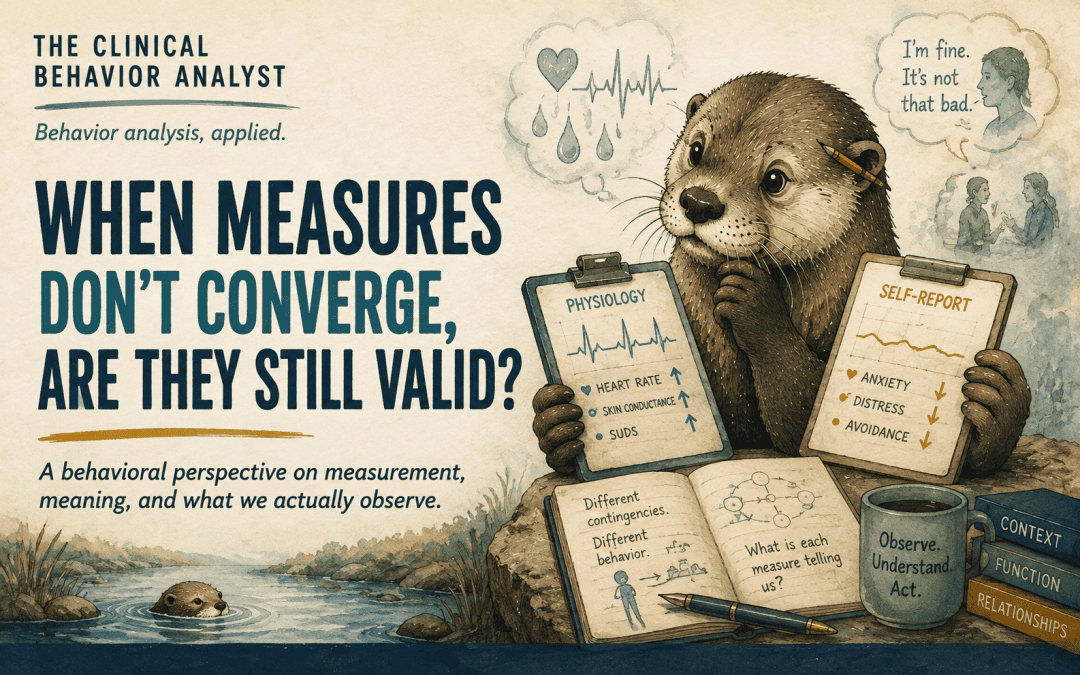
When measures don’t converge, are they still valid?

When measures don’t converge, are they still valid?

One of the most influential concepts in psychological measurement is convergent validity.

The idea seems straightforward. If several different measures are supposed to assess the same phenomenon, we would expect them to agree. If they do, we often become more confident that we’ve measured something “real.”

That sounds sensible.

Until you stop and ask a simple question:

What exactly have we observed?

Imagine someone with a snake phobia.

As they approach the snake, their heart rate increases. Their hands begin to sweat. At the same time, they continue walking toward the snake because their therapist is encouraging them and they are committed to treatment. If you ask them what they’re thinking, they tell you they are imagining themselves somewhere else entirely.

Three different response systems.

Three different patterns of behavior.

Which one tells us how afraid they “really” are?

From a behavioral perspective, that question is actually the wrong place to begin.

Each of those responses is behavior occurring under somewhat different environmental influences. The physiological response may reflect years of learning in which snakes became associated with danger. Walking toward the snake may be controlled by social reinforcement. The person’s verbal report may indicate rule-governed behavior, or not.

Why would we expect these behaviors to match perfectly?

What happens if, instead of asking “which one tells us how ‘afraid’ they really are?”, we ask “which one is going to be most tied to the change we’d like to drive?” We need to stop assuming “afraid” is some ‘thing’ we can accurately detect. 

Staying close to what we actually observed

This is one of the places where I think psychology sometimes moves too quickly away from its observations. Suppose someone completes a questionnaire designed to measure anxiety.

What did we actually observe?

We observed that a person endorsed a series of verbal statements in response to a particular set of prompts, under a particular set of circumstances.

That’s the observation.

Everything beyond that requires another inference.

If that questionnaire correlates highly with another questionnaire asking similar questions, what have we learned?

We have learned that people tend to respond similarly to similar verbal prompts.

That is an interesting and important finding.

But it is not, by itself, proof that an underlying psychological entity called “anxiety” or “fear” has been discovered.

The data demonstrate consistency in responding. Whether that consistency reflects an internal construct, a learned repertoire, recurring environmental contingencies, stable patterns of relational responding, characteristics of the measurement situation, or some combination of these remains a separate scientific question.

Those are different claims.

And they require different evidence.

Behavior analysis takes a more conservative position.

Behavior is treated as behavior.

Not as a sign pointing toward some hidden thing that must exist behind it.

That doesn’t mean internal events are ignored. It means we begin with what we can actually observe and then ask what variables are influencing those observations. When different measurements disagree, the first question isn’t, “Which one is right?”

Instead, it’s, “What environmental variables might be influencing each of these different behaviors?”

Sometimes disagreement between measures isn’t ‘measurement error’. Sometimes it is exactly what we should expect.

A person’s physiology, overt behavior, and verbal behavior are all influenced by overlapping—but not identical—histories and current contingencies.

Understanding why they diverge may teach us far more than forcing them into agreement.

Angela Coreil, PhD, BCBA

Angela Coreil, PhD, BCBA

Clinical Behavior Analyst, Methodologist & Trainer

Angela J. Coreil, PhD, is a professor at the University of Louisiana at Lafayette, clinical behavior analyst, and methodologist. Formerly director of an OCD and anxiety IOP/PHP, she integrates behavior analysis, ACT, Interpersonal Behavior Therapy, CBT, and exposure-based treatment. Her work develops practical improvements in behavioral science, and she provides consultation, professional training, workshops, and continuing education across disciplines.

Views expressed are those of Dr. Coreil or the explicitly named author, not the University of Louisiana at Lafayette.

Pin It on Pinterest