




Select Page
Working Toward Clinical Behavior Analysis: Practical Pathways for Behavior Analysts

Working Toward Clinical Behavior Analysis: Practical Pathways for Behavior Analysts

​

Working Toward Clinical Behavior Analysis: Practical Pathways for Behavior Analysts
By Angela Coreil, PhD, LP, BCBA

One of the most common questions I receive from behavior analysts is surprisingly straightforward:

“How do I get into clinical behavior analysis?”

Unlike becoming a BCBA, there is no universally recognized educational pathway, internship, or credential that makes someone a “clinical behavior analyst.” The route that makes sense for one clinician may not be appropriate—or even legally permissible—for another.

This article is intended as general educational information. It is not legal advice or individualized professional guidance.

Every clinician is responsible for understanding their professional scope of practice, state or national licensure laws, employer policies, insurance reimbursement rules, and the BACB Ethics Code.

The examples below represent common pathways that many clinicians have successfully followed. They are intended as starting points for exploration—not guarantees that a particular pathway is appropriate for your situation.

Path 1: Earn an Independent Mental Health License

If your long-term goal is to independently diagnose and treat a wide range of mental health concerns, obtaining an independent mental health license is usually the most straightforward path. Many behavior analysts choose to complete a master’s degree in Clinical Mental Health Counseling through a program accredited by the Council for Accreditation of Counseling and Related Educational Programs (CACREP). Others pursue graduate education in clinical psychology, counseling psychology, clinical social work, or marriage and family therapy, depending on their interests and state requirements. After graduation, virtually every profession requires a substantial period of supervised post-graduate practice before independent licensure. The exact requirements differ considerably across jurisdictions, but most involve several thousand supervised clinical hours over approximately two to three years.

This pathway offers the greatest long-term flexibility.

Independent licensure generally allows clinicians to diagnose (where permitted by law), provide psychotherapy independently, contract with insurance companies, supervise trainees within their profession, and develop private practices without relying on another professional’s license.

It is also the longest route.

For clinicians who know they want to spend their careers treating a broad range of mental health concerns, however, it is often well worth the investment.

Path 2: Join a Higher Level of Care Program

For many behavior analysts, this is the pathway that receives the least attention—but may offer some of the richest learning opportunities. Higher levels of care include programs such like Intensive Outpatient Programs (IOPs), Partial Hospitalization Programs (PHPs), Residential treatment center, and inpatient psychiatric hospitals. These settings are designed around interdisciplinary teams.

Unlike outpatient psychotherapy, reimbursement is frequently based on levels of care rather than individual psychotherapy sessions. Programs bill for half-day services (IOP), full-day services (PHP), or twenty-four-hour treatment (residential and inpatient). Those services are typically billed under the supervision of the highest licensed clinician directing the program—often a licensed psychologist or psychiatrist—while the entire treatment team contributes to patient care. For behavior analysts, this creates opportunities to participate in behavioral assessment, exposure programming, behavioral consultation, skills training, treatment planning, family meetings, interdisciplinary case conferences, and direct patient care while learning alongside professionals from multiple disciplines.

One point cannot be emphasized enough: The supervising clinician should understand behavior analysis.

Working under a psychologist or psychiatrist who appreciates the scope and competencies of behavior analysts is invaluable. Good supervision helps protect patients while also protecting clinicians from gradual “scope creep.”

Like every career decision, this pathway comes with tradeoffs.

Many BCBAs will likely earn less than they could providing intensive autism services. If maximizing income is your primary objective, this may not be the optimal career path. On the other hand, many clinicians find the work environment very different. Because reimbursement supports the treatment team rather than a single therapist’s individual hour, there is often less emphasis on maximizing one person’s billable time. Behavioral observations, consultation, treatment planning, documentation, family work, and collaboration all contribute meaningfully to patient care.

Depending on the setting and population served, clinicians may also encounter fewer of the occupational hazards familiar to many autism providers. Physical aggression certainly exists in behavioral health settings, but many clinicians experience substantially fewer incidents of being hit, kicked, bitten, or scratched than they did in intensive developmental disability programs.

The work is also tends to be center-based. For behavior analysts accustomed to spending large portions of the day driving between homes, schools, and clinics, eliminating daily travel can significantly improve quality of life.

None of these advantages make this pathway universally “better.” They simply represent a different set of contingencies. Some clinicians prefer the earning potential available in autism services. Others value interdisciplinary teamwork, reduced travel, broader clinical exposure, and the opportunity to work with adults or complex psychiatric populations. Understanding those tradeoffs helps you choose intentionally rather than accidentally.

Path 3: Develop Expertise Within a Specialty Behavioral Clinic

Another excellent entry point is joining an established specialty clinic where behavior analysts already practice successfully. One area where this has become increasingly common is obsessive-compulsive disorder (OCD) and related disorders. Behavior analysts possess strong backgrounds in learning theory, exposure, reinforcement, shaping, stimulus control, and functional assessment—all of which have obvious relevance to behavioral treatment for OCD.

Several specialty clinics now employ behavior analysts as members of interdisciplinary treatment teams. The International OCD Foundation (IOCDF) includes many of these programs in its provider directory. Working within an established specialty clinic offers several advantages. First, clinicians learn from professionals who already understand the behavioral treatment of OCD and related conditions. Second, supervision occurs in the context of actual clinical cases rather than isolated continuing education workshops. Finally, clinicians become familiar with the unique ethical, diagnostic, and collaborative issues involved in treating psychiatric disorders while remaining within their own professional scope.

There Is No Single Right Path

One encouraging reality is that these pathways are not mutually exclusive. Many clinicians combine them throughout their careers. Someone may begin providing ABA services, later join an OCD specialty clinic, eventually pursue independent mental health licensure, and later direct an interdisciplinary behavioral health program.

Career development is rarely linear. The important question is not how quickly you arrive. It is whether each step increases your competence while protecting the people who trust you with their care. Clinical behavior analysis has tremendous potential to contribute to modern behavioral health. That future will depend on clinicians who are technically skilled, scientifically informed, ethically grounded, and willing to work collaboratively across disciplines.

If you’re interested in Clinical Behavior Analysis, please comment below the post. Let us know what you’re interested in or thinking about! 

Career and Professional Information

Recommended Reading

Dougher, M. J. (Ed.). (2000). Clinical Behavior Analysis. Reno, NV: Context Press.

Goldiamond, I. (1974). Toward a constructional approach to social problems: Ethical and constitutional issues raised by applied behavior analysis. Behaviorism, 2(1), 1–84.

Hayes, S. C., Strosahl, K. D., & Wilson, K. G. (2012). Acceptance and Commitment Therapy: The Process and Practice of Mindful Change (2nd ed.). Guilford Press.

Twohig, M. P., & Levin, M. E. (2017). Acceptance and Commitment Therapy as a treatment for anxiety and depression: A review. Psychiatric Clinics of North America, 40(4), 751–770. https://doi.org/10.1016/j.psc.2017.08.009

Abramowitz, J. S. (2006). The psychological treatment of obsessive-compulsive disorder. Canadian Journal of Psychiatry, 51(7), 407–416. https://doi.org/10.1177/070674370605100702



Angela Coreil, PhD, BCBA

Angela Coreil, PhD, BCBA

Clinical Behavior Analyst, Methodologist & Trainer

Angela J. Coreil, PhD, is a professor at the University of Louisiana at Lafayette, clinical behavior analyst, and methodologist. Formerly director of an OCD and anxiety IOP/PHP, she integrates behavior analysis, ACT, Interpersonal Behavior Therapy, CBT, and exposure-based treatment. Her work develops practical improvements in behavioral science, and she provides consultation, professional training, workshops, and continuing education across disciplines.

Views expressed are those of Dr. Coreil or the explicitly named author, not the University of Louisiana at Lafayette.


Psychotherapy’s Taxonomy Problem

Psychotherapy’s Taxonomy Problem

​

Psychotherapy’s Taxonomy Problem

Why We Keep Arguing About Mythical Animals Instead of Studying Behavior

Imagine walking into a county fair where the grand prize is about to be awarded for Best Animal. One contestant is an elephant with zebra legs, butterfly wings, peacock feathers, and octopus tentacles. The next is a giraffe with the body of a bear, tiger paws, and the tail of a fish.The judges are having an intense argument.

Which creature is more authentic? Which one has the better anatomy? Which one deserves the blue ribbon for Effective Treatment?

No one stops to ask a more fundamental question.

When did we stop studying animals and start arguing about mythical ones?

Sometimes I wonder whether psychotherapy has wandered into the same county fair.

Every generation of researchers tries to build a better way of understanding human suffering. That’s exactly what science should do. New theories propose new mechanisms. New measures. New therapeutic languages. New ways of organizing behavior.

Over time, though, something subtle happens.

We stop treating those theories as useful maps and begin treating them as though they were different species inhabiting nature.

ACT becomes one animal.

CBT becomes another.

Psychodynamic therapy, DBT, Process-Based Therapy, Unified Protocols—they each develop their own anatomy, their own vocabulary, and their own criteria for what healthy functioning looks like.

Then the debates begin.

One of the most common arguments is that comparing therapies like ACT and CBT is like comparing apples and oranges.

I think we’ve accepted the wrong conclusion.

Apples and oranges are remarkably easy to compare.

We compare them by properties they both possess: acidity, water content, sugar, fiber, weight, shelf life.

What we don’t do is ask whether the orange became a better apple.

Yet that’s surprisingly close to how psychotherapy research often operates.

Each theory develops its own mechanisms.

Its own process measures.

Its own language.

Its own explanations.

Then we ask whether each therapy became a better version of itself.

The more our theories evolve, the stranger the animals become.

New mechanisms are added.

Old concepts are borrowed.

Measures are refined.

Constructs multiply.

Eventually we’re no longer comparing elephants and giraffes.

We’re comparing beautifully assembled mythical creatures built from decades of accumulated assumptions.

Then we race them.

We hand out blue ribbons.

And we argue endlessly about which mythical animal won.

I don’t think this is because psychotherapy research is failing.

I think it’s because our theories have become more sophisticated than the way we measure them.

Karl Popper reminded scientists that observations are never interpreted in isolation. Every scientific test rests on a network of assumptions connecting theory to observation. The challenge is not pretending those assumptions don’t exist; it’s remembering that they’re there.

Perhaps psychotherapy has become so successful at building increasingly sophisticated theories that we’ve started mistaking the theories for the thing they were created to explain.

The thing we were trying to understand was never ACT.

Or CBT.

Or any other named therapy.

It was human behavior.

Maybe the next step in psychotherapy isn’t inventing another mythical animal.

Maybe it’s learning how to measure the behavioral dimensions that all of them have in common.

Because mature sciences don’t advance by becoming more loyal to their taxonomies.

They advance by discovering ways to build knowledge across them.

Angela Coreil, PhD, BCBA

Angela Coreil, PhD, BCBA

Clinical Behavior Analyst, Methodologist & Trainer

Angela J. Coreil, PhD, is a professor at the University of Louisiana at Lafayette, clinical behavior analyst, and methodologist. Formerly director of an OCD and anxiety IOP/PHP, she integrates behavior analysis, ACT, Interpersonal Behavior Therapy, CBT, and exposure-based treatment. Her work develops practical improvements in behavioral science, and she provides consultation, professional training, workshops, and continuing education across disciplines.

Views expressed are those of Dr. Coreil or the explicitly named author, not the University of Louisiana at Lafayette.

What is ‘clinically relevant behavior’: Sign or sample

What is ‘clinically relevant behavior’: Sign or sample

By, Angela Coreil, PhD, LP, BCBA
As discussed by Ollendick et al. (2004), abnormal and clinically-relevant behavior can be viewed as either a “sample” or as a “sign.” To what extent does this difference, in turn, make a difference in the assumed temporal and situational consistency of such behavior?

Whether you view abnormal and clinically-relevant behavior as a “sample” or a “sign” makes a significant difference in whether you consider such behavior to be consistent over time and in various situations. If a behavior is seen as only a “sample” of a person’s behavior then there is no expectation that this behavior will be consistent over time or in different situations. When behavior is only said to be only a “sample” the implication is that you expect variation in the behavior. If the behavior is thought of as a “sign”, however, the implication is that the behavior is only an indication of an underlying trait or pathology which implies that the behavior should be more constant through time and situations. From this view as long as the underlying pathology, trait, etc. is present then behavioral “signs” of the underlying construct should also be present. In the relation to psychological problems this “sign” conceptualization, however, is most often a circular or reifying argument. A “sign” behavior indicates a “disorder” when a “disorder” only indicates a collection of symptoms. This conceptualization provides no particular “cause” for the behavior other than itself. This conceptualization is an artifact of using the methods of physicians to understand physical disease to understand human behavior.

The understanding of behavior as a “sample” vs a “sign” also impacts how problem behavior is conceptualized and in turn how assessment is conducted. If the behavior is only a “sample” of a person’s behavior at a certain time in a certain situation than an assessment of the person’s behavior in other situations is likely to be important. If the behavior is a “sign” then assessment over one time period in one situation is more acceptable because the behavior is assumed to be stable as long the “disorder” is constant. Assessment of “sample” behavior may also involve a less predetermined route than assessment of “sign” behavior. As behavior seen as a “sample” implies that there may be a wide variety of other problem behaviors that may exist with the target behavior. Thus, assessment may include any route of questioning, observing etc. that helps the clinician learn about all problem behavior and any possible relationships between the environment and problem behaviors. Because the behavior is expected to vary by situation, factors related to the situation may more likely be considered part of the conceptualization of the problem and should be assessed. If behavior is conceptualized as an “sign”, however, the behavior is related to internal factors and assessment is more likely to focus on assessing for other problem behaviors that are understood to cluster to indicate the underlying pathology. Assessment of environmental/situational factors is also less important if the behavior is understood to indicate pathology as the person’s behavior should continue to indicate the pathology across situations. In other words, assessment from a “sample” behavior perspective is more likely to be all-inclusive in assessing what other behaviors are present and what factors may be causing the problem behavior. Assessment from behavior as a “sign” perspective is more likely to be limiting in the sense that the clinician begins by looking specifically for behaviors that indicate a disorder and is more likely to ignore situational factors in the behavior and understand the “disorder” indicated the cause of the problem behavior.


Angela Coreil, PhD, BCBA

Angela Coreil, PhD, BCBA

Clinical Behavior Analyst, Methodologist & Trainer

Angela J. Coreil, PhD, is a professor at the University of Louisiana at Lafayette, clinical behavior analyst, and methodologist. Formerly director of an OCD and anxiety IOP/PHP, she integrates behavior analysis, ACT, Interpersonal Behavior Therapy, CBT, and exposure-based treatment. Her work develops practical improvements in behavioral science, and she provides consultation, professional training, workshops, and continuing education across disciplines.

Views expressed are those of Dr. Coreil or the explicitly named author, not the University of Louisiana at Lafayette.
Multi-trait Multi-method Assessment

Multi-trait Multi-method Assessment

By Angela Coreil, PhD, LP, BCBA

If you’re looking to move into Clinical Behavior Analysis, you need to have some understanding about how “psychology” talks about and tends to make judgments about the types of measurement they typically use.

Measures in psychology generally are compared to each other to determine whether they have adequate “convergent”, “discriminant”, and “construct” validity. Convergent validity is determined by examining the correlation between measures that are expected to measure the same “thing” as the measure being evaluated. For example, if one is evaluating a measure of “generalized anxiety disorder” symptoms – you would expect the correlation between responses on this measure to correlate with the same sample’s responses on other measures of “generalized anxiety” symptoms. “Discriminant” validity is the degree to which the measure being evaluated correlates with measures with which we would not expect it to be highly correlated. For example, if one is developing a measure of “generalized anxiety” symptoms a very high correlation between your samples responses on this measure and say a measure of “psychosis” symptoms would suggest that your measure of generalized anxiety symptoms cannot “discriminate” between ‘psychosis’ and ‘generalized anxiety.’ Construct validity, oh such a dirty word for behavior analysts… is understood in “psychology” as a measure demonstrating both adequate convergence with expected measures and adequate divergence (discrimination) from measures that would not be expected to be highly related.

A common method of evaluating the construct validity of measures follows in a completely fictitious example below, this is the Multi-trait, Multi-method Assessment of Construct Validity.

A psychologist at a mental health center develops a self-report inventory to assess generalized anxiety. Each new client at the mental health center is asked to complete this self-report inventory as well as a second questionnaire used to assess depression on two different occasions, separated by one month. In addition, two staff psychiatrists also conduct independent mental status exams with each new client and provide separate ratings of generalized anxiety and depression for each. Evaluate construct validity of the self-report inventory of generalized anxiety by interpreting all four sets of correlation coefficients within the multitrait-multimethod matrix that is obtained. Which, if any, of the four measures appears to possess adequate construct validity?

Instruments Types of Validity
Self-report Measures Convergent Discriminant Construct
Anxiety .64 Y .58 N No
Depression .41 N .58 N No
Psychiatrist Ratings      
Anxiety .64 Y .37 Y Yes
Depression .41 N .37 Y No


According to the multitrait-multimethod matrix only psychiatrist ratings of anxiety show adequate construct validity. When working through the multitrait-multimethod matrix it becomes apparent that the self-report measures of depression and psychiatrist ratings of depression show too low a correlation with each other and thus do not have adequate convergent validity. As the correlation is low, it would appear that these two methods of measurement do not measure “depression” in the same way or that factors related to measurement (rater biases, etc) may be interfering with measurement. Convergent validity between the self-report measures of anxiety and psychiatrist ratings of anxiety does appear to be sufficiently high though, indicating that the two methods of assessing “anxiety” appear to be measuring the same construct (or at least closely related constructs) through different methods.

When one examines the discriminant validity of these measures using the multitrait-multimethod matrix it appears that self-report measures of anxiety and depression are too highly correlated for adequate discriminant validity. Basically, these measures appear to be measuring constructs that are too closely related (probably because they are both influenced by a third ‘construct’ and are only topographically different). However, the psychiatrist ratings of anxiety and depression do appear to show adequate discriminant validity. As the correlation between these two is low, it would appear that they do not measure the same construct.

When examining the construct validity of the measures, only psychiatrist ratings of anxiety has both adequate convergent and discriminant validity. When the correlations for discriminant and convergent validity for this measure are compared it also appears that there is a substantial difference between them. This indicates that psychiatrist measures of anxiety tend to be reliably correlated with other measures of anxiety and not with measures of other related constructs. Thus, psychiatrist ratings of anxiety are considered to have good construct validity. None of the other measures meets all the requisite conditions for construct validity. However, despite this good evidence for the construct validity of psychiatrist ratings of anxiety we cannot be entirely sure of the construct validity of this measure; we are, however, much better justified in making such a leap.

If you like learning about methods or topics that expand your ability to understand the field of “psychology” as it relates to behavior analysis – sign up for our blog or leave us a comment below.

For those interested, here another example worked out of a multi-trait, multi-method assessment matrix. 


Angela Coreil, PhD, BCBA

Angela Coreil, PhD, BCBA

Clinical Behavior Analyst, Methodologist & Trainer

Angela J. Coreil, PhD, is a professor at the University of Louisiana at Lafayette, clinical behavior analyst, and methodologist. Formerly director of an OCD and anxiety IOP/PHP, she integrates behavior analysis, ACT, Interpersonal Behavior Therapy, CBT, and exposure-based treatment. Her work develops practical improvements in behavioral science, and she provides consultation, professional training, workshops, and continuing education across disciplines.

Views expressed are those of Dr. Coreil or the explicitly named author, not the University of Louisiana at Lafayette.
The Matrix Viz: A functional assessment of verbal behaving

The Matrix Viz: A functional assessment of verbal behaving

By Angela Coreil, PhD, LP, BCBA, @2017

Today I’m going to introduce a project that is one of many formulations of functional assessment we’ve been developing. The current formulation was first put to use more than a year ago with Benji Schoendorff, MSc and the Contextual Psychology Institute (CPI).

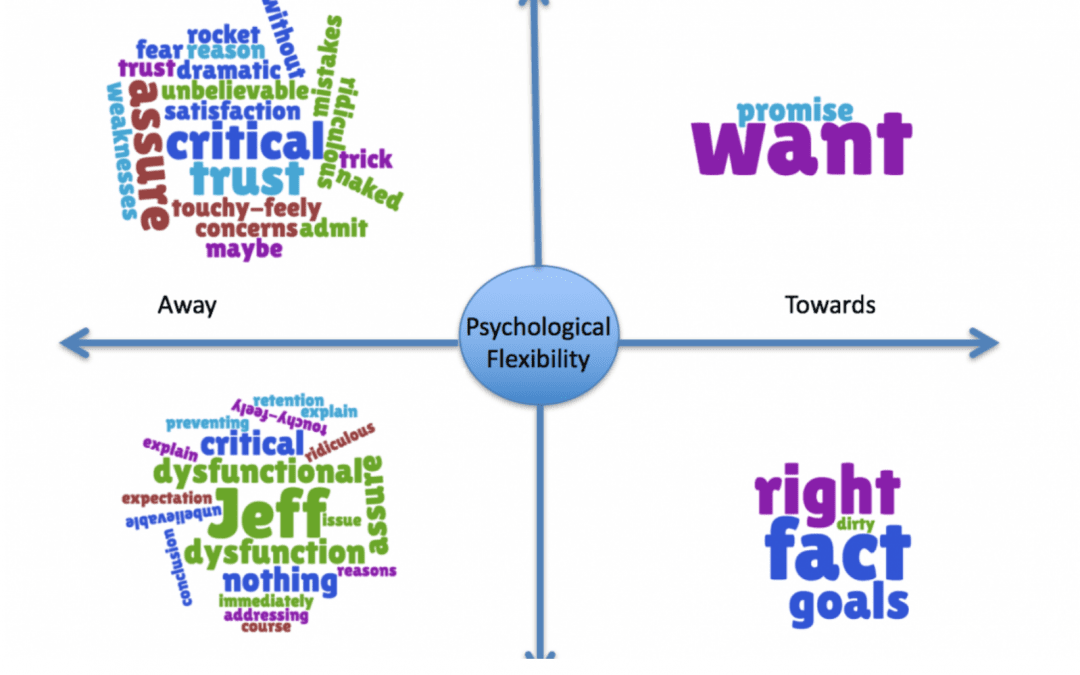
Below, you’ll see a data visualization built around “The Matrix” framework. The Matrix framework was developed some years ago by Kevin Polk, Benji Schoendorff, and others. It has gained quite a bit of popularity as a way to teach Acceptance and Commitment Therapy skills to both clinicians and clients. Use of The Matrix framework typically involves having clients or clinicians identify thoughts, feelings, and experiences and how they are oriented on the visual cross-hatch above. This is meant to help people begin to orient to important relationships between their behaviors and their experiences, without necessarily teaching the more elaborate hexaflex model of Acceptance and Commitment Therapy processes. In practice, most clinicians do not teach the skills taught in Acceptance and Commitment Therapy (ACT) by actually teaching the hexaflex to clients, but clinicians frequently start by learning this more complex model and trying to then translate that into how they work with clients. This is sometimes difficult for clinicians and can sometimes result in rather “canned” applications of ACT when clinicians are first mastering the model. Thus, the Matrix model is about teaching fluidity of process and flexibility in a way that often translates more easily.

This brings us to the Matrix Visualization that we’ll discuss today. What you are seeing, is best conceptualized as a tool to assist in the functional assessment of verbal behavior in the context of other behaviors you may observe from the client that are less difficult to track. We have used Ecological Momentary Assessment (EMA) and behavioral observations of other types to better situate verbal behavior (vocal or written) in the context of a functional analysis.

The picture below is only one of many formats to make looking at many layers of verbal behaving and actual behavior of individuals in a way that can help us see the meaning of ongoing behavior, in context. The visualization below is simply an output (like a graph) that is the result of using Natural Language Processing (methods of using computer science to examine verbal behavior) to process written or speech behavior. These measurements and the content tagged in the written behavior are then fed into a real-time data visualization (using Tableau) to allow us to see a visual model of what is reflected in the written or vocal verbal behavior over a particular period of time.

In this post, I will simply show the visualization and the source and describe what you are seeing.  To be sure, visualizing behavior through The Matrix format – is a matter of preference. Just as one can look at data in a bar graph or a pie chart, so too can we change the output format in which we display the ever-changing patterns of verbal behavior seen across time and context.

This visualization below is an example run on a piece of my own writing from an earlier post entitled, “RFT the Space-time of the Human Universe.” Here you will see a single moment of time of my own experience and verbal behavior reflected in the Matrix Visualization format. Though we have used this formulation in organizations that data is confidential. We’d also like to note that this work has evolved through a partnership with Contextual Psychology Institute (CPI). We greatly appreciate their continuing support of the development of this work.

The Matrix Viz
A tool to assist in functional assessment of verbal behaving within the larger context of a client’s behavior. This visualization is a data-driven analysis of verbal behavior only, again this would typically be used with other data about the client’s behavior across contexts to assist the clinician in functional analysis.

Though what the eye is frequently drawn to is the “content” level displayed, what should be attended to more fully is the movement of the content and changes in it over time. This snapshot gives us a brief idea of what of the likely functions of behavior across the time point covered by this writing, it should not in any way be considered a stable assessment of behavior (the writing period consisted of a few hours at most). To gain a better understanding of the function of behavior longer periods of communication should be analyzed and changes in the visualization noted. Further, change in quantitative form is useful to examine – but the visualization itself is meant to bridge some of the gaps encountered by clinicians and trainers as they attempt to use assessment to understand the ever-changing experience of their clients.

The assessment tool is driven by examining ideographic relating patterns, and to a lesser extent, the nomothetic functions of verbal behavior. This measurement is ideographic in the sense that it reflects patterns of relating specific to the individual, over the time covered. It is not based on the assumption of a normal curve of frequency or average levels of communication about a particular topic.

This measurement is nomothetic in the sense that at some level language has a shared cultural conditioning history, this is essential for it to function as a “language.” That is, if we don’t share enough of the same conditioning/relating history with regard to any word, sound, or group of words – then effective communication across individuals does not happen. Therefore, there is a level at which “content” based analysis does become relevant. For example, the concept of the verbal “self” (i.e., deictic relating) is based on the idea that the process of the verbal world speaking about us, identifying our experience, and of learning to speak about our experience ourselves – is fairly universal. The content that then becomes conditioned around the experience of the “self” is then identifiable by examining the language that ideographically hangs together around the content of “I”, “me”, etc. This is further supported by a significant body of research from others in related fields, such as Pennebaker who have extensively examined the function of pronouns using Natural Language Processing methods.

Further, though “universal” aspects of our language learning experience can be examined tagged to content, as mentioned above, most of the rest of the levels of analysis shown here is driven by vector-based Natural Language Processing methods. These do not assume particular content but instead look at changes in language by dropping to the level of semantic, syntactic, or statistical examination of the probability of a word/statement, etc following another word. Thus, rather than assuming normality around the frequency of a spoken word in a particular human context – they depend more on the underlying structure of language. This allows us to assume less about the content we expect and to pay more attention to the changing “signal” reflected in an individual or group’s “languaging” behavior. We can then use changes in the “signal” to understand what interpersonal, environmental, and other factors – constitute important contextual influences on the individual’s behavior.

At any moment, we relate on many levels of our experience. The “what” of what we relate is the layer most commonly assessed by psychological measures – it is by nature highly biased. “What,” we say is highly rule-governed and influenced heavily by contextual factors. It is well appreciated that our ability and willingness to report our experience moment-to-moment leads to significant response bias. Further, the methodology of asking about a specific “what” leads to efforts to standardize and statistically remove the influence of the questions themselves and other context. This is where the concept of standard error, etc. come into the creation of assessments. Assessing using a methodology that does not assume so many levels of normality, allows us to drop down to a lower level of analysis – a lower level of construct – and thus, hopefully, move closer to examining actual behavior and change – functionally.

This is akin to looking more at the  “how” of verbal relating, an indicator of experience. This is, in a way, similar to the difference between asking someone how much they hurt and instead of having them rate “0 (None) to 10 (A Lot),” listening to their expression about their pain from the warble in their voice or the strength of the words they use to describe their pain.

The Matrix Viz
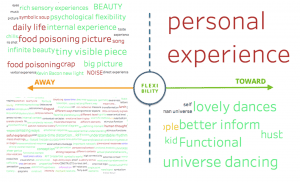
An example of the Matrix visualization as tool for assisting in the functional assessment of verbal behaving.

What can we see from this visualization?

Notice that the content is not sorted simply by base level “content”. There are phrases that on a face level of “content” would likely appear to belong in another quadrant. This categorization of content is based more heavily on the surrounding context in which the content appears. This occurs through a “weighting” of semantic and syntactic writing features that “weight” the “how” of the context of that the content is used in over the outright content-based meaning of the word. In other words, the “latent” levels of relating show you the deeper levels of experience relative to the surface “content” levels. This means that “I” or other pronouns may show up in any quadrant of the visualization based on the deeper relating context that which “I” is used. It is not simply “I” that falls in the lower right quadrant. It is based on the individual’s use and experience that shows up repeatedly around that content. Similarly, the same “content” can be reflected in different colors and quadrants simultaneously and this reflects our continuously changing relations and/or relating at different levels to the same content during a specific time point. For example, if the individual experienced a level of conflict between a desire and its aversive consequences, this same content might show up in red and green and in different quadrants. For example, desiring alcohol but feeling that one should not engage in drinking – would lead the word “alcohol” or any word in the same semantic group used to mean it to show up in red and green, in quadrants reflecting this simultaneous difference in the “function” of alcohol for the person.

The words in this particular visualization are coded in red, green, and black. These are micro indicators akin to red = aversive, green = appetitive, and black = neutral. So, for example – you can see that in this visualization “personal experience” comes up as both “red” = and aversive, and yet, it is in the “Toward” half of The Matrix. This reflects that in the author’s experience at the time of this writing – the personal experience was likely aversive but yet being approached.

In the bottom right quadrant, you see indications of values – again, you must step around surface content to see that “dancing” is a semantic substitute for a value of “playfulness.” A clinician or consultant using the Matrix Visualization to guide assessment would not assume the meaning of “dancing.” They should use the visualization as a guide and query the particular meaning of the content with the individual. This is akin to what you might do in a clinical session, pick out the patterns in relating and try to understand their significance in both the individual’s life and their behavior. The clinician can then use this information to understand and quickly assess likely functions and to use that to guide questioning and to also use more clinically and personally relevant metaphors for use in treatment.

In the bottom left quadrant, “Thinking/Away” – the main noticeable characteristic is the volume of material that shows up, both aversive and appetitive material. Notably, the content is also highly intellectualized and a bit defused sounding. This reflects the author’s tendency to intellectualize.

In the top left quadrant, “Sensing/Away,” you see indications of experiences that fall in networks of relations that were being moved away from at this point in time. Again, this type of assessment is best used as a method for examining likely functional relationships, following up with questioning with the client, and further using the assessment over time to examine likely changes in functional relationships. Thus, this kind of assessment likely provides a great deal more clinical useful information to a clinician than the average measure of “symptoms” – that reflects little about the client’s interpretation of those symptoms, no information about how the symptoms functionally relate and relies on self-report survey methodology that by nature includes a high degree of response bias influence.

If you’re curious about Natural Language Processing as up and coming method of quantitative assessment in Contextual Behavioral Science.

Angela Coreil, PhD, BCBA

Angela Coreil, PhD, BCBA

Clinical Behavior Analyst, Methodologist & Trainer

Angela J. Coreil, PhD, is a professor at the University of Louisiana at Lafayette, clinical behavior analyst, and methodologist. Formerly director of an OCD and anxiety IOP/PHP, she integrates behavior analysis, ACT, Interpersonal Behavior Therapy, CBT, and exposure-based treatment. Her work develops practical improvements in behavioral science, and she provides consultation, professional training, workshops, and continuing education across disciplines.

Views expressed are those of Dr. Coreil or the explicitly named author, not the University of Louisiana at Lafayette.

A Beginner’s Guide to Clinical Behavior Analysis (CBA) and Related Treatments (ACT, DBT, FAP)

A Beginner’s Guide to Clinical Behavior Analysis (CBA) and Related Treatments (ACT, DBT, FAP)

A Beginner’s Guide to Clinical Behavior Analysis
If you’re interested in studying how to treat ‘mental health’ issues, as a behavior analyst, Clinical Behavior Analysis (CBA) is the pathway you should be looking into.

Clinical Behavior Analysis (CBA) is not a new area for behavior analysis, in fact, behavior analysts treating “mental health” issues pre-dates the refocusing of the field to the treatment of Autism. Clinical Behavior Analysis involves using learning principles to help people who often identify as having “mental health” challenges change their behavior and improve their functioning. 

What is Clinical Behavior Analysis?
Clinical Behavior Analysis (CBA) is at the intersection of behavior analysis and psychology. It is the application of behavioral principles to changing behaviors previously considered to fit in within the are of ‘mental health’. Clinical Behavior Analysis focuses on changing behavior through functional analysis and reinforcement of more adaptive behaviors. CBA requires evaluating the impact of multiple levels of contingencies on the client and determining which level(s) of contingencies to intervene on to create the most impact in changing the client’s behavior. Changing the client’s behavior – also tends to change the client’s experience. Application of behavioral principles to ‘mental health’ has existed since Skinner’s time; however, much of CBA fell out of popularity during the Cognitive Revolution within psychology. Now, with ‘psychology’ in a replication crisis born of the constructs and methods that allowed for rapid growth and division from behavior analysis – CBA is rising again in popularity.

History of Clinical Behavior Analysis
Clinical behavior analysis was developed during a time of rapid growth and change in scientific psychology. With a strong interest in data-driven treatment, John B. Watson and other early behaviorists began researching methods that could be scientifically verified. They turned away from early clinical work with mental health issues—and techniques that couldn’t be measured or observed—and toward controlled experiments. They laid down a foundation for understanding how different operant and classical conditioning might be used to treat behaviors considered “mental illness.”

During the Cognitive Revolution, Clinical Behavior Analysis as a clear arm of behavior analysis fell out of focus; however, treatments based on behavior analytic principles grew within realms of “psychotherapy” traditions. These treatments are now often confused as themselves being CBA. Examples of these treatments that fall into this category include Acceptance and Commitment Therapy (ACT), Dialectical Behavior Therapy (DBT), and Functional Analytic Psychotherapy (FAP). To be clear – ACT, DBT, and Functional Analytic Psychotherapy may be performed in ways that are CBA – but they are not by default CBA. It is entirely possible to do ‘canned ACT’ or to otherwise do what people recognize as one of these treatments without using functional analysis to guide treatment. In those cases, these treatments are not CBA.

Acceptance and Commitment Therapy as Clinical Behavior Analysis
Acceptance and Commitment Therapy (ACT) has become very popular with behavior analysts, particularly as Relational Frame Theory (RFT) and as a clinical behavior analysis recently. There is much current debate over whether “ACT” is clinical behavior analysis. This debate is well warranted as ACT though grown out of Relational Frame Theory and explicitly behavior analytic principles diverged to compete with cognitive-behavioral treatment packages. This necessarily led to a language that would fit training a multitude of clinicians (mid-level terms) and result in higher inter-rater reliability in Randomized Controlled Trials (RCTs) against Cognitive Behavioral Therapy (CBT). Most would say “ACT” accomplished its goals here and now is recognized as a treatment efficacious for the treatment of a wide variety of “psychological” problems right alongside its former chief competitor, Beckian CBT. Now – the issue becomes that most of the existing training on ACT follows the patterns set during this period. These trainings are meant for psychotherapists, use imprecise mid-level terms that tend to confuse behavior analysts, and do not well prepare behavior analysts for utilizing ACT in ways consistent with behavior analytic scope and practice. 

Functional Analytic Psychotherapy as Clinical Behavior Analysis
Functional Analytic Psychotherapy has its foundation behavior analytic principles as a way of improving in-session behavioral repertoires. The clinician then seeks to generalize these in-session improvements to the client’s outside-of-session life. In recent years, this treatment has also begun to go the way that ACT did to become better recognized as an effective psychological treatment. This has included, again, developing standardized terminology and even beginning to focus on a more specific set of clinical problems. This again – is well suited for the treatment becoming a competitor in “psychotherapy” according to standards of Randomized Controlled Trials (RCTs) but does not bode well for the training of behavior analysts in this treatment according to their scope and capabilities.

Dialectical Behavior Therapy as Clinical Behavior Analysis
Dialectical behavior therapy (DBT) is a form of therapy developed by Marsha Linehan, Ph.D., that emphasizes chain analysis, fading, and reinforcement of less dangerous behaviors in its population of interest. This approach has been shown effective in treating people who suffer from intense suicidal urges or self-harming behaviors like cutting or drug addiction. Despite how DBT has held to its roots somewhat more effectively than it would seem ACT and Functional Analytic Psychotherapy have – it is also in this writer’s opinion likely the most out-of-scope for behavior analysts simply due to the typical target applications of the overall treatment package. There are many places where topography can be picked up under supervision for behavior analysts and treatment methods may be taught consistent with behavioral principles and behavior analysts’ scope of practice. DBT applied to “borderline personality disorder” is well appreciated for its difficulty and danger in application. True “DBT” is performed with a team of clinicians, with a great deal of support, and is not for behavior analysts beginning to develop skills in Clinical Behavior Analysis. 

Clinical Behavior Analysis as Clinical Behavior Analysis
It’s because of the incompatibilities in how some of these treatments are now taught that I prefer to refer to Clinical Behavior Analysis as “Clinical Behavior Analysis.” If we are clear in labeling it differently, it will be easier for behavior analysts wanting training in ACT or other treatment techniques to find clinicians able to train them in ways consistent with their scope and behavioral principles. This does not again mean that one cannot learn the techniques used in “ACT” but that one will likely be learning them without the use of mid-level terms and with more precise and clear linking to behavior principles. 


Angela Coreil, PhD, BCBA

Angela Coreil, PhD, BCBA

Clinical Behavior Analyst, Methodologist & Trainer

Angela J. Coreil, PhD, is a professor at the University of Louisiana at Lafayette, clinical behavior analyst, and methodologist. Formerly director of an OCD and anxiety IOP/PHP, she integrates behavior analysis, ACT, Interpersonal Behavior Therapy, CBT, and exposure-based treatment. Her work develops practical improvements in behavioral science, and she provides consultation, professional training, workshops, and continuing education across disciplines.

Views expressed are those of Dr. Coreil or the explicitly named author, not the University of Louisiana at Lafayette.

Pin It on Pinterest