
Select Page
What is ‘clinically relevant behavior’: Sign or sample

What is ‘clinically relevant behavior’: Sign or sample

By, Angela Coreil, PhD, LP, BCBA
As discussed by Ollendick et al. (2004), abnormal and clinically-relevant behavior can be viewed as either a “sample” or as a “sign.” To what extent does this difference, in turn, make a difference in the assumed temporal and situational consistency of such behavior?

Whether you view abnormal and clinically-relevant behavior as a “sample” or a “sign” makes a significant difference in whether you consider such behavior to be consistent over time and in various situations. If a behavior is seen as only a “sample” of a person’s behavior then there is no expectation that this behavior will be consistent over time or in different situations. When behavior is only said to be only a “sample” the implication is that you expect variation in the behavior. If the behavior is thought of as a “sign”, however, the implication is that the behavior is only an indication of an underlying trait or pathology which implies that the behavior should be more constant through time and situations. From this view as long as the underlying pathology, trait, etc. is present then behavioral “signs” of the underlying construct should also be present. In the relation to psychological problems this “sign” conceptualization, however, is most often a circular or reifying argument. A “sign” behavior indicates a “disorder” when a “disorder” only indicates a collection of symptoms. This conceptualization provides no particular “cause” for the behavior other than itself. This conceptualization is an artifact of using the methods of physicians to understand physical disease to understand human behavior.

The understanding of behavior as a “sample” vs a “sign” also impacts how problem behavior is conceptualized and in turn how assessment is conducted. If the behavior is only a “sample” of a person’s behavior at a certain time in a certain situation than an assessment of the person’s behavior in other situations is likely to be important. If the behavior is a “sign” then assessment over one time period in one situation is more acceptable because the behavior is assumed to be stable as long the “disorder” is constant. Assessment of “sample” behavior may also involve a less predetermined route than assessment of “sign” behavior. As behavior seen as a “sample” implies that there may be a wide variety of other problem behaviors that may exist with the target behavior. Thus, assessment may include any route of questioning, observing etc. that helps the clinician learn about all problem behavior and any possible relationships between the environment and problem behaviors. Because the behavior is expected to vary by situation, factors related to the situation may more likely be considered part of the conceptualization of the problem and should be assessed. If behavior is conceptualized as an “sign”, however, the behavior is related to internal factors and assessment is more likely to focus on assessing for other problem behaviors that are understood to cluster to indicate the underlying pathology. Assessment of environmental/situational factors is also less important if the behavior is understood to indicate pathology as the person’s behavior should continue to indicate the pathology across situations. In other words, assessment from a “sample” behavior perspective is more likely to be all-inclusive in assessing what other behaviors are present and what factors may be causing the problem behavior. Assessment from behavior as a “sign” perspective is more likely to be limiting in the sense that the clinician begins by looking specifically for behaviors that indicate a disorder and is more likely to ignore situational factors in the behavior and understand the “disorder” indicated the cause of the problem behavior.

 

Angela Coreil, PhD, BCBA

Angela Coreil, PhD, BCBA

Clinical Behavior Analyst, Methodologist & Trainer

Angela J. Coreil, PhD, is a professor at the University of Louisiana at Lafayette, clinical behavior analyst, and methodologist. Formerly director of an OCD and anxiety IOP/PHP, she integrates behavior analysis, ACT, Interpersonal Behavior Therapy, CBT, and exposure-based treatment. Her work develops practical improvements in behavioral science, and she provides consultation, professional training, workshops, and continuing education across disciplines.

Views expressed are those of Dr. Coreil or the explicitly named author, not the University of Louisiana at Lafayette.


A Beginner’s Guide to Clinical Behavior Analysis (CBA) and Related Treatments (ACT, DBT, FAP)

A Beginner’s Guide to Clinical Behavior Analysis (CBA) and Related Treatments (ACT, DBT, FAP)

A Beginner’s Guide to Clinical Behavior Analysis
If you’re interested in studying how to treat ‘mental health’ issues, as a behavior analyst, Clinical Behavior Analysis (CBA) is the pathway you should be looking into.

Clinical Behavior Analysis (CBA) is not a new area for behavior analysis, in fact, behavior analysts treating “mental health” issues pre-dates the refocusing of the field to the treatment of Autism. Clinical Behavior Analysis involves using learning principles to help people who often identify as having “mental health” challenges change their behavior and improve their functioning. 

What is Clinical Behavior Analysis?
Clinical Behavior Analysis (CBA) is at the intersection of behavior analysis and psychology. It is the application of behavioral principles to changing behaviors previously considered to fit in within the are of ‘mental health’. Clinical Behavior Analysis focuses on changing behavior through functional analysis and reinforcement of more adaptive behaviors. CBA requires evaluating the impact of multiple levels of contingencies on the client and determining which level(s) of contingencies to intervene on to create the most impact in changing the client’s behavior. Changing the client’s behavior – also tends to change the client’s experience. Application of behavioral principles to ‘mental health’ has existed since Skinner’s time; however, much of CBA fell out of popularity during the Cognitive Revolution within psychology. Now, with ‘psychology’ in a replication crisis born of the constructs and methods that allowed for rapid growth and division from behavior analysis – CBA is rising again in popularity.

History of Clinical Behavior Analysis
Clinical behavior analysis was developed during a time of rapid growth and change in scientific psychology. With a strong interest in data-driven treatment, John B. Watson and other early behaviorists began researching methods that could be scientifically verified. They turned away from early clinical work with mental health issues—and techniques that couldn’t be measured or observed—and toward controlled experiments. They laid down a foundation for understanding how different operant and classical conditioning might be used to treat behaviors considered “mental illness.”

During the Cognitive Revolution, Clinical Behavior Analysis as a clear arm of behavior analysis fell out of focus; however, treatments based on behavior analytic principles grew within realms of “psychotherapy” traditions. These treatments are now often confused as themselves being CBA. Examples of these treatments that fall into this category include Acceptance and Commitment Therapy (ACT), Dialectical Behavior Therapy (DBT), and Functional Analytic Psychotherapy (FAP). To be clear – ACT, DBT, and Functional Analytic Psychotherapy may be performed in ways that are CBA – but they are not by default CBA. It is entirely possible to do ‘canned ACT’ or to otherwise do what people recognize as one of these treatments without using functional analysis to guide treatment. In those cases, these treatments are not CBA.

Acceptance and Commitment Therapy as Clinical Behavior Analysis
Acceptance and Commitment Therapy (ACT) has become very popular with behavior analysts, particularly as Relational Frame Theory (RFT) and as a clinical behavior analysis recently. There is much current debate over whether “ACT” is clinical behavior analysis. This debate is well warranted as ACT though grown out of Relational Frame Theory and explicitly behavior analytic principles diverged to compete with cognitive-behavioral treatment packages. This necessarily led to a language that would fit training a multitude of clinicians (mid-level terms) and result in higher inter-rater reliability in Randomized Controlled Trials (RCTs) against Cognitive Behavioral Therapy (CBT). Most would say “ACT” accomplished its goals here and now is recognized as a treatment efficacious for the treatment of a wide variety of “psychological” problems right alongside its former chief competitor, Beckian CBT. Now – the issue becomes that most of the existing training on ACT follows the patterns set during this period. These trainings are meant for psychotherapists, use imprecise mid-level terms that tend to confuse behavior analysts, and do not well prepare behavior analysts for utilizing ACT in ways consistent with behavior analytic scope and practice. 

Functional Analytic Psychotherapy as Clinical Behavior Analysis
Functional Analytic Psychotherapy has its foundation behavior analytic principles as a way of improving in-session behavioral repertoires. The clinician then seeks to generalize these in-session improvements to the client’s outside-of-session life. In recent years, this treatment has also begun to go the way that ACT did to become better recognized as an effective psychological treatment. This has included, again, developing standardized terminology and even beginning to focus on a more specific set of clinical problems. This again – is well suited for the treatment becoming a competitor in “psychotherapy” according to standards of Randomized Controlled Trials (RCTs) but does not bode well for the training of behavior analysts in this treatment according to their scope and capabilities.

Dialectical Behavior Therapy as Clinical Behavior Analysis
Dialectical behavior therapy (DBT) is a form of therapy developed by Marsha Linehan, Ph.D., that emphasizes chain analysis, fading, and reinforcement of less dangerous behaviors in its population of interest. This approach has been shown effective in treating people who suffer from intense suicidal urges or self-harming behaviors like cutting or drug addiction. Despite how DBT has held to its roots somewhat more effectively than it would seem ACT and Functional Analytic Psychotherapy have – it is also in this writer’s opinion likely the most out-of-scope for behavior analysts simply due to the typical target applications of the overall treatment package. There are many places where topography can be picked up under supervision for behavior analysts and treatment methods may be taught consistent with behavioral principles and behavior analysts’ scope of practice. DBT applied to “borderline personality disorder” is well appreciated for its difficulty and danger in application. True “DBT” is performed with a team of clinicians, with a great deal of support, and is not for behavior analysts beginning to develop skills in Clinical Behavior Analysis. 

Clinical Behavior Analysis as Clinical Behavior Analysis
It’s because of the incompatibilities in how some of these treatments are now taught that I prefer to refer to Clinical Behavior Analysis as “Clinical Behavior Analysis.” If we are clear in labeling it differently, it will be easier for behavior analysts wanting training in ACT or other treatment techniques to find clinicians able to train them in ways consistent with their scope and behavioral principles. This does not again mean that one cannot learn the techniques used in “ACT” but that one will likely be learning them without the use of mid-level terms and with more precise and clear linking to behavior principles. 


Angela Coreil, PhD, BCBA

Angela Coreil, PhD, BCBA

Clinical Behavior Analyst, Methodologist & Trainer

Angela J. Coreil, PhD, is a professor at the University of Louisiana at Lafayette, clinical behavior analyst, and methodologist. Formerly director of an OCD and anxiety IOP/PHP, she integrates behavior analysis, ACT, Interpersonal Behavior Therapy, CBT, and exposure-based treatment. Her work develops practical improvements in behavioral science, and she provides consultation, professional training, workshops, and continuing education across disciplines.

Views expressed are those of Dr. Coreil or the explicitly named author, not the University of Louisiana at Lafayette.

Finding Clinical Behavior Analysis: Part I

Finding Clinical Behavior Analysis: Part I

by Angela Coreil, PhD

In my recent invited talk at CalABA on Clinical Behavior Analysis as a way of unifying the behavioral sciences, I alluded to a series of painful learning experiences that brought me to Clinical Behavior Analysis.

My training path has been long and winding – all with the intention of finding ways to improve clinical treatment. You see, I grew up with a close family member experiencing a great deal of impairment, emotional pain, and later addiction. I was present for years of this family member seeking treatment and even as a child seeing failures in the systems meant to help her. I watched her go through the revolving door of inpatient units, which became like brief vacations to her. I watched as therapists seemed helpless to soothe her pain. And, I watched as she was prescribed pill after pill to ease her pain. I was at an early age effectively an involuntary ‘mental health’ crisis worker.

This led to a passion for understanding human behavior and a desire to find better ways to address human suffering. I believed that I could best influence treatment by becoming a process and outcomes researcher and set upon a long path to become this. I spent a number of years gaining experience on process and outcomes studies at a number of major research institutions in Houston, Texas where I lived. Then I happened upon on a job as a Research Coordinator for a project called “Opportunity Houston.” This was a large grant focused on treating dual diagnosis (mental health + addiction) homeless individuals. The study focused in some respects on enriching the environments of those experiencing addiction by providing housing and work, contingent on improving maintenance of sobriety. I later learned this was a study in part of Kelly Wilson’s design, an ACT founder. At the time, I would not have known who he was but the William “Dub” Norwood was my advisor there and he was an early ACT devotee.  

It was through him that I began to be exposed to ACT and then entered the University of Houston – Clear Lake for my master’s in Clinical Psychology. Following this, I started my doctorate in Clinical Psychology under Rob Zettle, Steve Hayes’ first student who played a strong role in developing ACT back when it was called “Comprehensive Distancing.” Throughout my master’s I found myself drawn to ACT, in its stance that human suffering was a natural part of the human experience and often an extension of otherwise adaptive behavior. In my early exposures to Beckian Cognitive Behavior Therapy, I was often presented with a list of ‘cognitive distortions’ and told that treatment would in part be helping clients recognize their ‘cognitive distortions.’ At the time, I found this conceptualization offensive and insensitive. I could not imagine myself telling other humans experiencing pain that their painful thoughts were ‘distortions’ of reality.

I would say that the way that clinical psychology training is currently structured – learning deeply the key elements of treatment is not an easy experience. We are typically taught behavioral principles but soon after we begin to divide off into camps to learn the particular language ways of our chosen orientations. I broke from this tradition repeatedly because beyond my allegiance to “ACT” was the guiding rule that my mission was to find ways to understand and improve treatment as a process researcher. I became more fluid in ACT treatment and began to depart from “canned ACT” in the early years of my doctorate. I had early experiences of clients with Obsessive-Compulsive Disorder” finding ways to “compulse” (momentarily avoid or reduce their anxiety) with the very ACT exercises I provided them. One client taught mindfulness, returned the next week to tell me how effective mindfulness had been in reducing their anxiety. I asked what had occurred and the client recounted engaging in mindfulness ‘instead of’ compulsions each time they became anxious. 

I went back to Rob and told him what had occurred and in his monotone way of beating a dead horse for my benefit he said ‘Yes, of course.’ And, then followed it with the ‘Hole in the Field’ metaphor to illustrate how I’d simply given the client a new shovel. Now, I would need to again – get them to drop their new improved ‘shovel.’ This was all in the context of learning Exposure and Response Prevention (ERP) also known within the behavior analytic community still as desensitization.

It was working in OCD and specializing in a particular technique that was widely endorsed across theoretical orientations as the ‘gold standard’ (i.e., ERP) for treating anxiety and related disorders that allowed me, I believe, to be able to track more about the differences in models as a I learned. After learning this technique well embedded in ACT, I sought out an Advanced Assistantship with the closest highly regarded research and treatment specialty center in Kansas. My clinical supervisor was widely regarded as a highly-skilled Beckian Cognitive Behavioral Therapy clinician and researcher. My initial learning experiences here were somewhat disorienting; however, as I went in with experience and skill validated by ACT experts. Fairly quickly into my training at this center, it became clear that ACT was not particularly favored by my supervisor and to treat clients under her supervision using similar language was quick to elicit punishment.

I remember writing back to my lab at that time and questioning whether I was actually proficient in ERP and ACT. The response I received was telling – but for years I did not fully understand the impact of what I was told in the full context of my academic experience. Rob told me that my ACT and ERP was fine and that I would simply have to ‘learn their language.’ He mentioned that as Steve Hayes’ first student he was also sent to work under the competing theoretical model for his internship year – under Aaron Beck. Though he never disclosed much about this experience directly it often seemed apparent that his internship year had probably not been easy on him.

I’d like to say that I won this particular CBT expert over; in fact, I learned the language and got out as soon as possible. I seemed to be fighting a battle far bigger than myself with zero footing as a new mother of a 4-month old just pre-internship. From here, I moved onto working at Rogers Memorial Hospital under Brad Reimann and running the day-to-day clinical management of an adult Intensive Outpatient Program for OCD in Oconomowoc, Wisconsin. By that time, I had mastered the CBT language and found myself commended and promoted for my treatment skill.


Angela Coreil, PhD, BCBA

Angela Coreil, PhD, BCBA

Clinical Behavior Analyst, Methodologist & Trainer

Angela J. Coreil, PhD, is a professor at the University of Louisiana at Lafayette, clinical behavior analyst, and methodologist. Formerly director of an OCD and anxiety IOP/PHP, she integrates behavior analysis, ACT, Interpersonal Behavior Therapy, CBT, and exposure-based treatment. Her work develops practical improvements in behavioral science, and she provides consultation, professional training, workshops, and continuing education across disciplines.

Views expressed are those of Dr. Coreil or the explicitly named author, not the University of Louisiana at Lafayette.

RFT (Part 1): The Space-time of the Human Universe

RFT (Part 1): The Space-time of the Human Universe

Editor’s Note (2019): This article was originally published on AngelaCathey.com in 2016. It is reproduced here with only minor grammatical edits for readability. Some resources and terminology have evolved since its original publication, but the conceptual discussion is presented largely as it appeared at that time.

I’m going to start this post off by telling you a little secret. I get a little obsessive with ideas. Give me something interesting to think about, and I’m a kid with a Rubik’s cube all over again. When I immersed myself in RFT, I turned that Rubik’s cube so many times I dreamt in RFT. (Yes, I know that’s weird.)

While you’re adjusting to that information, let me show you why I will probably never get tired of playing with this toy. I’m going to show you several metaphorical, philosophical, and sometimes downright fun ways to understand RFT. 

CONSTRUCTS, RELATIONS, AND THE BEAUTY OF THE UNIVERSE

First, let’s loosen your frames a bit and help you ‘connect’ more abstractly. Let’s channel Carl Sagan for a moment and teach RFT through a little astrophysics.

Imagine the Earth and planets swirling about in space. They all have this rhythm and dance to how they move about each other. Imagine now that those planets are constructs (e.g., “psychological flexibility”, “courage”, “love”, “present-moment-focus”, “mindfulness”, “habituation”, “transference”, etc).

Screen Shot 2016-07-06 at 6.40.46 AM

Now looking out on the planets, we are like the astronomers once were. Seeing these celestial bodies in awe but not understanding their rhythms. We can ‘see’ them dancing around each other, but we can’t tell why. Most of our scientific method in psychology is based around this level of mystery. We assume we know very little and that every hypothesis is a bit like glancing in the telescope and hoping we see planets crash together. If we see it, and we haven’t spent all day looking through the telescope, then that’s an important finding! And, because we can’t all watch the whole universe, we each pick a few planets (constructs) to watch intensely.

Now let go of your favorite planets for a moment and zoom back to look at the big picture. See the planets moving on their orbits over the course of time?

Now drop to a different level of analysis.  In this picture, we see what we scientists later understood about how planets influence each other.

Screen Shot 2016-07-06 at 6.41.44 AM

What we understood that gave us infinite and useful knowledge about space (even beyond the planets we could see) was, as Carl Sagan put it, “gravity is geometry.”

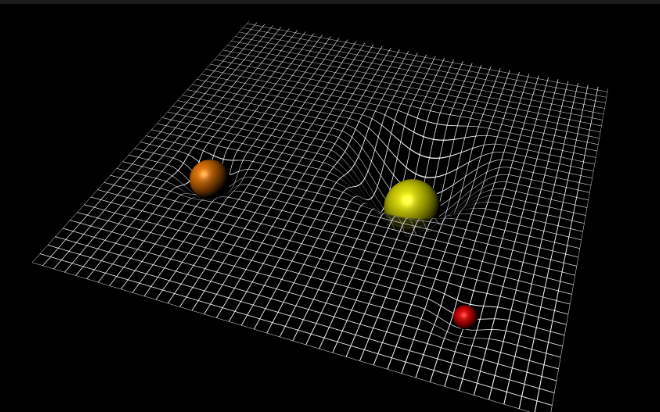
Gravity is a distortion in space-time that forms a kind of net that allows the weight of the planets to pull against each other. This is what gives them their lovely dances in relation to each other.

Screen Shot 2016-07-06 at 6.28.31 AM

RFT, and behavior analysis more broadly, is the gravity beneath our day-to-day behavior. It shows us how the constructs influenced by human verbal/symbolic behavior dance together.

This is ‘true’ in several ways:

Gravity is a very ‘real’ force to be reckoned with, and yet you can’t ‘prove’ it in most contexts. We just trust that it’s there because it is useful to do so. The construct of gravity is a description of relation. It’s a useful explanation in daily life for why it would be stupid to hold the DSM-5 over your foot and drop it. Sure, you could go ask Carl Sagan for the formula and proof, but in the meantime you should probably still move your foot out of the way of the DSM.

In the same way, RFT relations can’t typically be ‘proven’ in the moment. That’s not the point in applied work, though. Like the web you see below the planets, what RFT and behavior analysis more broadly gives us is far more powerful than a view of the actual planets. It gives a way to predict and intervene in nearly anything influenced by human thought. (If that doesn’t inspire awe, go back and read it again.)

Planets collide…

On another level, what it does is let us see the planets in a new light. They are no longer separate planets dancing unpredictably in space. They are a tiny visible piece of the universe dancing an understandable rhythm influenced by the interlocking distortion of space-time that holds them in relation to each other.

And just like this conception of gravity as space-time distortion, understanding RFT and behavior analysis allows us to come up with some amazing ways of understanding our universe.


Angela Coreil, PhD, BCBA

Angela Coreil, PhD, BCBA

Clinical Behavior Analyst, Methodologist & Trainer

Angela J. Coreil, PhD, is a professor at the University of Louisiana at Lafayette, clinical behavior analyst, and methodologist. Formerly director of an OCD and anxiety IOP/PHP, she integrates behavior analysis, ACT, Interpersonal Behavior Therapy, CBT, and exposure-based treatment. Her work develops practical improvements in behavioral science, and she provides consultation, professional training, workshops, and continuing education across disciplines.

Views expressed are those of Dr. Coreil or the explicitly named author, not the University of Louisiana at Lafayette.
The Parthenon on Quicksand

The Parthenon on Quicksand

Editor’s Note (2018): This article was originally published on AngelaCathey.com in 2016. It is reproduced here with only minor grammatical edits for readability. Some resources and terminology have evolved since its original publication, but the conceptual discussion is presented largely as it appeared at that time.

This may be a time of transition for psychology. Our path as a field has led to some great advances, but as it has grown, it also has begun to unravel at its seams.

The credibility of psychology

Though every field has its strong personalities and theoretical battles, psychology is one of the few fields so advanced, and yet, resistant to settling on common language and methodology. Having a level of fundamental disagreement that runs so deeply as to prevent basic agreement around measurement is obstructing the growth of our field. We advance a view of measurement at the base level of observable behavior, whenever possible, and fitting this under different traditions. Relying on this level of metric allows various schools to find a common language around fundamental and observable relationships between behavior.

The impact of not having a common language
Disagreements about metrics expand into disagreements around the constructs they measure, application of methods to move these constructs, and finally the construction of methodologies to measure the effects of application. We see this in the raising up of the Randomized Controlled Trial (RCT) as a standard research methodology for deeming treatments efficacious. RCTs are a research methodology established around finding differences between groups, assumptions that behaviors and symptoms vary on a normal curve, and attempts to reduce measurement ‘error’ around a hypothetically constant construct. Backing down to the level of measuring actual behavior, when possible, allows us to scale to a construct with less statistical and methodological ‘noise’ added to the top of everything. Use of these methods and reliance on assumptions to make the normal curve ‘work’ have likely contributed to the replication crises currently observed in behavioral science research. Some of this is inherent in the process of developing a science itself; however, as a science, we need to agree at the methodological level so we can soundly disagree at other levels. Allowing our science to further build on highly variable methodology is building the Parthenon on quicksand.

Angela Coreil, PhD, BCBA

Angela Coreil, PhD, BCBA

Clinical Behavior Analyst, Methodologist & Trainer

Angela J. Coreil, PhD, is a professor at the University of Louisiana at Lafayette, clinical behavior analyst, and methodologist. Formerly director of an OCD and anxiety IOP/PHP, she integrates behavior analysis, ACT, Interpersonal Behavior Therapy, CBT, and exposure-based treatment. Her work develops practical improvements in behavioral science, and she provides consultation, professional training, workshops, and continuing education across disciplines.

Views expressed are those of Dr. Coreil or the explicitly named author, not the University of Louisiana at Lafayette.

Pin It on Pinterest