Select Page
RFT: Let me show you something beautiful.

RFT: Let me show you something beautiful.

AUGUST 11, 2016, original post to angela.cathey.com

Stop over thinking RFT and feel it.

I would say that sometimes it takes a different perspective to look at the tools we are given and see them quite differently. We, the second and third generation ACTers, FAPers, and rising CFTers… we are reveling, rejecting, remixing, and refining the elegance of technical masterpieces.

So, here is one of my remixes. I don’t like connecting with RFT in examples of coin size, driving, or equations about how cats = “cats” and … =Screen Shot 2016-08-03 at 11.03.28 PM

Okay, he’s cute. I’ll give you that… but he’s still a cat.

RFT is the rhythm of human thought and feeling. Just because the Internet is officially full of cats. doesn’t mean that our conceptualizations of human thought and language should be. (No offense to the cat lovers or Schrode’ [inside joke]}

So what is more human? Art.

Here’s a different way of connecting with frames. Take a moment to look at the picture below. Notice.

Screen Shot 2016-08-03 at 10.26.48 PM

Feel your eyes pulled to the highest point? The background falling away into fuzziness. There’s a feeling of being pulled upward higher. This is a visual metaphor for how a hierarchical functions. This is what connecting with values, belonging, purpose… does to your sense of the world. You tune into the higher point and the rest falls away into the distance.

Now, look at this picture.

Screen Shot 2016-08-03 at 11.17.51 PM

Notice how the pieces fall away and the whole pops forth? You notice the togetherness, the uniformity of what is actually separate pieces. When we feel in coordination with something we move towards it, we identify with it, we become in some way a reflection of the other. (This is also a bit hierarchical, but “frames” are always functional concepts so let’s stick with what ‘works’.)

Now look at this picture.

Screen Shot 2016-08-03 at 11.21.53 PM

Maybe you could technically ‘see’ that this is tree bark but that’s not likely to be what you were paying attention to. Context sensitivity is like zooming in. You see the details. You experience, and you might be hyper- sensitive to a change in the context. For example, a giant ladybug landing in the middle of this might jolt your attention more so if you’re more contextually sensitive in-the-moment.

Now look at this picture.

Screen Shot 2016-08-03 at 11.14.02 PM.png

This is a visual metaphor for coherence. See how your mind likes the fitting together of randomness into a pattern? It’s naturally reinforcing. People don’t like messes.

Now look at this:

Screen Shot 2016-08-11 at 7.33.12 AM

This is a bit like the concept of adaptive peaks. Sometimes we can miss the forest, sunrise, and distance when we’re focusing on making wishes on the dandelions we can see in the immediate path.


If you like learning about Relational Frame Theory, behavior analysis, principles, or the philosophy of science in different forms – let us know in the comments. If you’d like to learn more feel free to check our selection of online, on-demand, and live training events.

Angela Coreil, PhD

Angela Coreil, PhD

Consultant and Educator

Angela J. Coreil, PhD works with individuals and organizations to promote better connected, purposeful, and effective living through behavior analytic principles. She has over a decade of clinical experience treating human suffering and promoting human excellence using Acceptance and Commitment Therapy (ACT) and other behavioral therapies. She now focuses on the promotion and translation of Clinical Behavior Analysis as a way to improve our science.

RFT: The Guerilla guide to pro-social change

RFT: The Guerilla guide to pro-social change

Original post to angelacathey.com, July 2016

Welcome to Frame Club. A Guerilla guide to pro-social change with RFT.

Screen Shot 2016-07-25 at 6.18.35 AM

The world is full of simple repetitive messaging. Everything is a bumper sticker. “Party A is evil, party B is good” and…. shootingsdiscriminationand ignorance follow.

Life and people aren’t bumper stickers. 

The repetitive simple messaging we’re privy to means that we’re deriving copies of copies of copies. That’s not good.  We’re also used to this and insensitive at times to direct contact contingencies. So, we get around rules in other ways for instance politicians can now move us more effectively through associative frame speak than through direct logic (eh hem… Drumpf for President anyone?).

And yet, we’re not doomed to idiocracy.

We know that simple low complexity derivation begets 1) rules, which leads to 2) unawareness (rule-governed insensitivity to contingencies).

When you add to that mix pain, you get: 1) avoidance, that leads of course to resilient and contagious ideas. This is why we teach acceptance by metaphor and experience. You can’t just say “accept” because you end up with a useless rigid rule and lack of awareness of the contingencies around it.

So, let’s acknowledge what’s there and why it’s there.

We all have histories of learning negative discriminatory relations about race, sex, gender, social class, body image, and a whole host of other things.

Even if they weren’t outright stated (aka you didn’t hear racist, sexist, anti-gay messaging regularly) simple repetition of any situation creates rules which spread in our minds in a variety of ways. We then deal with this in predictable ways.

Some of these rules may come about just through noticing differences and similarities between ourselves and others (Roche, Barnes-Holmes, Barnes-Holmes, Stewart, and O’Hora, 2002) and this influences our behavior.

So, we’re going to have these relations as a bi-product of our natural tendencies to categorize and organize our worlds (if we didn’t life would be a bit like 50 first dates. Where everything would be new and foreign each time we contacted it. That’s not workable. )

We’re going to have these rules in our heads about people that are painful as a result of living. We can try to wish them away but that’s just going to result in rules in the other direction then create insensitivity to direct contingencies (even if they’re as big as a gorilla in the room.)

Unfortunately, there is no erasing of relations. We all have painful thoughts that we’d rather not acknowledge.

Luckily, there’s been some great work on what this is in the social realm and what we can do about it (see Vilardaga, Levin, Hildebrant, Hayes, & Yadavia 2008, May ABA – need to log into ACBS for access) or Vilardaga, Hayes, Levin 2014 – The Flexible Connectedness Model).

We can deal with relations that are problematic in a variety of ways.

In some cases, we can simply derive new more complex relations that fade the old relations in importance; however, when the rule is more stubborn (i.e, involves any pain as it so often does when rules latch on to humans) this often won’t be enough.

We often need a shift in context (defusion, mindfulness of the contingencies of that drive our behavior in non-rule-based form). We can also combine these with combinations of context shift like this Deictic Framing Exercise (exercise by Vilardaga, Levin, Hayes, 2008 – video by Gareth Holman). This type of exercise combines several relations that move us past rule-based insensitivity including shifts in deictic and deictic related framing (temporal, hierarchial, etc.).

 This is likely to work for those who are willing to engage. 

However, we know that coherence, simplicity, avoidance of pain… all of this is self-reinforcing and we can’t expect a large portion of the population to sit down and do a perspective-taking exercise just yet. So, what can we do?

 Adapt the message or the context.

If argumentation and rule-based insensitivity are likely you need to adapt the message. Go metaphorical, go high complexity, and go associative. Feelings aren’t as easily blocked (see every perfume commercial ever made.)

Or shift the context, humor can work well at getting our attention when insensitivity is the norm (see Old Spice Muscle Pump  commercials that get our attention when we normally tune commercials out).

When humor, feeling, metaphor, aren’t practical and/or the consequences are too high, we can also reduce the accessibility of Sds (discriminative stimuli) if we know what’s pulling the problematic frames. We could be enacting this in some of our institutions (e.g., the justice system) now. We know the impact of race on judgments and sentencing and yet we just keep sending people into the justice system and pretending human bias isn’t there. When are we going to just start recognizing and adjusting to human bias tendencies to protect people? We’ll tend to engage in mass scale rule-based insensitivity to avoid contacting what’s difficult (see the DARE program and abstinence education for policies that continue to be funded despite their widely recognized ineffectiveness).

Contextual Behavioral Science and RFT can begin to mindfully examine these contingencies if we take the time to look at what’s going on with a stance of self-other compassion without blaming or shaming either party we can start from a new context where together we step forward to understand what keeps us stuck hurting ourselves and each other.

Angela Coreil, PhD

Angela Coreil, PhD

Consultant and Educator

Angela J. Coreil, PhD works with individuals and organizations to promote better connected, purposeful, and effective living through behavior analytic principles. She has over a decade of clinical experience treating human suffering and promoting human excellence using Acceptance and Commitment Therapy (ACT) and other behavioral therapies. She now focuses on the promotion and translation of Clinical Behavior Analysis as a way to improve our science.

You and I: Understanding and measuring high impact Functional Analytic Psychotherapy (FAP)

You and I: Understanding and measuring high impact Functional Analytic Psychotherapy (FAP)

Original Post to AngelaCathey.com on July 24th, 2016
by Angela Cathey

There are many ways to understand every therapy. Here I’ll offer a granular analysis of what seems to occur in the high impact FAP. What I present here is not an opposition to the current model of FAP but a different layer of analysis. I would agree that contingent reinforcement of behavior is a key mechanism of FAP. The purpose of an RFT-level analysis is to offer additional ways to measure and understand some of the effects of FAP that are otherwise difficult to characterize and measure.

I’m focusing on the symbolic relations that are created in what I call ‘high impact’ FAP. What I’m calling to in this description is the tendency of present moment relational therapy to become more powerful and evocative than one would normally suspect of a treatment based on reinforcement of adaptive behavior via the therapeutic relationship.

Those of you who have been to a FAP intensive or are highly experienced in FAP may be familiar with the report of FAP being “life-changing”, “transformative”, etc. To some extent one would hope most treatments are experienced this way; however, the rate which participants report intense response to FAP is likely higher. And, an RFT driven analysis there are empirical logical explanations for why those that experience FAP as moving may experience it as life-altering.)

Note that RFT is about symbolic relations and their properties. Patterns of pairing (between behavior, language in any form, sensations/perceptions, contexts) can all become meaningful over time through association with important (e.g., painful, joyful) experiences.

This is no different than operant reinforcement or classical conditioning – the type of pairing, the frequency/schedule, context, etc. all affect the relations made. The only difference here is that the SD can show up more easily symbolically (via language or some other cue).

So, let’s now look at perspective (the “I”) that orients your experience. You walk through life each day seeing, doing, feeling, thinking… and each of these things becomes a part of your continuing experience. In some way, they have become paired with the “I”. Perhaps very weakly paired but paired none the less. (See RFT: The space-time of the human universe for further description of perspective).

Experiences that happen over and over, including consistencies in the way that people describe you or relate to you become a part of your “I” and your concept of the other, or symbolic “YOU”.

The way you explain what occurs in these relations gives them additional power as it becomes a symbolically ‘sticky’ way of seeing the world (i.e., coherence relations, schema). You see others through this story of yourself and yourself as well. They, similarly, have stories about themselves and others and how people relate by which they organize their experience.

Now consider that everything you do in a relationship creates associations between:

The “YOU” and “I” present, or symbolically referenced (spoken about, etc.). Further, the emotions you express, the way that you talk about yourself and others, the behaviors you emit in any respect all become attached to the “YOUs” and “Is” in the room. (Yes, plural “I”s through the sometimes distinct tracks of symbolically defined behavior (e.g., roles, contexts, etc.) serving to create classes of behavior that ‘hang’ together.

Stop and consider that for a bit… Do you often belittle yourself in your own mind or in front of others? If you do you may find that people’s behavior towards you will begin to reflect this relation or that your own behavior towards your self will become less compassionate over time.

Our learning histories, ‘sticky’self-stories, and current histories all affect our sense of self and other. And, because the “I” is theoretically the relation most complexly derived (it is always there as a part of the associations forming) transformation of the “I” can ripple through all the attached relations.

Stop and think for a minute. All your sensory experience, all your visual perceptions, all your everything is hooked right through that “I” relation. So, what if it is altered? What will you experience?

If the alteration is “good”, perhaps you feel like this?

Now let’s switch to thinking about the process of an intimate relationship, using a lovely cheesy music video metaphor that we’ll then build upon both these to discuss the complex symbolic relating that can occur in high impact FAP.

Do watch as it will help you connect to the symbolic journey we’re going on through metaphor. The Story of My Life

Imagine that the moments of your life are pictures. The experiences that reflect complexity (ERRRs) most often are a series of pictures with richly emotional colorful (good or bad) details. See the birth of your child, and the hundreds of pictures to capture the complex experiences that follow.

Now, look around your home… are there single large photos blown up… special moments you wanted to save. These are likely snapshots of complexly derived moments (see the pictures from Hawaii… feel the sand beneath your toes? Sometimes complexity is lovely.

Now there are thousands of random shots in between that capture random moments, important relationships, accomplishments… and because this is your life, not a photo album imagine that all the moments you never wanted to remember are also there. In their full, and sometimes awful glory.

That time you fell on your ass in front of a crowd…
Your worst mistakes. All of them are memorialized in all their complex and highly derived glory (because rumination derives!) in big lovely photographs you keep hidden away.

All these moments that form the history of you, your pain, your joys, your disappointments… see them all strung along the wall back behind you (in time).

Now imagine opening your heart and mind to pull out these photographs and show another. Each time that you hand a painful or joyful memory to this person a connection between you forms, a connection between both of you and the memories seen, the emotional expressions of both (YOU and I) then shape the memories and the relationship. There’s a heck of a lot of relating going on here – temporal, deictic, high complexity, transformation of stimulus functions through coordination/distinction/opposition with the other.

And, this… is just a close relationship. This isn’t even therapy.

Notice how we all are deeply affected by our relations, good or bad, to those around us.

People are a core of our experience, our ‘self’, and our world.

Now, let’s work towards understanding the complexities of high impact Functional Analytic Psychotherapy relating.

Open this and listen while you Imagine.

Let’s walk through a super simplified course of FAP via the special case of intensives. For the unfamiliar, this is 3-4 day long training of therapists who come to hone their skills together by experiential practice.

Much like most FAP treatment itself it generally begins with some sort of Life History or discussion of adaptive (CRB2) and maladaptive (CRB1) behaviors. The very discussion pulls the relations along from the past, symbolically, to accompany the present. The power of the past (pain and joy) becomes more accessible by relation.

Now you begin to hand not the pictures described above but your real present moment experience (that is sometimes still fused with pain) to your colleagues. You may be brought to tears by the transformation of stimulus functions simply involved in discussing your pain and struggles in front of another.

As you engage in this interaction the other makes out-to-in parallels creating a symbolic I-YOU relation linking to the past relations involved (to people and behaviors that can be present in the now for changing).

In doing this, you are allowing the present moment interaction to alter contingencies set in other relationships because the attachment of past and present I-YOU to in the moment I-YOU is like creating a transcendent I-YOU.

The impact of the learning experience naturally becomes stronger as the symbolically present and in vivo relations combine. Anything altered through reinforcement or otherwise, can now affect the past, the present, the “I” and the “YOU” in the present, and all other “Is” and “YOUs” relevant to these relations.

At this point, contingent reinforcement takes on a new life. You’re shaping behavior but you’re also shaping relations, which allows you to interact with and shape someone’s relating to what occurred long with someone else. The shaping of that entire chain of relation can in a sense begin to over-write the relations of the self, the other, and the world.

The result can be “magic” and leave people changed. A present moment, relational therapy, driven by behaviorism. This is powerful medicine (not without its challenges).

Intensives, in particular, may evoke strong reactions as days of present moment relating in a uniquely supportive environment while bringing in other relations and experiencing the transformation of pain from long ago… it’s a bit like flooding of the deictic relations with new, hopefully adaptive, learning.

What are your thoughts on this and the complications of what we’re describing? Let us know in the comments. If you’re interested in more writing on clincial behavior analysis, RFT, principles, or the philosophy of science – let us know. Also, check out our selection on-line, on-demand, and live training on related topics!


Angela Coreil, PhD

Angela Coreil, PhD

Consultant and Educator

Angela J. Coreil, PhD works with individuals and organizations to promote better connected, purposeful, and effective living through behavior analytic principles. She has over a decade of clinical experience treating human suffering and promoting human excellence using Acceptance and Commitment Therapy (ACT) and other behavioral therapies. She now focuses on the promotion and translation of Clinical Behavior Analysis as a way to improve our science.

RFT: The Space-time of the Human Universe, Part I

RFT: The Space-time of the Human Universe, Part I

Original post to angelacathey.com (June, 2016)

I’m going to start this post off by telling you a little secret. I get a little obsessive with ideas. Give me something interesting to think about and I’m a kid with a Rubik’s cube all over again. When I immersed myself in RFT I turned that Rubik’s cube so many times I dreamt in RFT. (Yes, I know that’s weird.)

While you’re adjusting to that information, let me show you why I will probably never get tired of playing with this toy. I’m going to show you several metaphorical, philosophical, and sometimes downright fun, ways to understand RFT. 

CONSTRUCTS, RELATIONS, AND THE BEAUTY OF THE UNIVERSE

First, let’s loosen your frames a bit and help you ‘connect’ more abstractly. Let’s channel Karl Sagan for a moment and teach RFT through a little astrophysics.

Imagine the earth and planets swirling about in space. They all have this rhythm and dance to how they move about each other. Imagine now that those planets are constructs (e.g., “psychological flexibility”, “courage”, “love”, “present-moment-focus”, “mindfulness”, “habituation”, “transference”, etc).

Screen Shot 2016-07-06 at 6.40.46 AM

Now looking out on the planets we are like the astronomers once were… seeing these celestial bodies in awe but not understanding their rhythms. We can ‘see’ them dancing around each other but we can’t tell why. Most of our scientific method in psychology is based around this level of mystery. We assume we know very little and that every hypothesis is a bit like glancing in the telescope and hoping we see planets crash together. If we see it, and we haven’t spent all day looking through the telescope… then that’s an important finding! And, because we can’t all watch the whole universe we each pick a few planets (constructs) to watch intensely.

Now let go of your favorite planets for a moment and zoom back… look at the big picture. See the planets moving on their orbits over the course of time…

Now drop to a different level of analysis.  In this picture, we see what we scientists later understood about planets influence each other.

Screen Shot 2016-07-06 at 6.41.44 AM

What we understood that gave us infinite and useful knowledge about space (even beyond the planets we could see) was… as Karl Sagan put it, “gravity is geometry.”

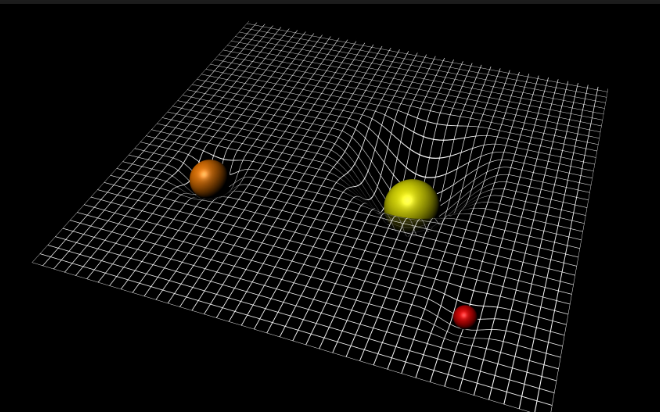
Gravity is a distortion in space-time that forms a kind of net that allows the weight of the planets to pull against each other. This is what gives them their lovely dances in relation to each other.

Screen Shot 2016-07-06 at 6.28.31 AM

RFT, and behavior analysis more broadly, is the gravity beneath our day-to-day behavior. It shows us how the constructs influenced by human verbal/symbolic behavior dance together.

This is ‘true’ in several ways:

Gravity is a very ‘real’ force to be reckoned with and yet you can’t ‘prove’ it in most contexts. We just trust that it’s there because it is useful to do so. The construct of gravity is a description of relation. It’s a useful explanation in daily life for why it would be stupid to hold the DSM-5 over your foot and drop it. Sure, you could go ask Karl Sagan for the formula and proof but in the meantime… you should probably still move your foot out of the way of the DSM.

In the same way, RFT relations can’t typically be ‘proven’ in the moment. That’s not the point in applied work though. Like the web you see below the planets, what RFT, and behavior analysis more broadly, gives us is far more powerful than a view of the actual planets. It gives a way to predict and intervene in nearly anything influenced by human thought. (If that doesn’t inspire awe … go back and read it again.)

Planets collide…

On another level, what it does is let use see the planets in a new light. They are no longer separate planets dancing unpredictably in space. They are a tiny visible piece of the universe dancing an understandable rhythm influenced by the interlocking distortion of space-time that holds them in relation to each other.

And just like this conception of gravity as space-time distortion… understanding RFT, and behavior analysis, allows us to come up with some amazing ways of understanding our universe.

If you like learning about Relational Frame Theory, behavior analysis, principles, or the philosophy of science through metaphor, or otherwise, let us know in the comments below! 

Angela Coreil, PhD

Angela Coreil, PhD

Consultant and Educator

Angela J. Coreil, PhD works with individuals and organizations to promote better connected, purposeful, and effective living through behavior analytic principles. She has over a decade of clinical experience treating human suffering and promoting human excellence using Acceptance and Commitment Therapy (ACT) and other behavioral therapies. She now focuses on the promotion and translation of Clinical Behavior Analysis as a way to improve our science.

Relational Frame Theory (RFT)- What’s the big deal?

Relational Frame Theory (RFT)- What’s the big deal?

by Angela Coreil, PhD (Original post to angela.cathey.com June, 2016)


So, what’s the deal with RFT? Isn’t this just another theory to add to your dusty reading stack? No. Put it on top, like yesterday.

RFT is a theory of how relating becomes a part of our processing of the world. We are richly hooked into our very verbal sense-making of the world. Our internal verbal-ish history can become a more predominate shaper of perception, in the moment, than even previous respondent or operant conditioning. Move over Bandura and those ridiculous Bobo dolls, we’re onto something big.

Yes, it’s a big deal. HUGE. The most coherent, expansive, and useful theories we have in psychology allow us to predict and influence behavior are operant and respondent conditioning-based. Functional Analysis (FA) is a cornerstone of modern behaviorist therapies and yet we’re saying that even if you account for all the ‘external’ context you could be missing the most important variable in the room.

Our ideographic and collective history of verbal relating influences our perception. Note: this is not the same as ‘language’. What we’re talking about is a hodgepodge mix of learning history, language, internal rules, sensations, etc. that people often hear as “language”). It’s not about “language” it’s about relational history that gets heavily influenced by language because that’s the framework we see the world through. Just think… when is the last time that voice in your head actually shut up? Never? We are verbal and that verbal-ness is often key in high-jacking a human’s response to the contingencies in the room. Further, we understand that the specific ways and frequencies in which we relate things can influence our perception, behavior, emotion in predictable ways.

So, this verbal relational soup of history is on-going and heavily influencing our contact with the world. This is pretty profound, but in itself, esoteric at best. Like knowledge of quantum mechanics and M-theory it’s cool but what can we DO with it? That’s where we really start getting to the sexiness inherent in RFT. RFT describes properties of relating such that you can walk back and forth with empirical logic from observation, to assessment, to intervention strategy.

As a clinician and researcher, I’ve done most of my work in exposure-based treatment of anxiety and related issues. In treating severe anxiety at the Intensive Outpatient and Partial Hospitalization levels I saw clients on a daily basis for hours, for months at a time.  It was doing this level of treatment where I saw the quirks of change, or lack of it, in my client’s behavior the best. It was here that I kept running across quirks in treatment and assessment that were not well explained in the literature. One of those phenomena was that what tended to most amp up or dampen exposure intensity within OCD and PTSD wasn’t what you’d expect. I found that often the stimuli or experiences that were most painful for people were linked to their values or their sense of themselves, others, or the world. I also noticed that sometimes hierarchies needed to include exposure to stimuli that just didn’t fit into normal models of fear conditioning (see exposures to milkshakes, umbrellas, The Doors, and emotions themselves). And, weirder yet – that a change in context could sometimes seemingly result in immediate ‘habituation’.

I returned to Relational Frame Theory and behavior analysis because training across modalities still left me with insufficient explanation for what I saw. Take the example of values intensifying exposure via values. Yes, that might be covered by ACT mid-level terms but it doesn’t give you a full picture. If we consider properties inherent in various types of ‘framing’ that might be at hand in values we not only know what to do to move this material with the client but we also have indications of other, less intuitive things that might also be amply or de-amplify an exposure (outside of values). We can reasonably say that hierarchical framing is likely at hand. Knowing this, we might also be able to find other material that moves exposures up and down the hierarchy simply by understanding the types of relations that are most predominant in driving the client’s experience. 

What’s more, you can do this underneath the level of therapeutic orientation and diagnosis. Everything becomes about relations that we can influence without clinging to our own preferred tools. (Yes, that’s right. I’m a behaviorist and I believe those psychoanalytic folks may even be getting it right too – just differently. None of us has a total lock-down on effective treatment.

I see this as the real beauty and possibility of Relational Frame Theory and behavior analysis – the promise that unification of psychology – across all areas influenced by human thought, across levels of analysis, across basic and applied, across therapeutic orientation, and across diagnoses might be possible. That we may just be able to move forward from the elaborated mess of opposing theories, big egos, and lack of cooperation that we currently call ‘psychology.’

Are you interested in learning more about RFT and behavior analysis? Let us know in the comments or consider taking one of our online training events.


Angela Coreil, PhD

Angela Coreil, PhD

Consultant and Educator

Angela J. Coreil, PhD works with individuals and organizations to promote better connected, purposeful, and effective living through behavior analytic principles. She has over a decade of clinical experience treating human suffering and promoting human excellence using Acceptance and Commitment Therapy (ACT) and other behavioral therapies. She now focuses on the promotion and translation of Clinical Behavior Analysis as a way to improve our science.

No Results Found

The page you requested could not be found. Try refining your search, or use the navigation above to locate the post.

Pin It on Pinterest