Select Page
The Matrix Viz: A functional assessment of verbal behaving

The Matrix Viz: A functional assessment of verbal behaving

Today I’m going to introduce a project that is one of many formulations of functional assessment we’ve been developing. The current formulation was first put to use more than a year ago with Benji Schoendorff, MSc and the Contextual Psychology Institute (CPI).

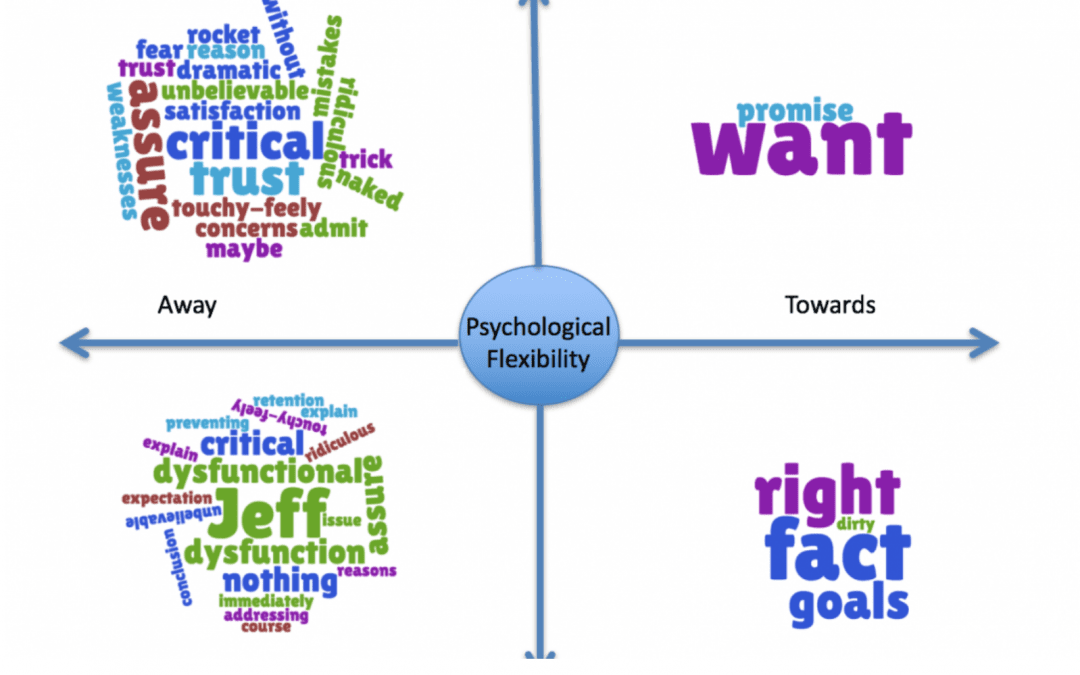
Below, you’ll see a data visualization built around “The Matrix” framework. The Matrix framework was developed some years ago by Kevin Polk, Benji Schoendorff, and others. It has gained quite a bit of popularity as a way to teach Acceptance and Commitment Therapy skills to both clinicians and clients. Use of The Matrix framework typically involves having clients or clinicians identify thoughts, feelings, and experiences and how they are oriented on the visual cross-hatch above. This is meant to help people begin to orient to important relationships between their behaviors and their experiences, without necessarily teaching the more elaborate hexaflex model of Acceptance and Commitment Therapy processes. In practice, most clinicians do not teach the skills taught in Acceptance and Commitment Therapy (ACT) by actually teaching the hexaflex to clients, but clinicians frequently start by learning this more complex model and trying to then translate that into how they work with clients. This is sometimes difficult for clinicians and can sometimes result in rather “canned” applications of ACT when clinicians are first mastering the model. Thus, the Matrix model is about teaching fluidity of process and flexibility in a way that often translates more easily.

This brings us to the Matrix Visualization that we’ll discuss today. What you are seeing, is best conceptualized as a tool to assist in the functional assessment of verbal behavior in the context of other behaviors you may observe from the client that are less difficult to track. We have used Ecological Momentary Assessment (EMA) and behavioral observations of other types to better situate verbal behavior (vocal or written) in the context of a functional analysis. 

The picture below is only one of many formats to make looking at many layers of verbal behaving and actual behavior of individuals in a way that can help us see the meaning of ongoing behavior, in context. The visualization below is simply an output (like a graph) that is the result of using Natural Language Processing (methods of using computer science to examine verbal behavior) to process written or speech behavior. These measurements and the content tagged in the written behavior are then fed into a real-time data visualization (using Tableau) to allow us to see a visual model of what is reflected in the written or vocal verbal behavior over a particular period of time. 

In this post, I will simply show the visualization and the source and describe what you are seeing.  To be sure, visualizing behavior through The Matrix format – is a matter of preference. Just as one can look at data in a bar graph or a pie chart, so too can we change the output format in which we display the ever-changing patterns of verbal behavior seen across time and context.

This visualization below is an example run on a piece of my own writing from an earlier post entitled, “RFT the Space-time of the Human Universe.” Here you will see a single moment of time of my own experience and verbal behavior reflected in the Matrix Visualization format. Though we have used this formulation in organizations that data is confidential. We’d also like to note that this work has evolved through a partnership with Contextual Psychology Institute (CPI). We greatly appreciate their continuing support of the development of this work.

The Matrix Viz
A tool to assist in functional assessment of verbal behaving within the larger context of a client’s behavior. This visualization is a data-driven analysis of verbal behavior only, again this would typically be used with other data about the client’s behavior across contexts to assist the clinician in functional analysis.

Though what the eye is frequently drawn to is the “content” level displayed, what should be attended to more fully is the movement of the content and changes in it over time. This snapshot gives us a brief idea of what of the likely functions of behavior across the time point covered by this writing, it should not in any way be considered a stable assessment of behavior (the writing period consisted of a few hours at most). To gain a better understanding of the function of behavior longer periods of communication should be analyzed and changes in the visualization noted. Further, change in quantitative form is useful to examine – but the visualization itself is meant to bridge some of the gaps encountered by clinicians and trainers as they attempt to use assessment to understand the ever-changing experience of their clients.

The assessment tool is driven by examining ideographic relating patterns, and to a lesser extent, the nomothetic functions of verbal behavior. This measurement is ideographic in the sense that it reflects patterns of relating specific to the individual, over the time covered. It is not based on the assumption of a normal curve of frequency or average levels of communication about a particular topic.

This measurement is nomothetic in the sense that at some level language has a shared cultural conditioning history, this is essential for it to function as a “language.” That is, if we don’t share enough of the same conditioning/relating history with regard to any word, sound, or group of words – then effective communication across individuals does not happen. Therefore, there is a level at which “content” based analysis does become relevant. For example, the concept of the verbal “self” (i.e., deictic relating) is based on the idea that the process of the verbal world speaking about us, identifying our experience, and of learning to speak about our experience ourselves – is fairly universal. The content that then becomes conditioned around the experience of the “self” is then identifiable by examining the language that ideographically hangs together around the content of “I”, “me”, etc. This is further supported by a significant body of research from others in related fields, such as Pennebaker who have extensively examined the function of pronouns using Natural Language Processing methods.

Further, though “universal” aspects of our language learning experience can be examined tagged to content, as mentioned above, most of the rest of the levels of analysis shown here is driven by vector-based Natural Language Processing methods. These do not assume particular content but instead look at changes in language by dropping to the level of semantic, syntactic, or statistical examination of the probability of a word/statement, etc following another word. Thus, rather than assuming normality around the frequency of a spoken word in a particular human context – they depend more on the underlying structure of language. This allows us to assume less about the content we expect and to pay more attention to the changing “signal” reflected in an individual or group’s “languaging” behavior. We can then use changes in the “signal” to understand what interpersonal, environmental, and other factors – constitute important contextual influences on the individual’s behavior.

At any moment, we relate on many levels of our experience. The “what” of what we relate is the layer most commonly assessed by psychological measures – it is by nature highly biased. “What,” we say is highly rule-governed and influenced heavily by contextual factors. It is well appreciated that our ability and willingness to report our experience moment-to-moment leads to significant response bias. Further, the methodology of asking about a specific “what” leads to efforts to standardize and statistically remove the influence of the questions themselves and other context. This is where the concept of standard error, etc. come into the creation of assessments. Assessing using a methodology that does not assume so many levels of normality, allows us to drop down to a lower level of analysis – a lower level of construct – and thus, hopefully, move closer to examining actual behavior and change – functionally.

This is akin to looking more at the  “how” of verbal relating, an indicator of experience. This is, in a way, similar to the difference between asking someone how much they hurt and instead of having them rate “0 (None) to 10 (A Lot),” listening to their expression about their pain from the warble in their voice or the strength of the words they use to describe their pain.

The Matrix Viz
An example of the Matrix visualization as tool for assisting in the functional assessment of verbal behaving.
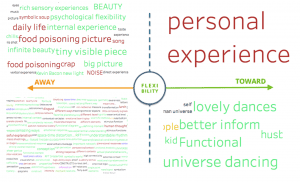
What can we see from this visualization?

Notice that the content is not sorted simply by base level “content”. There are phrases that on a face level of “content” would likely appear to belong in another quadrant. This categorization of content is based more heavily on the surrounding context in which the content appears. This occurs through a “weighting” of semantic and syntactic writing features that “weight” the “how” of the context of that the content is used in over the outright content-based meaning of the word. In other words, the “latent” levels of relating show you the deeper levels of experience relative to the surface “content” levels. This means that “I” or other pronouns may show up in any quadrant of the visualization based on the deeper relating context that which “I” is used. It is not simply “I” that falls in the lower right quadrant. It is based on the individual’s use and experience that shows up repeatedly around that content. Similarly, the same “content” can be reflected in different colors and quadrants simultaneously and this reflects our continuously changing relations and/or relating at different levels to the same content during a specific time point. For example, if the individual experienced a level of conflict between a desire and its aversive consequences, this same content might show up in red and green and in different quadrants. For example, desiring alcohol but feeling that one should not engage in drinking – would lead the word “alcohol” or any word in the same semantic group used to mean it to show up in red and green, in quadrants reflecting this simultaneous difference in the “function” of alcohol for the person.

The words in this particular visualization are coded in red, green, and black. These are micro indicators akin to red = aversive, green = appetitive, and black = neutral. So, for example – you can see that in this visualization “personal experience” comes up as both “red” = and aversive, and yet, it is in the “Toward” half of The Matrix. This reflects that in the author’s experience at the time of this writing – the personal experience was likely aversive but yet being approached.

In the bottom right quadrant, you see indications of values – again, you must step around surface content to see that “dancing” is a semantic substitute for a value of “playfulness.” A clinician or consultant using the Matrix Visualization to guide assessment would not assume the meaning of “dancing.” They should use the visualization as a guide and query the particular meaning of the content with the individual. This is akin to what you might do in a clinical session, pick out the patterns in relating and try to understand their significance in both the individual’s life and their behavior. The clinician can then use this information to understand and quickly assess likely functions and to use that to guide questioning and to also use more clinically and personally relevant metaphors for use in treatment.

In the bottom left quadrant, “Thinking/Away” – the main noticeable characteristic is the volume of material that shows up, both aversive and appetitive material. Notably, the content is also highly intellectualized and a bit defused sounding. This reflects the author’s tendency to intellectualize.

In the top left quadrant, “Sensing/Away,” you see indications of experiences that fall in networks of relations that were being moved away from at this point in time. Again, this type of assessment is best used as a method for examining likely functional relationships, following up with questioning with the client, and further using the assessment over time to examine likely changes in functional relationships. Thus, this kind of assessment likely provides a great deal more clinical useful information to a clinician than the average measure of “symptoms” – that reflects little about the client’s interpretation of those symptoms, no information about how the symptoms functionally relate and relies on self-report survey methodology that by nature includes a high degree of response bias influence.

If you’re curious about Natural Language Processing as up and coming method of quantitative assessment in Contextual Behavioral Science – See our Resources menu.

Angela Coreil, PhD

Angela Coreil, PhD

Consultant and Educator

Angela J. Coreil, PhD works with individuals and organizations to promote better connected, purposeful, and effective living through behavior analytic principles. She has over a decade of clinical experience treating human suffering and promoting human excellence using Acceptance and Commitment Therapy (ACT) and other behavioral therapies. She now focuses on the promotion and translation of Clinical Behavior Analysis as a way to improve our science.

You and I: Understanding and measuring high impact Functional Analytic Psychotherapy (FAP)

You and I: Understanding and measuring high impact Functional Analytic Psychotherapy (FAP)

Original Post to AngelaCathey.com on July 24th, 2016
by Angela Cathey

There are many ways to understand every therapy. Here I’ll offer a granular analysis of what seems to occur in the high impact FAP. What I present here is not an opposition to the current model of FAP but a different layer of analysis. I would agree that contingent reinforcement of behavior is a key mechanism of FAP. The purpose of an RFT-level analysis is to offer additional ways to measure and understand some of the effects of FAP that are otherwise difficult to characterize and measure.

I’m focusing on the symbolic relations that are created in what I call ‘high impact’ FAP. What I’m calling to in this description is the tendency of present moment relational therapy to become more powerful and evocative than one would normally suspect of a treatment based on reinforcement of adaptive behavior via the therapeutic relationship.

Those of you who have been to a FAP intensive or are highly experienced in FAP may be familiar with the report of FAP being “life-changing”, “transformative”, etc. To some extent one would hope most treatments are experienced this way; however, the rate which participants report intense response to FAP is likely higher. And, an RFT driven analysis there are empirical logical explanations for why those that experience FAP as moving may experience it as life-altering.)

Note that RFT is about symbolic relations and their properties. Patterns of pairing (between behavior, language in any form, sensations/perceptions, contexts) can all become meaningful over time through association with important (e.g., painful, joyful) experiences.

This is no different than operant reinforcement or classical conditioning – the type of pairing, the frequency/schedule, context, etc. all affect the relations made. The only difference here is that the SD can show up more easily symbolically (via language or some other cue).

So, let’s now look at perspective (the “I”) that orients your experience. You walk through life each day seeing, doing, feeling, thinking… and each of these things becomes a part of your continuing experience. In some way, they have become paired with the “I”. Perhaps very weakly paired but paired none the less. (See RFT: The space-time of the human universe for further description of perspective).

Experiences that happen over and over, including consistencies in the way that people describe you or relate to you become a part of your “I” and your concept of the other, or symbolic “YOU”.

The way you explain what occurs in these relations gives them additional power as it becomes a symbolically ‘sticky’ way of seeing the world (i.e., coherence relations, schema). You see others through this story of yourself and yourself as well. They, similarly, have stories about themselves and others and how people relate by which they organize their experience.

Now consider that everything you do in a relationship creates associations between:

The “YOU” and “I” present, or symbolically referenced (spoken about, etc.). Further, the emotions you express, the way that you talk about yourself and others, the behaviors you emit in any respect all become attached to the “YOUs” and “Is” in the room. (Yes, plural “I”s through the sometimes distinct tracks of symbolically defined behavior (e.g., roles, contexts, etc.) serving to create classes of behavior that ‘hang’ together.

Stop and consider that for a bit… Do you often belittle yourself in your own mind or in front of others? If you do you may find that people’s behavior towards you will begin to reflect this relation or that your own behavior towards your self will become less compassionate over time.

Our learning histories, ‘sticky’self-stories, and current histories all affect our sense of self and other. And, because the “I” is theoretically the relation most complexly derived (it is always there as a part of the associations forming) transformation of the “I” can ripple through all the attached relations.

Stop and think for a minute. All your sensory experience, all your visual perceptions, all your everything is hooked right through that “I” relation. So, what if it is altered? What will you experience?

If the alteration is “good”, perhaps you feel like this?

Now let’s switch to thinking about the process of an intimate relationship, using a lovely cheesy music video metaphor that we’ll then build upon both these to discuss the complex symbolic relating that can occur in high impact FAP.

Do watch as it will help you connect to the symbolic journey we’re going on through metaphor. The Story of My Life

Imagine that the moments of your life are pictures. The experiences that reflect complexity (ERRRs) most often are a series of pictures with richly emotional colorful (good or bad) details. See the birth of your child, and the hundreds of pictures to capture the complex experiences that follow.

Now, look around your home… are there single large photos blown up… special moments you wanted to save. These are likely snapshots of complexly derived moments (see the pictures from Hawaii… feel the sand beneath your toes? Sometimes complexity is lovely.

Now there are thousands of random shots in between that capture random moments, important relationships, accomplishments… and because this is your life, not a photo album imagine that all the moments you never wanted to remember are also there. In their full, and sometimes awful glory.

That time you fell on your ass in front of a crowd…

Your worst mistakes. All of them are memorialized in all their complex and highly derived glory (because rumination derives!) in big lovely photographs you keep hidden away.

All these moments that form the history of you, your pain, your joys, your disappointments… see them all strung along the wall back behind you (in time).

Now imagine opening your heart and mind to pull out these photographs and show another. Each time that you hand a painful or joyful memory to this person a connection between you forms, a connection between both of you and the memories seen, the emotional expressions of both (YOU and I) then shape the memories and the relationship. There’s a heck of a lot of relating going on here – temporal, deictic, high complexity, transformation of stimulus functions through coordination/distinction/opposition with the other.

And, this… is just a close relationship. This isn’t even therapy.

Notice how we all are deeply affected by our relations, good or bad, to those around us.

People are a core of our experience, our ‘self’, and our world.

Now, let’s work towards understanding the complexities of high impact Functional Analytic Psychotherapy relating.

Open this and listen while you Imagine.

Let’s walk through a super simplified course of FAP via the special case of intensives. For the unfamiliar, this is 3-4 day long training of therapists who come to hone their skills together by experiential practice.

Much like most FAP treatment itself it generally begins with some sort of Life History or discussion of adaptive (CRB2) and maladaptive (CRB1) behaviors. The very discussion pulls the relations along from the past, symbolically, to accompany the present. The power of the past (pain and joy) becomes more accessible by relation.

Now you begin to hand not the pictures described above but your real present moment experience (that is sometimes still fused with pain) to your colleagues. You may be brought to tears by the transformation of stimulus functions simply involved in discussing your pain and struggles in front of another.

As you engage in this interaction the other makes out-to-in parallels creating a symbolic I-YOU relation linking to the past relations involved (to people and behaviors that can be present in the now for changing).

In doing this, you are allowing the present moment interaction to alter contingencies set in other relationships because the attachment of past and present I-YOU to in the moment I-YOU is like creating a transcendent I-YOU.

The impact of the learning experience naturally becomes stronger as the symbolically present and in vivo relations combine. Anything altered through reinforcement or otherwise, can now affect the past, the present, the “I” and the “YOU” in the present, and all other “Is” and “YOUs” relevant to these relations.

At this point, contingent reinforcement takes on a new life. You’re shaping behavior but you’re also shaping relations, which allows you to interact with and shape someone’s relating to what occurred long with someone else. The shaping of that entire chain of relation can in a sense begin to over-write the relations of the self, the other, and the world.

The result can be “magic” and leave people changed. A present moment, relational therapy, driven by behaviorism. This is powerful medicine (not without its challenges).

Intensives, in particular, may evoke strong reactions as days of present moment relating in a uniquely supportive environment while bringing in other relations and experiencing the transformation of pain from long ago… it’s a bit like flooding of the deictic relations with new, hopefully adaptive, learning.

What are your thoughts on this and the complications of what we’re describing? Let us know in the comments. If you’re interested in more writing on clincial behavior analysis, RFT, principles, or the philosophy of science – let us know. Also, check out our selection on-line, on-demand, and live training on related topics!

Angela Coreil, PhD

Angela Coreil, PhD

Consultant and Educator

Angela J. Coreil, PhD works with individuals and organizations to promote better connected, purposeful, and effective living through behavior analytic principles. She has over a decade of clinical experience treating human suffering and promoting human excellence using Acceptance and Commitment Therapy (ACT) and other behavioral therapies. She now focuses on the promotion and translation of Clinical Behavior Analysis as a way to improve our science.

RFT: The Space-time of the Human Universe, Part I

RFT: The Space-time of the Human Universe, Part I

Original post to angelacathey.com (June, 2016)

I’m going to start this post off by telling you a little secret. I get a little obsessive with ideas. Give me something interesting to think about and I’m a kid with a Rubik’s cube all over again. When I immersed myself in RFT I turned that Rubik’s cube so many times I dreamt in RFT. (Yes, I know that’s weird.)

While you’re adjusting to that information, let me show you why I will probably never get tired of playing with this toy. I’m going to show you several metaphorical, philosophical, and sometimes downright fun, ways to understand RFT. 

CONSTRUCTS, RELATIONS, AND THE BEAUTY OF THE UNIVERSE

First, let’s loosen your frames a bit and help you ‘connect’ more abstractly. Let’s channel Karl Sagan for a moment and teach RFT through a little astrophysics.

Imagine the earth and planets swirling about in space. They all have this rhythm and dance to how they move about each other. Imagine now that those planets are constructs (e.g., “psychological flexibility”, “courage”, “love”, “present-moment-focus”, “mindfulness”, “habituation”, “transference”, etc).

Screen Shot 2016-07-06 at 6.40.46 AM

Now looking out on the planets we are like the astronomers once were… seeing these celestial bodies in awe but not understanding their rhythms. We can ‘see’ them dancing around each other but we can’t tell why. Most of our scientific method in psychology is based around this level of mystery. We assume we know very little and that every hypothesis is a bit like glancing in the telescope and hoping we see planets crash together. If we see it, and we haven’t spent all day looking through the telescope… then that’s an important finding! And, because we can’t all watch the whole universe we each pick a few planets (constructs) to watch intensely.

Now let go of your favorite planets for a moment and zoom back… look at the big picture. See the planets moving on their orbits over the course of time…

Now drop to a different level of analysis.  In this picture, we see what we scientists later understood about planets influence each other.

Screen Shot 2016-07-06 at 6.41.44 AM

What we understood that gave us infinite and useful knowledge about space (even beyond the planets we could see) was… as Karl Sagan put it, “gravity is geometry.”

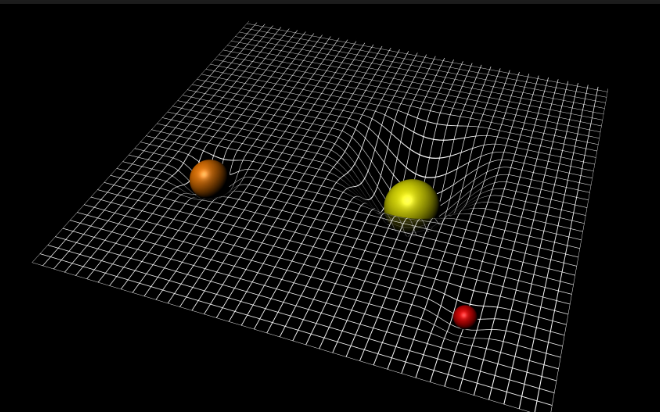
Gravity is a distortion in space-time that forms a kind of net that allows the weight of the planets to pull against each other. This is what gives them their lovely dances in relation to each other.

Screen Shot 2016-07-06 at 6.28.31 AM

RFT, and behavior analysis more broadly, is the gravity beneath our day-to-day behavior. It shows us how the constructs influenced by human verbal/symbolic behavior dance together.

This is ‘true’ in several ways:

Gravity is a very ‘real’ force to be reckoned with and yet you can’t ‘prove’ it in most contexts. We just trust that it’s there because it is useful to do so. The construct of gravity is a description of relation. It’s a useful explanation in daily life for why it would be stupid to hold the DSM-5 over your foot and drop it. Sure, you could go ask Karl Sagan for the formula and proof but in the meantime… you should probably still move your foot out of the way of the DSM.

In the same way, RFT relations can’t typically be ‘proven’ in the moment. That’s not the point in applied work though. Like the web you see below the planets, what RFT, and behavior analysis more broadly, gives us is far more powerful than a view of the actual planets. It gives a way to predict and intervene in nearly anything influenced by human thought. (If that doesn’t inspire awe … go back and read it again.)

Planets collide…

On another level, what it does is let use see the planets in a new light. They are no longer separate planets dancing unpredictably in space. They are a tiny visible piece of the universe dancing an understandable rhythm influenced by the interlocking distortion of space-time that holds them in relation to each other.

And just like this conception of gravity as space-time distortion… understanding RFT, and behavior analysis, allows us to come up with some amazing ways of understanding our universe.

If you like learning about Relational Frame Theory, behavior analysis, principles, or the philosophy of science through metaphor, or otherwise, let us know in the comments below! 

Angela Coreil, PhD

Angela Coreil, PhD

Consultant and Educator

Angela J. Coreil, PhD works with individuals and organizations to promote better connected, purposeful, and effective living through behavior analytic principles. She has over a decade of clinical experience treating human suffering and promoting human excellence using Acceptance and Commitment Therapy (ACT) and other behavioral therapies. She now focuses on the promotion and translation of Clinical Behavior Analysis as a way to improve our science.

What is Acceptance and Commitment Therapy?

What is Acceptance and Commitment Therapy?

Acceptance and Commitment Therapy or “ACT” said as one word is considered one of a new wave of cognitive-behavioral therapies, including Dialectical Behavioral Therapy (DBT), Functional Analytic Psychotherapy (FAP), and others. These treatments largely involve many of the aspects common in traditional cognitive-behavioral therapies but with important technical and theoretical differences (Hayes, Strosahl, & Wilson, 1999). In ACT there is a focus on “accepting” what is out of the client’s control and commit to changing what is in their control, to improve their lives (Orsillo & Roemer, 2005). ACT includes the use of mindfulness, to assist in reaching these goals, which has long been a part of Eastern philosophies such as Buddhism and Taoism. Mindfulness can be explained as being aware of your experiences moment to moment and experiencing them with openness and interest, rather than judgment (Hayes et al., 1999; Orsillo & Roemer, 2005).

ACT is a tradition based on Functional Contextualism (Hayes et al., 1999). Functional contextualism is a form of pragmatism, which states events should be understood as a whole, in context, and as ongoing (Hayes et al., 1999). This is in opposition with most traditional views of behavioral therapies, which are more present-focused and tend to limit their focus to what is appears directly relevant to the presenting problem. Also important in functional contextualism is the following of pragmatic truth criterion. Pragmatic truth criterion refers to judge the effectiveness of our actions based on how they meet our goals rather than their match to some supposed concrete reality. In this line of thought, no ‘truth’ is universal; what is true is only what works in getting a person to their unique goals. This differs from most traditional cognitive-behavioral treatments that might focus on having clients test the validity of their thoughts in quasi scientific manner against reality. In ACT, a person we would tend not to ask a client to test their thoughts regarding fears to see if they are “valid” or “logical” fears. In ACT, the focus is on whether believing the thought constricts or expands the individual’s ability to live a valued life. This is often referred to as “workability” and is a central concept to contextualism. “Context” here refers to how the behavior occurs and what rules govern the behavior (Hayes et al., 1999). Within ACT the context of the behavior, and not the form, of the behavior itself is the focus of change. Thus, symptom reduction is not directly an aim of ACT but rather a side effect (Hayes et al., 1999). From the ACT perspective, suffering is both a necessary and unavoidable part of life, but the way we experience suffering is determined by our understanding of it (Hayes et al., 1999).

Also essential to the foundation of Acceptance and Commitment Therapy is its take on the role of human language in human suffering. Understood through Relational Frame Theory, human language as a process results in destruction, dysfunction, and pathological processes (Hayes et al., 1999). Language is necessary for the advancement of human society and each individual, however; the associations we make through language eventually cause us misery. Relational Frame Theory (RFT) suggests that through behavioral conditioning language itself can affect how we feel. As we learn language, conditioning creates “mutual entailment” or bi-directionality in associations between words, feelings, and things. It is in this way that children learn that words and things are equivalent (Hayes et al., 1999). However, it is his essential feature in learning to communicate with others that can later cause us a great deal of suffering. Since the words we have learned trigger the images and feelings they have been paired with in our past; we are prone to sometimes feel emotional pain unnecessarily. Just as when you think of the word “lemon”, you have an immediate reaction to taste sour you can have a response to the word “anxiety”, such that thinking about the word “anxiety” can make you feel anxious. This creates problems because as most people try to avoid feeling unpleasant feelings; they cause themselves the very feelings they are trying to avoid. For example, to think, “Don’t get anxious!” includes the thought of “anxiety”, and thus feelings of anxiety (Hayes et al., 1999; Orsillo & Roemer, 2005). These conditioned relationships in our minds are the result of often life long patterns of association, and thus are also quite difficult associations to break up. And, in fact, though we can break them up they quite often resurge (Hayes et al., 1999).

Through ACT individuals learn to reduce the impact of conditioned language associations on their feelings and actions. ACT takes the position that because of the way we process language, according to RFT, our typical methods for solving problems logically in the outside world are inappropriate for solving problems with thoughts and feelings. We tend to assume that we must simply determine the reason for some unpleasant feeling or behavior and remove it, to remedy unpleasant feelings or consequences. This leads us to the culturally supported idea that thoughts and feelings are good explanations for what we do. So, though we have the capability to act contrary to our thoughts and feelings, we assume that to control our actions we must control the feelings and thoughts associated with them. However, as RFT indicates, the more we endeavor to control our thoughts the more we will suffer from them. Therefore an important feature of ACT is to reduce experiential avoidance, or the unwillingness to experience certain feelings (Hayes et al., 1999; Orsillo & Roemer, 2005). What we have to realize is that it is perfectly normal to feel unpleasant feelings at times and that the objective to control, reduce, or rid ourselves of these feelings is not a successful approach (Hayes et al., 1999).

ACT suggests that the alternative to experiential avoidance is acceptance, and mindfulness, as in accepting that feeling unpleasant sometimes is a natural and necessary part of life. ACT also suggests that choice and committed action are more appropriate ways to deal with life than avoidance. ACT’s goals include the shift from understanding words as content to context; learning to understand both the benefits of language and how it can affect us negatively when we do not take into account the learning context (Hayes et al., 1999).  ACT seeks to undermine unworkable change agendas, such as experiential avoidance, by helping clients realize their refusal to feel and accept causes more pain. In addition, ACT seeks to help individuals identify and clarify their life direction and goals. ACT therapists endeavor to suspend their own judgment regarding what goals a person should have, because from the ACT perspective, the appropriateness of goals is subjective, and the client should pursue those goals important to them (Hayes et al., 1999).

Therapeutic tools used in ACT, to reach ACT consistent goals, include: the use of metaphors, therapeutic paradox, and experiential exercises (Hayes et al., 1999). Metaphors are used to reduce the impact of literal language and to prevent the client from simply following the requests of the therapist without achieving true understanding. Since metaphors cannot be exactly interpreted, they cannot be exactly followed; the client is forced to experience and understand rather than rely on the therapist’s direction (Hayes et al., 1999). Therapeutic paradox is similarly used to reduce the impact of literal language on the client. The client is given a task where they can experience the consequences of not avoiding their symptoms, which typically includes a reduction in the symptom. Experiential Exercises can also be used to change the verbal context of situations, so that the client can learn to observe and study their feelings without imposing judgment on them. ACT methods include many metaphors and experiential exercises to address different problems and different frames of mind. Another tool used by ACT therapists is creating “hopelessness” in clients by pointing out the failure of previously used methods to control their feelings. This technique motivates the client to accept new ways of understanding their problems and new solutions for them (Hayes et al., 1999). As mentioned above, ACT therapists help clients explore their values and help them learn to lead their lives in accordance with these values. This last phase of treatment is often more behaviorally oriented than other phases of ACT; it includes intense discussion over the client’s values and behavioral strategies to assist the client in reducing discrepancies between their actions and values (Hayes et al., 1999).

Recent years have seen an explosion in ACT-related research and the effectiveness of ACT in many different populations and with many different diagnoses. Hayes and associates continue to conduct training seminars, workshops, and conferences devoted to the promotion and further development of ACT theory and methods. Clinicians also continue to develop a wider variety of useful metaphors and experiential exercises to inspire clients to a new understanding of their problems and motivate them to “ACT” in line with their values (Hayes et al., 1999).

Angela Coreil, PhD

Angela Coreil, PhD

Consultant and Educator

Angela J. Coreil, PhD works with individuals and organizations to promote better connected, purposeful, and effective living through behavior analytic principles. She has over a decade of clinical experience treating human suffering and promoting human excellence using Acceptance and Commitment Therapy (ACT) and other behavioral therapies. She now focuses on the promotion and translation of Clinical Behavior Analysis as a way to improve our science.

Strengthening the Roots of Our Science and Practice.

Strengthening the Roots of Our Science and Practice.

by Angela Cathey, MA, LPC (Owner, Behavior-Behavior.org & Evolve, by ENSO Group)

Behavior-Behavior was founded as a part of a movement to strengthen the roots of our science and practice as behavioral scientists and practitioners.

As a field, we have moved too far under the conditions that influence our training and funding as researchers and practitioners. Training programs more and more spend significant time training their students on particular treatment protocols and their components, without spending adequate time teaching students what drives these protocols – the principles, methodology, and contingencies that move our field.

As practitioners and researchers, it becomes our responsibility to obtain a deeper level of skill and to do so in environments that don’t typically support the time and cost needed to keep abreast of important developments in our field.

Behavior-Behavior is an effort to make strengthening and deepening your practice based on principles and the latest research more workable for practicing clinicians and researchers. We offer news, practice tools, online training, and consultation for the discriminating clinician and researcher.

Pin It on Pinterest