
Select Page
You and I: Understanding and measuring high impact Functional Analytic Psychotherapy (FAP)

You and I: Understanding and measuring high impact Functional Analytic Psychotherapy (FAP)

Original Post to AngelaCathey.com on July 24th, 2016
by Angela Cathey

There are many ways to understand every therapy. Here I’ll offer a granular analysis of what seems to occur in the high impact FAP. What I present here is not an opposition to the current model of FAP but a different layer of analysis. I would agree that contingent reinforcement of behavior is a key mechanism of FAP. The purpose of an RFT-level analysis is to offer additional ways to measure and understand some of the effects of FAP that are otherwise difficult to characterize and measure.

I’m focusing on the symbolic relations that are created in what I call ‘high impact’ FAP. What I’m calling to in this description is the tendency of present moment relational therapy to become more powerful and evocative than one would normally suspect of a treatment based on reinforcement of adaptive behavior via the therapeutic relationship.

Those of you who have been to a FAP intensive or are highly experienced in FAP may be familiar with the report of FAP being “life-changing”, “transformative”, etc. To some extent one would hope most treatments are experienced this way; however, the rate which participants report intense response to FAP is likely higher. And, an RFT driven analysis there are empirical logical explanations for why those that experience FAP as moving may experience it as life-altering.)

Note that RFT is about symbolic relations and their properties. Patterns of pairing (between behavior, language in any form, sensations/perceptions, contexts) can all become meaningful over time through association with important (e.g., painful, joyful) experiences.

This is no different than operant reinforcement or classical conditioning – the type of pairing, the frequency/schedule, context, etc. all affect the relations made. The only difference here is that the SD can show up more easily symbolically (via language or some other cue).

So, let’s now look at perspective (the “I”) that orients your experience. You walk through life each day seeing, doing, feeling, thinking… and each of these things becomes a part of your continuing experience. In some way, they have become paired with the “I”. Perhaps very weakly paired but paired none the less. (See RFT: The space-time of the human universe for further description of perspective).

Experiences that happen over and over, including consistencies in the way that people describe you or relate to you become a part of your “I” and your concept of the other, or symbolic “YOU”.

The way you explain what occurs in these relations gives them additional power as it becomes a symbolically ‘sticky’ way of seeing the world (i.e., coherence relations, schema). You see others through this story of yourself and yourself as well. They, similarly, have stories about themselves and others and how people relate by which they organize their experience.

Now consider that everything you do in a relationship creates associations between:

The “YOU” and “I” present, or symbolically referenced (spoken about, etc.). Further, the emotions you express, the way that you talk about yourself and others, the behaviors you emit in any respect all become attached to the “YOUs” and “Is” in the room. (Yes, plural “I”s through the sometimes distinct tracks of symbolically defined behavior (e.g., roles, contexts, etc.) serving to create classes of behavior that ‘hang’ together.

Stop and consider that for a bit… Do you often belittle yourself in your own mind or in front of others? If you do you may find that people’s behavior towards you will begin to reflect this relation or that your own behavior towards your self will become less compassionate over time.

Our learning histories, ‘sticky’self-stories, and current histories all affect our sense of self and other. And, because the “I” is theoretically the relation most complexly derived (it is always there as a part of the associations forming) transformation of the “I” can ripple through all the attached relations.

Stop and think for a minute. All your sensory experience, all your visual perceptions, all your everything is hooked right through that “I” relation. So, what if it is altered? What will you experience?

If the alteration is “good”, perhaps you feel like this?

Now let’s switch to thinking about the process of an intimate relationship, using a lovely cheesy music video metaphor that we’ll then build upon both these to discuss the complex symbolic relating that can occur in high impact FAP.

Do watch as it will help you connect to the symbolic journey we’re going on through metaphor. The Story of My Life

Imagine that the moments of your life are pictures. The experiences that reflect complexity (ERRRs) most often are a series of pictures with richly emotional colorful (good or bad) details. See the birth of your child, and the hundreds of pictures to capture the complex experiences that follow.

Now, look around your home… are there single large photos blown up… special moments you wanted to save. These are likely snapshots of complexly derived moments (see the pictures from Hawaii… feel the sand beneath your toes? Sometimes complexity is lovely.

Now there are thousands of random shots in between that capture random moments, important relationships, accomplishments… and because this is your life, not a photo album imagine that all the moments you never wanted to remember are also there. In their full, and sometimes awful glory.

That time you fell on your ass in front of a crowd…

Your worst mistakes. All of them are memorialized in all their complex and highly derived glory (because rumination derives!) in big lovely photographs you keep hidden away.

All these moments that form the history of you, your pain, your joys, your disappointments… see them all strung along the wall back behind you (in time).

Now imagine opening your heart and mind to pull out these photographs and show another. Each time that you hand a painful or joyful memory to this person a connection between you forms, a connection between both of you and the memories seen, the emotional expressions of both (YOU and I) then shape the memories and the relationship. There’s a heck of a lot of relating going on here – temporal, deictic, high complexity, transformation of stimulus functions through coordination/distinction/opposition with the other.

And, this… is just a close relationship. This isn’t even therapy.

Notice how we all are deeply affected by our relations, good or bad, to those around us.

People are a core of our experience, our ‘self’, and our world.

Now, let’s work towards understanding the complexities of high impact Functional Analytic Psychotherapy relating.

Open this and listen while you Imagine.

Let’s walk through a super simplified course of FAP via the special case of intensives. For the unfamiliar, this is 3-4 day long training of therapists who come to hone their skills together by experiential practice.

Much like most FAP treatment itself it generally begins with some sort of Life History or discussion of adaptive (CRB2) and maladaptive (CRB1) behaviors. The very discussion pulls the relations along from the past, symbolically, to accompany the present. The power of the past (pain and joy) becomes more accessible by relation.

Now you begin to hand not the pictures described above but your real present moment experience (that is sometimes still fused with pain) to your colleagues. You may be brought to tears by the transformation of stimulus functions simply involved in discussing your pain and struggles in front of another.

As you engage in this interaction the other makes out-to-in parallels creating a symbolic I-YOU relation linking to the past relations involved (to people and behaviors that can be present in the now for changing).

In doing this, you are allowing the present moment interaction to alter contingencies set in other relationships because the attachment of past and present I-YOU to in the moment I-YOU is like creating a transcendent I-YOU.

The impact of the learning experience naturally becomes stronger as the symbolically present and in vivo relations combine. Anything altered through reinforcement or otherwise, can now affect the past, the present, the “I” and the “YOU” in the present, and all other “Is” and “YOUs” relevant to these relations.

At this point, contingent reinforcement takes on a new life. You’re shaping behavior but you’re also shaping relations, which allows you to interact with and shape someone’s relating to what occurred long with someone else. The shaping of that entire chain of relation can in a sense begin to over-write the relations of the self, the other, and the world.

The result can be “magic” and leave people changed. A present moment, relational therapy, driven by behaviorism. This is powerful medicine (not without its challenges).

Intensives, in particular, may evoke strong reactions as days of present moment relating in a uniquely supportive environment while bringing in other relations and experiencing the transformation of pain from long ago… it’s a bit like flooding of the deictic relations with new, hopefully adaptive, learning.

What are your thoughts on this and the complications of what we’re describing? Let us know in the comments. If you’re interested in more writing on clincial behavior analysis, RFT, principles, or the philosophy of science – let us know. Also, check out our selection on-line, on-demand, and live training on related topics!

Angela Coreil, PhD

Angela Coreil, PhD

Consultant and Educator

Angela J. Coreil, PhD works with individuals and organizations to promote better connected, purposeful, and effective living through behavior analytic principles. She has over a decade of clinical experience treating human suffering and promoting human excellence using Acceptance and Commitment Therapy (ACT) and other behavioral therapies. She now focuses on the promotion and translation of Clinical Behavior Analysis as a way to improve our science.


RFT: The Space-time of the Human Universe, Part I

RFT: The Space-time of the Human Universe, Part I

Original post to angelacathey.com (June, 2016)

I’m going to start this post off by telling you a little secret. I get a little obsessive with ideas. Give me something interesting to think about and I’m a kid with a Rubik’s cube all over again. When I immersed myself in RFT I turned that Rubik’s cube so many times I dreamt in RFT. (Yes, I know that’s weird.)

While you’re adjusting to that information, let me show you why I will probably never get tired of playing with this toy. I’m going to show you several metaphorical, philosophical, and sometimes downright fun, ways to understand RFT. 

CONSTRUCTS, RELATIONS, AND THE BEAUTY OF THE UNIVERSE

First, let’s loosen your frames a bit and help you ‘connect’ more abstractly. Let’s channel Karl Sagan for a moment and teach RFT through a little astrophysics.

Imagine the earth and planets swirling about in space. They all have this rhythm and dance to how they move about each other. Imagine now that those planets are constructs (e.g., “psychological flexibility”, “courage”, “love”, “present-moment-focus”, “mindfulness”, “habituation”, “transference”, etc).

Screen Shot 2016-07-06 at 6.40.46 AM

Now looking out on the planets we are like the astronomers once were… seeing these celestial bodies in awe but not understanding their rhythms. We can ‘see’ them dancing around each other but we can’t tell why. Most of our scientific method in psychology is based around this level of mystery. We assume we know very little and that every hypothesis is a bit like glancing in the telescope and hoping we see planets crash together. If we see it, and we haven’t spent all day looking through the telescope… then that’s an important finding! And, because we can’t all watch the whole universe we each pick a few planets (constructs) to watch intensely.

Now let go of your favorite planets for a moment and zoom back… look at the big picture. See the planets moving on their orbits over the course of time…

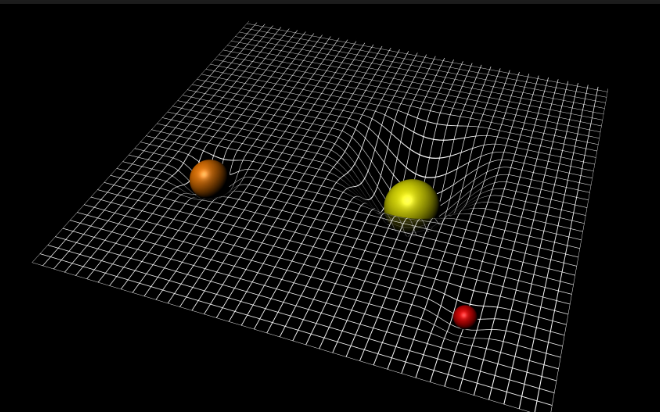
Now drop to a different level of analysis.  In this picture, we see what we scientists later understood about planets influence each other.

Screen Shot 2016-07-06 at 6.41.44 AM

What we understood that gave us infinite and useful knowledge about space (even beyond the planets we could see) was… as Karl Sagan put it, “gravity is geometry.”

Gravity is a distortion in space-time that forms a kind of net that allows the weight of the planets to pull against each other. This is what gives them their lovely dances in relation to each other.

Screen Shot 2016-07-06 at 6.28.31 AM

RFT, and behavior analysis more broadly, is the gravity beneath our day-to-day behavior. It shows us how the constructs influenced by human verbal/symbolic behavior dance together.

This is ‘true’ in several ways:

Gravity is a very ‘real’ force to be reckoned with and yet you can’t ‘prove’ it in most contexts. We just trust that it’s there because it is useful to do so. The construct of gravity is a description of relation. It’s a useful explanation in daily life for why it would be stupid to hold the DSM-5 over your foot and drop it. Sure, you could go ask Karl Sagan for the formula and proof but in the meantime… you should probably still move your foot out of the way of the DSM.

In the same way, RFT relations can’t typically be ‘proven’ in the moment. That’s not the point in applied work though. Like the web you see below the planets, what RFT, and behavior analysis more broadly, gives us is far more powerful than a view of the actual planets. It gives a way to predict and intervene in nearly anything influenced by human thought. (If that doesn’t inspire awe … go back and read it again.)

Planets collide…

On another level, what it does is let use see the planets in a new light. They are no longer separate planets dancing unpredictably in space. They are a tiny visible piece of the universe dancing an understandable rhythm influenced by the interlocking distortion of space-time that holds them in relation to each other.

And just like this conception of gravity as space-time distortion… understanding RFT, and behavior analysis, allows us to come up with some amazing ways of understanding our universe.

If you like learning about Relational Frame Theory, behavior analysis, principles, or the philosophy of science through metaphor, or otherwise, let us know in the comments below! 

Angela Coreil, PhD

Angela Coreil, PhD

Consultant and Educator

Angela J. Coreil, PhD works with individuals and organizations to promote better connected, purposeful, and effective living through behavior analytic principles. She has over a decade of clinical experience treating human suffering and promoting human excellence using Acceptance and Commitment Therapy (ACT) and other behavioral therapies. She now focuses on the promotion and translation of Clinical Behavior Analysis as a way to improve our science.

What is Acceptance and Commitment Therapy?

What is Acceptance and Commitment Therapy?

Acceptance and Commitment Therapy or “ACT” said as one word is considered one of a new wave of cognitive-behavioral therapies, including Dialectical Behavioral Therapy (DBT), Functional Analytic Psychotherapy (FAP), and others. These treatments largely involve many of the aspects common in traditional cognitive-behavioral therapies but with important technical and theoretical differences (Hayes, Strosahl, & Wilson, 1999). In ACT there is a focus on “accepting” what is out of the client’s control and commit to changing what is in their control, to improve their lives (Orsillo & Roemer, 2005). ACT includes the use of mindfulness, to assist in reaching these goals, which has long been a part of Eastern philosophies such as Buddhism and Taoism. Mindfulness can be explained as being aware of your experiences moment to moment and experiencing them with openness and interest, rather than judgment (Hayes et al., 1999; Orsillo & Roemer, 2005).

ACT is a tradition based on Functional Contextualism (Hayes et al., 1999). Functional contextualism is a form of pragmatism, which states events should be understood as a whole, in context, and as ongoing (Hayes et al., 1999). This is in opposition with most traditional views of behavioral therapies, which are more present-focused and tend to limit their focus to what is appears directly relevant to the presenting problem. Also important in functional contextualism is the following of pragmatic truth criterion. Pragmatic truth criterion refers to judge the effectiveness of our actions based on how they meet our goals rather than their match to some supposed concrete reality. In this line of thought, no ‘truth’ is universal; what is true is only what works in getting a person to their unique goals. This differs from most traditional cognitive-behavioral treatments that might focus on having clients test the validity of their thoughts in quasi scientific manner against reality. In ACT, a person we would tend not to ask a client to test their thoughts regarding fears to see if they are “valid” or “logical” fears. In ACT, the focus is on whether believing the thought constricts or expands the individual’s ability to live a valued life. This is often referred to as “workability” and is a central concept to contextualism. “Context” here refers to how the behavior occurs and what rules govern the behavior (Hayes et al., 1999). Within ACT the context of the behavior, and not the form, of the behavior itself is the focus of change. Thus, symptom reduction is not directly an aim of ACT but rather a side effect (Hayes et al., 1999). From the ACT perspective, suffering is both a necessary and unavoidable part of life, but the way we experience suffering is determined by our understanding of it (Hayes et al., 1999).

Also essential to the foundation of Acceptance and Commitment Therapy is its take on the role of human language in human suffering. Understood through Relational Frame Theory, human language as a process results in destruction, dysfunction, and pathological processes (Hayes et al., 1999). Language is necessary for the advancement of human society and each individual, however; the associations we make through language eventually cause us misery. Relational Frame Theory (RFT) suggests that through behavioral conditioning language itself can affect how we feel. As we learn language, conditioning creates “mutual entailment” or bi-directionality in associations between words, feelings, and things. It is in this way that children learn that words and things are equivalent (Hayes et al., 1999). However, it is his essential feature in learning to communicate with others that can later cause us a great deal of suffering. Since the words we have learned trigger the images and feelings they have been paired with in our past; we are prone to sometimes feel emotional pain unnecessarily. Just as when you think of the word “lemon”, you have an immediate reaction to taste sour you can have a response to the word “anxiety”, such that thinking about the word “anxiety” can make you feel anxious. This creates problems because as most people try to avoid feeling unpleasant feelings; they cause themselves the very feelings they are trying to avoid. For example, to think, “Don’t get anxious!” includes the thought of “anxiety”, and thus feelings of anxiety (Hayes et al., 1999; Orsillo & Roemer, 2005). These conditioned relationships in our minds are the result of often life long patterns of association, and thus are also quite difficult associations to break up. And, in fact, though we can break them up they quite often resurge (Hayes et al., 1999).

Through ACT individuals learn to reduce the impact of conditioned language associations on their feelings and actions. ACT takes the position that because of the way we process language, according to RFT, our typical methods for solving problems logically in the outside world are inappropriate for solving problems with thoughts and feelings. We tend to assume that we must simply determine the reason for some unpleasant feeling or behavior and remove it, to remedy unpleasant feelings or consequences. This leads us to the culturally supported idea that thoughts and feelings are good explanations for what we do. So, though we have the capability to act contrary to our thoughts and feelings, we assume that to control our actions we must control the feelings and thoughts associated with them. However, as RFT indicates, the more we endeavor to control our thoughts the more we will suffer from them. Therefore an important feature of ACT is to reduce experiential avoidance, or the unwillingness to experience certain feelings (Hayes et al., 1999; Orsillo & Roemer, 2005). What we have to realize is that it is perfectly normal to feel unpleasant feelings at times and that the objective to control, reduce, or rid ourselves of these feelings is not a successful approach (Hayes et al., 1999).

ACT suggests that the alternative to experiential avoidance is acceptance, and mindfulness, as in accepting that feeling unpleasant sometimes is a natural and necessary part of life. ACT also suggests that choice and committed action are more appropriate ways to deal with life than avoidance. ACT’s goals include the shift from understanding words as content to context; learning to understand both the benefits of language and how it can affect us negatively when we do not take into account the learning context (Hayes et al., 1999).  ACT seeks to undermine unworkable change agendas, such as experiential avoidance, by helping clients realize their refusal to feel and accept causes more pain. In addition, ACT seeks to help individuals identify and clarify their life direction and goals. ACT therapists endeavor to suspend their own judgment regarding what goals a person should have, because from the ACT perspective, the appropriateness of goals is subjective, and the client should pursue those goals important to them (Hayes et al., 1999).

Therapeutic tools used in ACT, to reach ACT consistent goals, include: the use of metaphors, therapeutic paradox, and experiential exercises (Hayes et al., 1999). Metaphors are used to reduce the impact of literal language and to prevent the client from simply following the requests of the therapist without achieving true understanding. Since metaphors cannot be exactly interpreted, they cannot be exactly followed; the client is forced to experience and understand rather than rely on the therapist’s direction (Hayes et al., 1999). Therapeutic paradox is similarly used to reduce the impact of literal language on the client. The client is given a task where they can experience the consequences of not avoiding their symptoms, which typically includes a reduction in the symptom. Experiential Exercises can also be used to change the verbal context of situations, so that the client can learn to observe and study their feelings without imposing judgment on them. ACT methods include many metaphors and experiential exercises to address different problems and different frames of mind. Another tool used by ACT therapists is creating “hopelessness” in clients by pointing out the failure of previously used methods to control their feelings. This technique motivates the client to accept new ways of understanding their problems and new solutions for them (Hayes et al., 1999). As mentioned above, ACT therapists help clients explore their values and help them learn to lead their lives in accordance with these values. This last phase of treatment is often more behaviorally oriented than other phases of ACT; it includes intense discussion over the client’s values and behavioral strategies to assist the client in reducing discrepancies between their actions and values (Hayes et al., 1999).

Recent years have seen an explosion in ACT-related research and the effectiveness of ACT in many different populations and with many different diagnoses. Hayes and associates continue to conduct training seminars, workshops, and conferences devoted to the promotion and further development of ACT theory and methods. Clinicians also continue to develop a wider variety of useful metaphors and experiential exercises to inspire clients to a new understanding of their problems and motivate them to “ACT” in line with their values (Hayes et al., 1999).

Angela Coreil, PhD

Angela Coreil, PhD

Consultant and Educator

Angela J. Coreil, PhD works with individuals and organizations to promote better connected, purposeful, and effective living through behavior analytic principles. She has over a decade of clinical experience treating human suffering and promoting human excellence using Acceptance and Commitment Therapy (ACT) and other behavioral therapies. She now focuses on the promotion and translation of Clinical Behavior Analysis as a way to improve our science.

Understanding ACT, DBT, and FAP: Similarities and Differences

Understanding ACT, DBT, and FAP: Similarities and Differences

by Michel Reyes, Ph.D.

Dialectical Behavior Therapy (DBT), Acceptance and Commitment Therapy (ACT), and Functional Analytic Psychotherapy (FAP) are all considered ‘third-wave’ behavior therapies. Dialectical Behavior Therapy and Acceptance and Commitment Therapy are considered empirically supported treatments (ESTs), while Functional Analytic Psychotherapy, though also a principle-based behavior treatment, has yet to amass the same level of empirical validation. New learners of ACT, DBT, and FAP often struggle to distinguish these treatments from each other on the basis of more than their topography. Here, we provide a description of key features of these treatments and their similarities and differences.

Dialectical Behavior Therapy (DBT)
Dialectical Behavior Therapy, or DBT, is a principle-based behavioral therapy in which clinicians have a wide range of treatment strategies and protocols that can be used with flexibility according to the client presentation in any particular point in time. DBT is an intersection between behavior therapy and Zen contemplative practice held together with a dialectical philosophy, these three are the foundations of DBT. The Behavioral foundation of DBT is linked to Arthur A. Staats psychological behaviorism and translate in DBT as the adoption of a scientific approach to the study and treatment of behavior, the application of learning theory to explain people’s behavior and the use of empirically supported Behavior Therapy assessment and treatment procedures. Zen foundations can be observed in the introduction of concepts such as Mindfulness and Radical Acceptance, the notion of pain as part of existence, the recognition that the denial of pain creates suffering, and several others. And the dialectical foundations can be noticed in DBT holistic view of behavior and the transactional perspective it takes to its understanding, the adoption of a dialectical perspective in which every perspective on reality is true but partial and so complimentary. And also, DBT embraces a dialectical approach in basically any aspect of DBT such as its biosocial theory, the balance between acceptance and change strategies and the balance between modifying client behavior and changing clients environment. Some distinctive features of comprehensive DBT are the presence of different treatment modalities aimed to develop client’s skills, generalized them, enhance motivation to use them, structure the environment and enhance therapists’ skills and motivation. DBT is an Empirically Supported treatment for adults and adolescents’ problems characterized by great emotion regulation difficulties and severe impulsivity.

Acceptance and Commitment Therapy (ACT)
Acceptance and Commitment Therapy, or ACT, is a treatment rooted in the philosophy of science known as Functional Contextualism and the behaviorism wave known as Contextual Behavioral Science. ACT is, in many senses, the application of Relational Frame Theory, a contextual behavioral approach to the study of language and cognition, to the understanding and treatment of client self-regulatory behavior. ACT therapists seek to promote psychological flexibility, which is the skill to remain aware in the presence of discomfort while behavior is organized according to what is valuable in that particular moment. The way ACT therapists accomplish this is through developing acceptance of aversive private events, present moment awareness and committed action, which is behavior-oriented with the person individual values. ACT targets the tendency to follow ineffective rules, especially those that promote experiential avoidance at the expense of a valued life, through the use of metaphors, experiential exercises and defusion techniques. ACT is an empirically supported intervention for problems related to experiential avoidance and, more broadly, psychological inflexibility.

Functional Analytic Psychotherapy (FAP)
Functional Analytic Psychotherapy, or FAP, is closer to Skinner’s radical behaviorism. It is based on the observation that client’s behavior outside and inside therapy session is, in general, functionally equivalent. And so, the occurrence of behavior inside a session provides a great opportunity to make hypotheses about its controlling variables and a great opportunity to intervention. FAP technique is the application of five rules, this could be understood as observing the occurrence of Clinically Relevant Behaviors abbreviated as CRBs in session, the use therapists natural reactions to evoke CRB, reinforce desirable behavior, and if everything worked well enough analyzing the interaction between client and therapists and generalize desirable behavior shaped and reinforced in session to clients natural environment.

Similarities and Differences between DBT, ACT, and FAP
In this moment, the commonalities I find between DBT and ACT are the notion of suffering as a product of trying to avoid or suppress uncomfortable experience and attachment to rules about the way things and oneself are supposed to work, the goal of creating a life perceive as valuable or worth living, and the integration of acceptance and change, or commitment, interventions to enhance clients ability to stay mindful in the presence of uncomfortable situations while remaining aware of their values and goals, so that they can choose to behave in a conscious or effective way towards their life choosing directions. Both treatments make use of functional analysis, metaphors, experiential exercises and unconventional uses of language to help clients reframe their experience. The main differences would be that DBT adopts a more educative approach while ACT emphasizes an experiential one, DBT adopts a biosocial perspective on behavior while ACT perspective is contextual, DBT philosophy is dialectical while ACT is functional contextualistic, DBT is a treatment applied to a group of community of clients by a community of clinicians and ACT is much more used as an individual intervention although it can be adapted to group or commentary interventions. Both treatments have very specific strategies that make them unique. Also, ACT and FAP, targets functional classes of behavior, while DBT has very clear target priorities that aren’t defined by its function but by their severity.

Other similarities are that DBT, ACT, and FAP put a lot of attention to the transaction between therapist and client’s behavior and the observation of parallels between clients in session and out of session behavior. Also, these 3 therapy models target clients in session behavior as a way to strength client’s useful behaviors that can be generalized to their natural environment. Maybe the differences would be that FAP makes a greater emphasis in the disclosing of therapist’s reactions as a way to evoke and reinforce client’s desirable actions, while DBT and ACT therapists use self-disclosure in more moderated fashion and for additional purposes. Again, DBT has a specific target hierarchy of in session client’s behavior and specific strategies, ACT targets classes of behavior and they have specific strategies to target in session behavior, FAP targets are defined ideographically and since it depends on therapists natural reactions is difficult to define specific treatment processes and strategies.

Dr. Reyes has worked in the development of three public sector outpatient clinics for persons with severe emotion dysregulation problems and coordinated the implementation of a DBT based program in 52 schools in Guadalajara Jalisco. He is co-founder of Mexico’s CBS & Therapy Institute where he coordinates an outpatient DBT program. Michel has published four books in Spanish, two manuals on emotion regulation, another on Functional Analytic Psychotherapy, and co-authored a manual on ACT for grief-related problems. These titles include Functional Analytic PsychotherapyEmotion Regulation in the Clinical Practice, and Acceptance and Commitment treatment of Grief.

The impact of an Acceptance and Commitment Therapy (ACT) intervention on parent behavior towards children with Autism

The impact of an Acceptance and Commitment Therapy (ACT) intervention on parent behavior towards children with Autism

by Lisa Truong

Parents of children with autism or other developmental delays often face difficult challenges and negative private thoughts, which in turn inhibits parents’ abilities to implement effective interventions for their children. The parents’ behaviors are influenced by rule-governed behavior as opposed to contingency shaped behavior. Contingency-shaped behavior is controlled by being exposed to environmental contingencies, while rule-governed behavior (RGB) is an effect of our ability to derive rules from other experiences. Our ability to learn from other experiences and the verbal behavior of others and then apply it to other situations is thought to be an essential human ability that explains many of our higher thinking capabilities. However, RGB can result in over-extension of rules to situations in which they do not apply. One particular category of RBGs, called plys (or “pliance”) is the over-extension of socially derived rules for behavior. For example, a child told by a parent that they should always wear a jacket when they go outside may derive a rule driven by social contingencies rather than the appropriate response to the environment. If the child then tends to put on their jacket based on the rule, without regard for whether it is hot or cold outside, then this child is acting in pliance. This is likely to occur, in part, because one of the known properties of RGB is a reduction in sensitivity to environmental contingencies and contingency-shaped behavior. In a sense, the stronger RGB, the more in tune an individual is with rules rather than the environment. This tends to result in behavior that becomes increasingly narrow and inflexible.

Parents may also act in rule-governed ways when it comes to responding to their child’s behavior. An example would be how a parent would respond to their child crying in public. Rather than ignoring the child’s inappropriate behavior, parents tend to act according to societal expectations. Further, parents may experience accompanying aversive emotional states (e.g., anxiety and embarrassment) and seek to avoid these emotions by parenting in such a way that ends their child’s problematic behavior more quickly in the short-run but extends the life of the behavior through reinforcement. This can lead parents struggling to deal with their own private events to effectively follow behavior plans.

Acceptance and Commitment Therapy (ACT) is a contemporary behavior analytic approach to addressing these private events. The goal of ACT is to increase response flexibility so that clients can better track and engage in behaviors that lead them toward valued living. The ability to act in such ways is often referred to as “psychological flexibility.” Recent research has shown that parenting-specific psychological flexibility leads to more adaptive parenting behaviors and lower levels of child problem behaviors.

The main goal of ACT for parents of children on the autism spectrum is to increase adaptive parenting behaviors in the service of the parents’ values. Parents are asked to identify specific overt behaviors (e.g., playing with their child for at least 15 minutes each day) which would move them towards their own parenting values. A 2017 study (Gould, Tarbox, & Coyne) indicated that a six-week ACT protocol produced an increase in value-directed, overt behaviors in parents with children with autism. These increases in value-directed behavior were maintained at follow-up.

Sources

Gould, E. R., Tarbox, J., & Coyne, L. (2018). Evaluating the effects of Acceptance and Commitment Therapy on overt behavior of parents of children with autism. Journal of Contextual Behavioral Science, 7, 81-88.

Lisa Truong

Lisa Truong

Contributing Writer

Lisa Truong graduated from the University of Texas of Austin with degrees in Psychology and Human Development and Family Sciences, with a concentration in personal relationships. She has over a year of experience in the applied behavioral analysis field and currently works as a behavior therapist at The Behavior Exchange. She has experience working with children from 2 to 16 years of age in both clinical and in-home settings. She also has an interest in tech, visual design, and art since she was young. Since graduating, she has been trying to find opportunities to bridge behavioral sciences, technology, and visual aesthetics to create beautiful and easy-to-follow experiences.

Pin It on Pinterest